
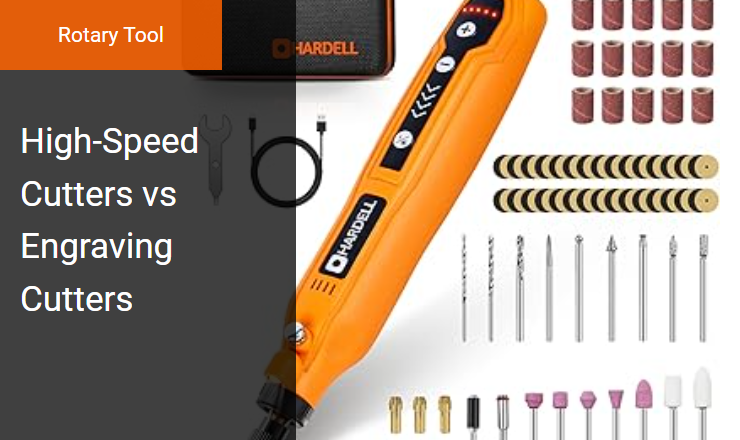
Achieving flawless detail on intricate workpieces often leaves craftspeople struggling with torn wood fibers or melted plastics-a common frustration when utilizing improper rotary accessories. While many developers and educators rely on standard workshop equipment grants or basic departmental funding to procure their initial rotary kits, merely owning the tool is only the first step in the workflow.
Mastering these accessories grants operators the ability to achieve unparalleled material removal rates while maintaining absolute workpiece integrity. However, this level of control requires a vital stipulation: users must strictly align accessory geometry with material hardness and optimal RPM limits. For example, utilizing a Dremel 115 high-speed cutter for rapid shaping in softwoods requires a completely different approach than using a micro-fluted engraving cutter on soft metals.
In this article, we will compare high-speed cutters against engraving cutters, examining their structural designs, material compatibilities, and operational best practices to ensure you select the perfect accessory for your precision applications.
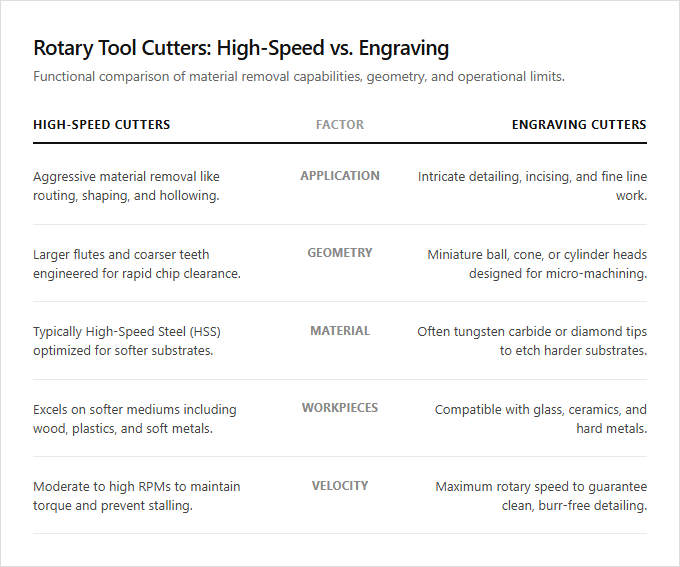
| Factor | Summary |
|---|---|
| Primary Application | High-speed cutters are designed for aggressive material removal like routing and hollowing, whereas engraving cutters are engineered for intricate detailing, incising, and fine line work. |
| Head Geometry | High-speed cutters feature larger flutes and coarser teeth for rapid chip clearance, while engraving cutters utilize miniature ball, cone, or cylinder heads to achieve precise micro-machining. |
| Material Composition | While both tool types are often made of high-speed steel (HSS), engraving cutters frequently feature tungsten carbide construction to maintain sharpness when etching harder substrates. |
| Workpiece Compatibility | High-speed cutters excel on softer materials like wood, plastics, and non-ferrous metals, whereas engraving cutters can also be used on harder mediums including glass and ceramics when utilizing diamond-impregnated tips. |
| Rotational Speed | High-speed cutters require moderate to high RPMs to prevent stalling during heavy cuts, while engraving cutters operate at maximum rotary speed to ensure clean, burr-free engraving lines. |
High-Speed Steel metallurgy vs tungsten carbide substrate composition
High-speed cutters utilize high-speed steel (HSS) metallurgy, which incorporates alloying elements like tungsten, chromium, and vanadium. This specific composition maintains hardness at elevated operating temperatures, making these accessories ideal for shaping, hollowing, and grooving softer materials such as wood, plastics, and soft metals.
In contrast, high-performance engraving cutters often feature a tungsten carbide substrate composition. This sintered material of tungsten and carbon bound by cobalt offers exceptional wear resistance and hardness, allowing the tool to carve hard steels, fired ceramics, and other dense mediums without losing its sharp edge under intense friction.
High-speed steel cutters suit hobbyists and woodworkers seeking cost-effective versatility in soft mediums, while tungsten carbide cutters are designed for industrial machinists and professional engravers requiring extreme durability on hardened surfaces.
Flute geometry and chip clearance volume
High-speed cutters feature deep, aggressive flute geometries engineered to maximize chip clearance volume. This spacious design prevents clogging during rapid material removal, allowing the rotary tool to efficiently shed larger debris when shaping or hollowing wood, plastic, and soft metals.
Conversely, engraving cutters utilize shallow, tightly spaced flutes that prioritize structural rigidity and precision over material displacement. The reduced chip clearance volume is highly optimized for fine, controlled scoring and detailed line work, ensuring the tool maintains stability without grabbing the workpiece.
High-speed cutters are ideal for fabrication professionals requiring fast stock removal, whereas engraving cutters are best suited for jewelry designers and detailers performing intricate personalization.
Rockwell C scale hardness compatibility of workpiece materials
High-speed cutters and engraving cutters serve distinct roles in rotary tool applications, primarily differentiated by the workpiece hardness they can tolerate. High-speed steel cutters are engineered for softer materials, maintaining peak performance on workpieces rating below 30 Rockwell C (HRC), such as aluminum, plastics, and wood. Exceeding this threshold causes rapid tool wear and compromises cutting precision.
Carbide engraving cutters handle much harder substrates. These specialized accessories easily carve materials rating up to 65 HRC, including hardened steel and ceramics, by resisting the extreme heat of detailed carving.
High-speed cutters are ideal for general hobbyists reshaping softer mediums, while engraving cutters are essential for professional machinists executing intricate detailing on hardened metals.
Rotational speed thresholds measured in revolutions per minute
High-speed cutters are engineered for aggressive material removal, including shaping, hollowing, and grooving. To operate efficiently, these accessories require high rotational speed thresholds, typically performing best between 20,000 and 35,000 RPM. This elevated velocity ensures clean cuts through diverse materials like wood, plastics, and soft metals without bogging down the rotary tool motor.
Engraving cutters are designed for intricate, detailed work such as etching, lettering, and fine-line carving. These cutters function optimally at lower to moderate speed thresholds, generally ranging from 10,000 to 15,000 RPM, to prevent material scorching and maximize hand control. High-speed cutters are ideal for construction hobbyists needing rapid material shaping, whereas engraving cutters are best suited for artisans and jewelers executing delicate surface personalization.
Shank diameter dimensions and collet concentricity
Rotary tool high-speed cutters and engraving cutters differ significantly in their dimensional demands. High-speed cutters typically utilize standard 1/8-inch (3.2mm) shanks to withstand the high torque of rapid material removal. Engraving cutters often feature smaller shank diameters, down to 1/16-inch (1.6mm), requiring precise collet matching to prevent slippage.
Collet concentricity is critical for both accessories, though its impact varies. For high-speed cutters, poor concentricity causes vibration and premature tool wear during heavy carving. For delicate engraving cutters, even minor runout ruins fine-line detail and snaps fragile tips. Fabrication professionals requiring rapid wood or plastic shaping benefit most from high-speed cutters, while detailed artists and jewelry makers require the precision of engraving cutters.
Single-cut vs double-cut tooth profiles
High-speed cutters and engraving cutters are essential rotary tool accessories distinguished primarily by their tooth profiles. Single-cut profiles feature a single, spiral flute design that excels at rapid material removal. This configuration produces long, curled chips, making it highly efficient for soft materials like wood, plastics, and non-ferrous metals where clogging is a concern.
Double-cut profiles incorporate two intersecting sets of flutes, creating smaller, diamond-shaped teeth. This design delivers superior control, minimizes chatter, and produces fine, powdery chips, which is ideal for harder materials like steel, ceramics, and stone. Professional model makers and woodworkers requiring rapid shaping benefit most from single-cut cutters, while detail-oriented engravers and metal fabricators demand the precision of double-cut profiles.
Lateral feed rate tolerance and axial load capacity
High-speed cutters are engineered for rapid material removal, featuring robust flutes that excel in lateral feed rate tolerance. They withstand significant side-to-side forces, making them highly efficient for shaping, hollowing, and grooving. Their axial load capacity is relatively limited, meaning they perform best when swept across a workpiece rather than plunged directly into it.
Engraving cutters are designed for intricate detailing with a superior capacity for axial loads, allowing for controlled perpendicular pressure and fine linework. They possess a lower lateral feed rate tolerance, requiring a slower hand to prevent tool deflection or breakage. High-speed cutters are ideal for fabrication professionals requiring fast bulk material shaping, whereas engraving cutters are best suited for detailed craftspeople executing precise, decorative work.
Leave a comment