
Selecting the ideal milling platform for high-precision subtractive manufacturing presents a critical challenge for workshop managers, where missteps in capital allocation can bottleneck production. While traditional capital expenditure (CAPEX) budgets and equipment financing offer standard pathways to acquisition, choosing incorrectly between manual and CNC systems risks operational stagnation.
Investing in the appropriate technology grants facilities a decisive competitive edge in both throughput and accuracy. However, this upgrade comes with a key stipulation: advanced machinery only delivers its theoretical ROI when matched with the correct production volumes and operator expertise. For instance, high-tolerance aerospace components require vastly different machining capabilities than low-volume toolroom repairs.
This article provides an objective evaluation of CNC versus manual milling machines. We will analyze their mechanical capabilities, cost-to-benefit ratios, and labor requirements, establishing a clear decision framework to guide your next facility investment.
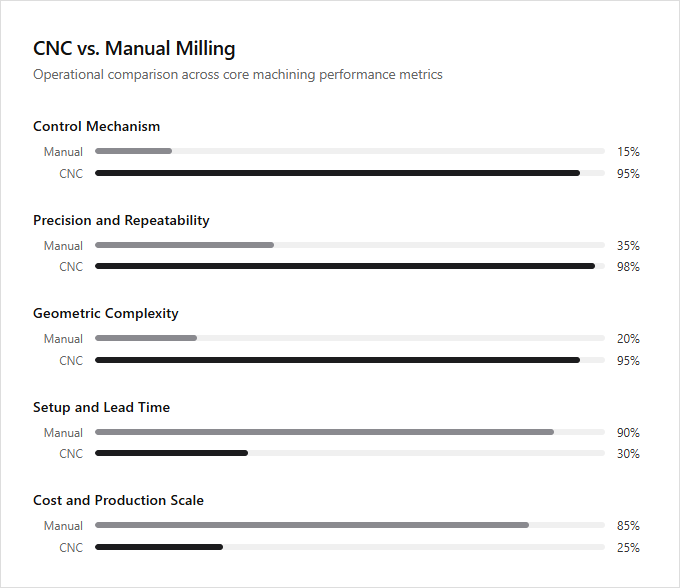
| Factor | Summary |
|---|---|
| Control Mechanism | CNC milling utilizes pre-programmed G-code instructions for automated axis movement, whereas manual milling relies on the operator's physical manipulation of handwheels and lead screws. |
| Precision and Repeatability | CNC machines achieve extremely tight dimensional tolerances and identical repeatability across production runs, unlike manual mills which are limited by human error and mechanical backlash. |
| Geometric Complexity | Multi-axis CNC mills easily generate intricate three-dimensional surfaces and helical interpolations that are practically impossible to execute on standard manual milling machines. |
| Setup and Lead Time | CNC milling requires digital CAD/CAM modeling and toolpath simulation prior to machining, whereas manual milling allows for immediate setup and rapid prototyping of simple components. |
| Cost and Production Scale | Manual milling is highly cost-effective for low-volume repairs and singular prototype fabrication, while CNC milling justifies its high capital investment through high-throughput economies of scale. |
Recirculating ball screws and automated backlash compensation
Manual milling machines typically utilize standard lead screws, which inherently possess mechanical play that operators must manually monitor during operation. In contrast, CNC milling machines employ high-precision recirculating ball screws. These advanced components use rolling steel balls to minimize friction and virtually eliminate physical backlash, ensuring highly accurate and efficient linear positioning.
While manual operators must physically account for slack when reversing directions, CNC systems utilize automated backlash compensation. The control software dynamically adjusts the motor inputs to correct for minuscule mechanical deviations in real time. Manual milling is best suited for repair technicians requiring quick, low-volume adjustments, while CNC milling is ideal for industrial manufacturers targeting high-precision, automated mass production.
Simultaneous multi-axis interpolation
Manual milling relies on manual control, limiting coordinate adjustments to sequential axes. In contrast, Computer Numerical Control (CNC) milling excels at simultaneous multi-axis interpolation. This technology utilizes advanced software to coordinate the movement of multiple axes at the exact same time, enabling the seamless machining of complex, sculpted surfaces that are impossible to replicate manually.
While manual mills require separate, step-by-step adjustments to approximate curves, CNC systems synchronize the toolpath continuously. This advanced interpolation eliminates human error and guarantees repeatable accuracy across complex geometries. CNC milling is best suited for industrial manufacturers requiring high-volume, high-precision components, whereas manual milling remains ideal for toolmakers and repair technicians who prioritize immediate tactile feedback for low-volume prototyping.
Closed-loop servo feedback systems
CNC milling machines rely heavily on closed-loop servo feedback systems to achieve exceptional precision. These advanced systems continuously monitor the actual position of the tool axes using rotary encoders or linear scales, making real-time adjustments to eliminate discrepancies between the commanded path and actual movement. Manual milling, conversely, lacks this automated loop, relying entirely on the operator to observe digital readouts and manually correct for mechanical deviations.
While manual operation offers direct physical feedback, it cannot match the rapid, micro-adjustments facilitated by CNC integration. The continuous error correction in closed-loop systems prevents inaccuracies caused by backlash or thermal expansion. CNC milling is ideal for high-volume manufacturing professionals requiring automated precision, whereas manual milling remains best suited for prototype developers and toolmakers who value tactile control and low-volume flexibility.
G-code and CAM software integration
CNC milling relies heavily on computer-aided manufacturing (CAM) software to translate digital designs into G-code, the numerical control language that dictates precise toolpaths, spindle speeds, and feed rates. This software integration automates complex, multi-axis movements, ensuring exceptional repeatability and eliminating human error during the cutting process.
Manual milling bypasses digital programming entirely, relying instead on the operator's physical manipulation of handwheels and levers. While manual operations lack the automated efficiency of G-code, they provide immediate tactile feedback and require no software setup. CNC milling is best suited for high-volume manufacturers requiring complex, repeatable geometry, while manual milling is ideal for prototype developers and repair technicians who prioritize rapid, hands-on adjustments.
Spindle speed and chip load optimization
CNC milling machines excel in spindle speed and chip load optimization through automated, real-time adjustments. Advanced algorithms calculate the precise relationship between feed rate and rotation speed to maintain a consistent chip load throughout the cutting cycle. This continuous calibration prevents tool deflection and thermal degradation, maximizing material removal rates and extending tool longevity.
Manual milling requires operators to set these parameters based on static formulas and tactile feedback. Achieving the optimal chip load on a manual mill relies heavily on the machinist's intuition and physical feel of the handwheels. High-production facilities requiring repeatable, high-speed precision favor CNC platforms, whereas manual mills are ideal for custom fabricators, repair technicians, and hobbyists seeking tactile control and rapid setup times.
HSK or BT taper toolholding with Automatic Tool Changers
Milling machines are categorized into manual and CNC systems, with toolholding technology defining their efficiency. CNC mills leverage Automatic Tool Changers (ATCs) using BT or HSK tapers to automate transitions. BT tapers provide a robust, cost-effective interface for heavy-duty cutting, while HSK tapers offer superior high-speed precision through dual-contact engagement. In contrast, manual mills utilize simpler drawbars, requiring physical labor and downtime for every tool change.
The integration of ATCs with advanced tapers maximizes spindle uptime and ensures high repeatability in production. CNC systems with automated HSK or BT tooling are ideal for high-volume manufacturers requiring precision and automation, whereas manual mills are best suited for prototype machinists, repair technicians, and hobbyists needing quick, single-part fabrication.
In-process optical touch-probe inspection
In precision machining, the choice between CNC and manual milling often hinges on automation and accuracy. In-process optical touch-probe inspection represents a significant technological divide. CNC milling machines seamlessly integrate these automated probes to measure workpieces dynamically during the machining cycle, reducing setup errors and ensuring real-time quality control without human intervention.
Manual milling relies on physical measurement tools and operator manual dexterity, making the integration of active optical touch-probes impractical. While CNC systems leverage automated probing technology for high-volume, unattended precision manufacturers, manual setups remain ideal for prototype developers and custom toolmakers who require hands-on tactile feedback and low-volume bespoke adjustments.
Leave a comment