
In high-precision manufacturing, machinists and assembly technicians frequently struggle to balance raw tonnage with tactile feedback, often risking ruined workpieces by applying excessive, unmeasured force. While operations managers typically leverage standard capital funding sources to procure versatile workshop machinery, choosing between specialized pressing technologies requires a highly calculated approach.
Investing in the correct mechanical advantage guarantees zero part deformation and optimized workflow efficiency, providing an immediate return on investment. However, under the stipulation that manual tactile sensitivity cannot be replicated by fluid power, operators must manage expectations regarding the limits of manual leverage. For instance, using a Dake single-lever rack and pinion press for delicate press-fit bearings provides a level of descent control that a 20-ton hydraulic shop press simply cannot mimic.
This article compares the mechanical profiles of rack and pinion arbor presses against hydraulic shop presses, detailing their leverage ratios, precision limits, and application suitability to guide your next tooling acquisition.
| Factor | Summary |
|---|---|
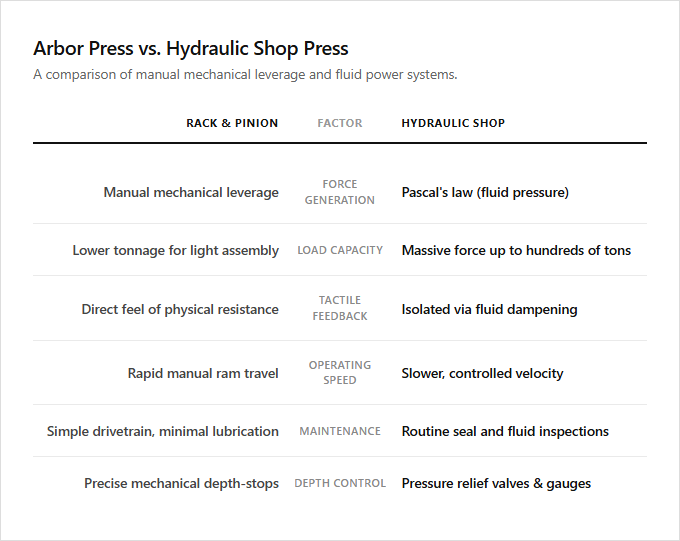
| Force Generation | While the rack and pinion press relies on manual mechanical leverage, the hydraulic shop press utilizes Pascal's law to multiply force via fluid pressure. |
| Load Capacity | Rack and pinion presses typically deliver lower tonnage suited for light assembly, whereas hydraulic presses exert massive force measuring up to hundreds of tons. |
| Tactile Feedback | The direct mechanical linkage of a rack and pinion allows the operator to feel physical resistance during assembly, while hydraulic systems isolate this feedback through fluid dampening. |
| Operating Speed | A rack and pinion arbor press allows for rapid manual ram travel, whereas a hydraulic shop press operates at a slower, controlled velocity. |
| Maintenance Requirements | Manual gear presses feature a simple drivetrain requiring minimal lubrication, whereas hydraulic presses require routine inspection of seals and hydraulic fluid levels to prevent pressure loss. |
| Depth Control | Mechanical presses excel at precise depth-stop repeatability for delicate seating tasks, while hydraulic presses rely on pressure relief valves and analog gauges to control stroke limits. |
Rack and Pinion Presses for Sensitive Press-Fits
Choosing between a rack and pinion arbor press and a hydraulic shop press depends heavily on the level of precision your specific application requires. Rack and pinion presses deliver immediate tactile feedback and a direct mechanical advantage. This direct physical connection allows operators to feel the resistance during sensitive press-fit operations, significantly reducing the risk of damaging delicate components or misaligning parts.
In contrast, hydraulic shop presses utilize fluid power to generate immense force, making them highly effective for heavy-duty bending and extraction tasks where sensory feedback is secondary to sheer tonnage. Manual rack and pinion models are best suited for precision instrument makers performing delicate bearing assemblies, while hydraulic presses are ideal for heavy equipment mechanics requiring maximum force for stubborn components.
How Hydraulic Shop Presses Generate High Tonnage
Selecting the appropriate pressing equipment depends on the force and precision required for your fabrication tasks. A rack and pinion arbor press relies on manual leverage, offering excellent tactile feedback and speed for lighter operations such as seating bearings, staking, or riveting. In contrast, hydraulic shop presses utilize a fluid power cylinder to generate high tonnage capacity far exceeding manual leverage, allowing operators to perform demanding tasks with minimal physical effort.
While the mechanical design provides immediate response for delicate components, the hydraulic system delivers the sustained, immense force necessary for manipulating heavy steel and stubborn industrial parts. Manual rack and pinion presses are ideal for precision assembly technicians and electronics hobbyists, whereas hydraulic shop presses are best suited for automotive mechanics and heavy industrial fabricators requiring maximum force capacity.
High-Precision Arbor Presses for Repeatable Travel
When selecting press machinery, understanding the mechanical distinctions between a rack and pinion arbor press and a hydraulic shop press is essential for operational efficiency. Arbor presses are engineered for high-precision, low-force applications. These mechanical tools feature precise depth stop adjustments and minimal gear backlash for repeatable travel tolerances, allowing operators to achieve consistent results during delicate assembly runs.
In contrast, hydraulic shop presses utilize fluid pressure to generate massive tonnage, making them suitable for heavy-duty applications where brute force is required. While the hydraulic option lacks the tactile feedback of a manual gear system, it excels in tasks requiring substantial load capacity. Precision assembly technicians and instrument makers benefit most from the controlled accuracy of the arbor press, while automotive mechanics and industrial fabricators are ideally suited for the high-tonnage capacity of the hydraulic shop press.
Gear-Driven Rack Design for Rapid Assembly
When selecting pressing equipment for manufacturing operations, the mechanism of force delivery dictates production efficiency. A rack and pinion arbor press utilizes a direct mechanical linkage rather than fluid power. The gear-driven rack design allows for rapid ram velocity and shorter cycle times during assembly, making it highly efficient for repetitive, high-speed production runs.
In contrast, a hydraulic shop press relies on hydraulic fluid to generate substantially higher tonnage. While hydraulic systems offer immense force capabilities, they operate at much slower cycle speeds due to the manual or pneumatic pumping required to build fluid pressure.
The fast-acting rack and pinion arbor press is ideal for precision electronics assembly technicians requiring tactile feedback and speed, while the high-tonnage hydraulic shop press is best suited for heavy-duty industrial mechanics performing high-force extractions and structural metal bending.
Hydraulic Overload Protection vs. Manual Arbor Press Torque
When comparing a rack and pinion arbor press to a hydraulic shop press, the mechanical drive system dictates how force is managed. Hydraulic shop presses utilize fluid power to generate immense force, requiring integrated pressure relief valves to prevent structural overloading and system failure. In contrast, manual rack and pinion arbor presses rely entirely on direct manual input torque, giving operators tactile feedback and eliminating the need for complex fluid safety mechanisms.
This fundamental difference in force transmission influences both operational speed and control. Rack and pinion presses are ideal for technicians requiring precise tactile feedback during light, repetitive assembly tasks, while hydraulic presses suit heavy-duty fabricators demanding maximum force application for high-capacity pressing.
Mechanical Arbor Presses: Gear Lube Over Hydraulic Leaks
When selecting workshop machinery, the drive mechanism dictates both maintenance protocols and operational longevity. Rack and pinion arbor presses utilize a purely mechanical system to deliver manual force. While these mechanical presses require periodic gear lubrication to prevent frictional wear, they completely avoid the seal degradation and fluid leaks commonly associated with hydraulic actuators. This dry design ensures a clean workspace and eliminates the risk of hydraulic pressure loss over time.
In contrast, hydraulic shop presses rely on fluid pressure to generate significantly higher force capacities, though they demand regular inspection of cylinders and valves to prevent fluid contamination. Rack and pinion arbor presses are ideal for precision artisans requiring tactile feedback for light assembly, whereas hydraulic shop presses suit heavy-duty industrial operators performing high-force fabrication and component removal.
Arbor Presses: Superior Alignment for Delicate Tasks
When selecting pressing equipment, the choice between a rack and pinion arbor press and a hydraulic shop press depends on the required precision. Arbor presses maintain superior coaxial alignment, making them indispensable for delicate broaching, staking, and shearing tasks where even minor angular deviation can compromise the workpiece. This mechanical system provides direct force transmission and invaluable tactile feedback, which is absent in fluid-driven systems.
In contrast, hydraulic shop presses excel in delivering high-tonnage force over greater distances, though they lack the rigid guidance needed for intricate operations. Precision instrument makers and micro-assembly technicians rely on the exacting control of the rack and pinion design, while heavy equipment mechanics and structural fabricators are better served by the high-power output of a hydraulic press.
Leave a comment