
Mechanical assembly and maintenance professionals frequently battle the frustration of stripped threads, snapped fasteners, or seized bolts that refuse to budge despite utilizing high-powered impact wrenches. Traditionally, operators rely on standard manufacturer torque charts and generic tool specifications as their baseline reference points for fastening operations.
However, mastering the critical distinction between breakaway torque and fastening torque grants technicians the precise control needed to optimize tool performance under varying loads. It must be stipulated, however, that these maximum torque ratings are highly contingent on real-world variables, such as pneumatic line pressure, battery charge levels, and thread friction.
For instance, in heavy-duty fleet maintenance, understanding this mechanical boundary is the difference between a properly secured wheel hub and a catastrophically sheared stud. In this article, we will break down the distinct physics governing tightening versus loosening torque, analyze how to calibrate your impact wrench for specific applications, and outline practical strategies to optimize your tool's output for safe, efficient fastener assembly and disassembly.
| Factor | Summary |
|---|---|
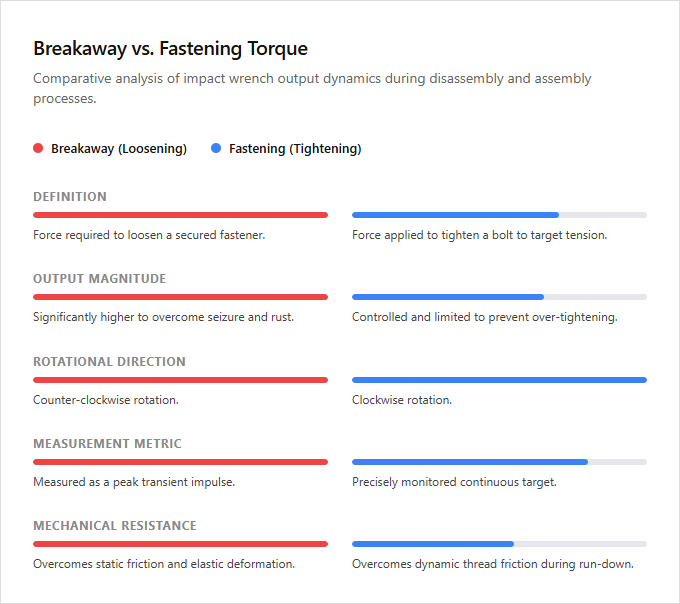
| Definition | Breakaway torque measures the maximum twisting force required to loosen a secured fastener, whereas fastening torque refers to the rotational force applied to tighten a bolt to its target tension. |
| Output Magnitude | Breakaway torque ratings are typically much higher because the tool must overcome static friction, thread galling, and corrosion to free a seized fastener. |
| Rotational Direction | Fastening torque is applied during clockwise rotation for standard right-hand threads, while breakaway torque operates in the counter-clockwise direction during disassembly. |
| Measurement Metric | Fastening torque must be precisely controlled using a torque transducer to prevent over-tightening, whereas breakaway torque is measured as a peak transient impulse during removal. |
| Mechanical Resistance | Fastening torque overcomes dynamic friction during joint clamp-up, while breakaway torque must overcome the high initial resistance caused by elastic deformation and fastener adhesion. |
Stiction and Corrosion Demand Higher Breakaway Torque
When utilizing an impact wrench, understanding the distinction between fastening torque and breakaway torque is critical for successful joint management. Fastening torque represents the rotational force applied to tighten a threaded fastener to its specified tension. Conversely, removing that same fastener often demands a much higher force, known as breakaway torque, because the tool must overcome additional physical resistance.
Over time, tightened joints develop static friction, or "stiction," alongside thread corrosion and environmental debris that bind the mating surfaces together. Overcoming these adhesive forces requires a significantly higher breakaway torque than the initial fastening torque to safely break the bond without damaging the workpiece.
Assembly line operators requiring precise structural tension rely heavily on controlled fastening torque specifications, whereas heavy-duty mechanics and demolition technicians prioritize tools with high breakaway torque to release stubborn, seized bolts.
Precise Torque Calibration for Safe Fastener Preload
When operating an impact wrench, understanding the distinction between breakaway torque and fastening torque is critical for joint integrity. Breakaway torque represents the maximum force required to loosen a secured nut or bolt. In contrast, fastening torque is the torque applied during assembly. Fastening torque must be precisely calibrated to establish the correct axial preload without exceeding the fastener yield strength, preventing thread stripping or structural failure.
Selecting the right tool specifications depends heavily on the application. High breakaway torque is essential for heavy-duty maintenance technicians removing rusted bolts, while precise fastening torque limiters are crucial for structural assembly workers requiring exact tension calibration.
How Friction Affects Torque-to-Tension Conversion
In threaded assemblies, fastening torque is the rotational force applied to tighten a bolt, whereas breakaway torque is the force required to loosen it. Crucially, the coefficient of friction dictates how much applied fastening torque is converted into useful bolt tension versus frictional heat. In a standard joint, up to 90 percent of the tightening energy is lost to friction under the bolt head and within the threads, leaving only a small fraction to generate the clamping force necessary for joint integrity.
Breakaway torque demands are typically much higher due to thread deformation, corrosion, and the transition from static to kinetic friction during removal. High fastening torque is critical for structural steel erectors and automotive assembly technicians who require precise clamping tension, while extreme breakaway torque is indispensable for heavy equipment mechanics and industrial maintenance crews tasked with removing rusted or seized fasteners.
Consider Prevailing Torque for Accurate Clamp Force
In mechanical assembly, understanding the distinction between fastening torque and breakaway torque is critical for joint integrity. Fastening torque represents the active force applied to secure a fastener, whereas breakaway torque is the threshold force required to loosen it. When utilizing locking elements such as nylon-insert nuts or thread adhesives, prevailing torque-the frictional resistance encountered before the bolt head seats-must be carefully accounted for to ensure the target clamp force is accurately achieved during assembly.
Impact wrenches must be selected and calibrated based on these distinct torque dynamics. Fastening torque specifications serve precision assembly technicians requiring exact tension control, while high breakaway torque ratings are vital for heavy equipment mechanics and demolition specialists tasked with loosening stubborn or corroded fasteners.
How Joint Relaxation Alters Tension and Breakaway Torque
When utilizing impact wrenches, understanding the distinction between fastening torque and breakaway torque is critical for securing joint integrity. Fastening torque represents the active force applied to tighten a fastener, while breakaway torque is the force required to loosen it. Following assembly, joints undergo natural relaxation as surface imperfections flatten and materials settle under load. This post-assembly relaxation reduces the residual tension within the joint, directly altering the breakaway torque profile and often requiring a different force to disassemble the connection than was initially applied.
Accounting for this tension loss ensures accurate joint auditing and prevents fastener failure. Assembly line engineers and quality control technicians rely on precise fastening torque parameters to guarantee structural integrity, while heavy equipment mechanics and industrial maintenance personnel prioritize high breakaway torque capabilities to successfully overcome settled, stubborn fasteners.
High-Speed Impact Disassembly Risks Thread Galling and Seizure
In industrial bolting, understanding the distinction between fastening torque and breakaway torque is critical for preserving hardware integrity. While fastening torque secures joints to specific tension limits, breakaway torque represents the maximum power generated to loosen stubborn fasteners. During disassembly, however, the sudden release of resistance can lead to excessive rotational speed. This rapid movement generates intense friction and heat, risking immediate thread galling and permanent joint seizure.
Managing these forces requires selecting the appropriate tool capability for the specific application. Heavy-duty industrial mechanics require high breakaway torque models to extract corroded, stubborn fasteners, whereas precision assembly technicians rely on adjustable fastening torque configurations to ensure safe, repeatable clamp loads.
How Inertia and Kinetic Energy Power Impact Wrenches
An impact wrench delivers two critical force measurements: fastening torque for tightening and breakaway torque for loosening. To overcome stubborn or rusted fasteners, the tool's power output relies heavily on anvil inertia and kinetic energy transfer. The internal hammer strikes the anvil, converting rotational momentum into high-intensity impact blows that quickly break high static resistance.
Fastening torque requires controlled force to prevent over-tightening, whereas breakaway torque delivers the raw power needed to free seized components. Precise fastening torque tools are ideal for structural steel assemblers who must meet strict tension specifications, while high breakaway torque models are suited for heavy-machinery mechanics dealing with seized industrial bolts.
Leave a comment