
Few things derail a productive workday like a heavy impact socket slipping off your wrench mid-task, or conversely, fighting a stubborn mechanism just to change sizes. While standard equipment procurement and tool funding sources typically focus on raw torque specifications, they frequently overlook the critical interface of socket retention.
Selecting the correct anvil configuration is a crucial decision, as the right choice grants operators seamless workflow efficiency, reduced hand fatigue, and heightened jobsite safety. It is important to stipulate, however, that neither design is universally superior; their value is entirely dependent on your specific operational environment. For example, structural steel erectors working at height require the absolute security of a detent pin, while automotive technicians performing rapid wheel service rely on the quick-change agility of a friction ring.
This guide provides a comprehensive comparison of friction rings and detent pins, analyzing their durability, ease of use, and application suitability to help you choose the optimal anvil for your toolkit.
| Factor | Summary |
|---|---|
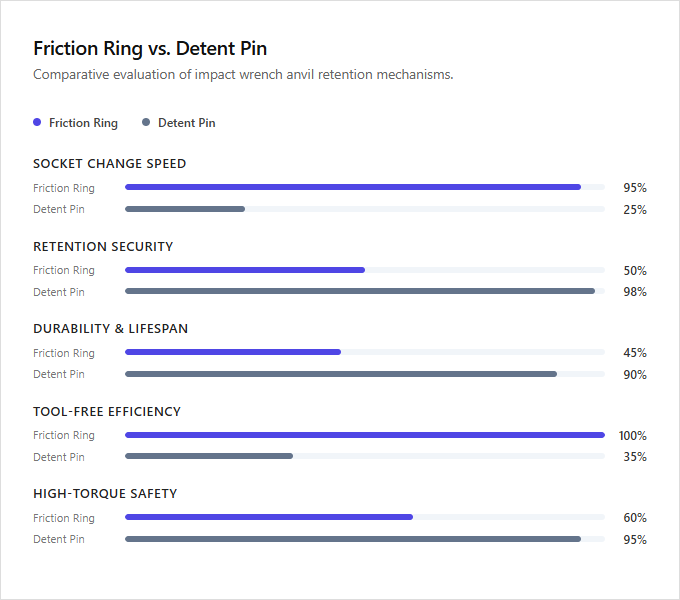
| Retention Mechanism | The friction ring relies on radial pressure from a split hog ring around the anvil to hold sockets, whereas the detent pin utilizes a spring-loaded metal pin that physically locks into the socket's internal detent hole. |
| Socket Changing Speed | Friction ring anvils allow for rapid, tool-free socket swaps with a simple pull, while detent pin anvils require manual alignment of the pin and hole, slowing down the transition process. |
| High-Torque Security | Detent pins provide superior mechanical interlocking security to prevent socket detachment during high-vibration applications, unlike friction rings which can slip under heavy rotational stress. |
| Tool Requirements | Changing sockets on a detent pin system often necessitates a pin punch or screwdriver to depress the spring-loaded ball, whereas the friction ring system requires only manual physical force. |
| Durability and Wear | The elastomeric O-ring and steel hog ring on a friction anvil degrade over time from shear stress, whereas the internal steel spring of a detent pin mechanism offers greater long-term durability. |
How Hog Rings Enable Rapid Socket Transitions
When selecting an impact wrench, the anvil design significantly influences workflow efficiency. Hog ring friction rings facilitate rapid socket transitions by relying on radial tension to secure the accessory. This design allows operators to quickly pull sockets off and push new ones on by hand, making it highly efficient for tasks requiring frequent size changes.
Conversely, the detent pin system utilizes a spring-loaded pin that locks into the socket's retaining hole. This mechanism provides a highly secure attachment that prevents accidental detachment during heavy-duty vibration, though it requires a tool or manual depression to release the socket, which slows down transitions.
Friction rings are ideal for automotive technicians who require quick, frequent socket swaps, whereas detent pins are best suited for structural steelworkers and utility crews who prioritize maximum tool retention while working at heights.
Ball Detent Pins Prevent High-Torque Socket Slippage
When selecting an impact wrench, the anvil design-specifically the friction ring versus the detent pin-significantly influences safety and workflow efficiency. The friction ring, or hog ring, allows for rapid, tool-free socket changes by relying on frictional force to hold the socket in place. In contrast, ball detent pin mechanisms offer positive locking engagement to prevent socket slippage during high-torque applications, requiring a pin tool or nail to depress the detent for socket removal.
The choice between these retention methods depends heavily on the specific demands of the work environment. Friction rings are ideal for automotive technicians who require rapid socket swaps throughout the day, whereas detent pins are best suited for structural steelworkers and utility linemen who prioritize maximum socket retention during high-altitude or heavy-duty fastening tasks.
Friction Ring Anvil Elastomer O-Ring Wear
When selecting an impact wrench, professionals must evaluate the socket retention mechanism, specifically choosing between a friction ring and a detent pin. Friction ring anvils, also known as hog rings, offer rapid socket changes but are susceptible to mechanical degradation. Over time, the backing elastomer O-ring beneath the steel ring experiences gradual wear from repeated compression and friction, reducing its holding power and requiring periodic replacement.
Detent pin systems utilize a spring-loaded pin that secures the socket through a matching hole, providing a highly secure connection that resists accidental detachment during heavy-duty operation. Friction rings are best suited for automotive technicians requiring frequent socket size changes, while detent pins are ideal for utility workers and steel erectors prioritizing maximum retention at height.
Using a Pin Punch for Detent Socket Removal
When selecting an impact wrench, the choice between a friction ring and a detent pin anvil determines how securely sockets are held and how easily they are changed. The friction ring, or hog ring, allows for quick, manual socket changes through radial tension. In contrast, the detent pin system utilizes a spring-loaded pin that locks into the socket's retaining hole. This secure connection provides maximum retention but often requires a pin punch or small tool to depress the detent for socket detachment.
This mechanical lock prevents accidental socket drops during high-torque or overhead applications. Friction rings are ideal for automotive mechanics who require rapid socket swaps, while detent pins are suited for structural ironworkers who prioritize absolute socket security at height.
Detent Pins for Overhead Dropped Object Prevention
When selecting an impact wrench, the choice between a friction ring and a detent pin anvil directly affects job site safety and efficiency. In high-altitude or overhead industrial environments, detent pin systems are the standard requirement. These mechanisms securely lock the socket onto the anvil, preventing accidental detachment and ensuring compliance with strict dropped object prevention protocols.
Friction ring anvils allow for rapid, tool-free socket changes, prioritizing speed in fast-paced workshops. Because they rely on friction alone, they carry a higher risk of socket slippage when working at heights. Friction rings are ideal for automotive mechanics needing quick socket transitions, while detent pins are essential for structural ironworkers and industrial technicians prioritizing maximum retention and safety.
Impact Socket Recesses for Detent Ball Alignment
When selecting an impact wrench, the choice between a friction ring and a detent pin anvil determines how securely sockets are retained. The friction ring allows for quick socket changes by utilizing outward frictional force. In contrast, the detent pin system offers a locked connection. To achieve this secure hold, impact sockets must have a matching internal recess for optimal detent ball seat alignment, as a mismatch prevents the pin from engaging properly.
Operating a detent pin without the correct recessed socket compromises safety and causes premature tool wear. Automotive mechanics who frequently swap socket sizes benefit most from the rapid usability of the friction ring, whereas structural ironworkers and heavy equipment technicians requiring maximum socket security at height are best suited for the detent pin system.
Friction Rings Maximize Socket Change Productivity
When selecting an impact wrench, the anvil design determines operational efficiency. A friction ring, or hog ring, utilizes outward pressure to secure the socket. This design allows operators to swap sockets rapidly without external tools, making friction rings the preferred option for high-frequency socket changes to maximize productivity.
The detent pin system employs a spring-loaded pin that locks into the socket hole, providing a highly secure connection that prevents accidental detachments. Friction rings are ideal for automotive technicians who perform rapid, multi-size fastening tasks, whereas detent pins best suit steel erectors and utility linemen working at heights where socket drops pose safety hazards.
Leave a comment