
Finding the right balance between raw fastening power and physical tool size is a constant frustration for automotive technicians and industrial operators alike. Selecting an impact wrench that lacks the muscle to break stubborn fasteners results in stalled projects, while using an overly bulky tool restricts access to confined workspaces.
Traditionally, professionals rely on standard pneumatic lines or heavy-duty, high-torque cordless systems as their primary power investments. However, modern brushless motor technology now grants users the ability to leverage incredible power density within highly streamlined profiles. To manage expectations, we must stipulate that neither tool category is a universal solution; a compact model cannot match the brute breakaway force of a high-torque unit on heavy machinery. Yet, for everyday applications like securing subframe bolts or removing rusted lug nuts, they offer unmatched efficiency.
Below, we analyze the specific fastening torque profiles, physical dimensions, and key application trade-offs of mid-torque versus compact impact wrenches, helping you select the optimal tool for your diagnostic and repair needs.
| Factor | Summary |
|---|---|
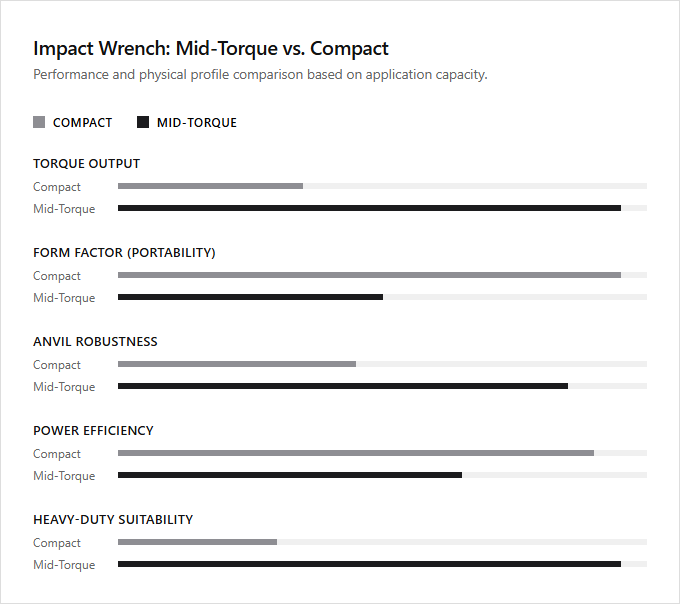
| Torque Output | Mid-torque models deliver significantly higher fastening and breakaway torque (often exceeding 500 ft-lbs) compared to compact models, which prioritize lower torque outputs for lighter tasks. |
| Form Factor | Compact impact wrenches feature a shorter head length and reduced weight to optimize ergonomics in tight spaces, whereas mid-torque units require a larger housing to accommodate heavier internal components. |
| Anvil Configuration | While compact wrenches frequently utilize a 3/8-inch friction ring anvil, mid-torque options standardly feature a 1/2-inch anvil with a detent pin or hog ring for secure socket retention during high-vibration applications. |
| Power Consumption | Both options utilize brushless motors, but mid-torque tools draw higher amperage and perform best with high-capacity lithium-ion batteries, whereas compact tools run efficiently on smaller, low-Ah battery packs. |
| Application Suitability | Compact wrenches are ideal for high-speed fastening in engine bays and interior automotive work, while mid-torque wrenches are engineered for heavy-duty automotive suspension disassembly and structural steel assembly. |
Mid-torque models provide superior breakaway torque for heavy-duty fastening
Selecting the right impact wrench depends on balancing physical size with power requirements. Compact impact wrenches excel in tight overhead spaces, offering maneuverability at the expense of raw power. In contrast, mid-torque models provide superior breakaway torque, making them highly effective for heavy-duty fastening tasks where stubborn, rusted, or high-specification fasteners must be loosened or secured.
While compact units minimize user fatigue during repetitive assembly, mid-torque tools offer a versatile middle ground, delivering substantial power without the extreme weight of high-torque alternatives. Professionals performing light automotive maintenance or cabinet installation benefit most from compact models, whereas industrial mechanics and heavy equipment technicians require the robust capability of mid-torque units.
Compact Models: Shorter Heads for Confined Spaces
When selecting between mid-torque and compact impact wrenches, the primary trade-off lies between sheer power and physical accessibility. Compact models utilize a shorter head length to access confined spaces, making them indispensable for intricate automotive work under the hood or within tight chassis rails. Their lightweight design minimizes operator fatigue during prolonged overhead applications while still delivering sufficient fastening torque for most standard tasks.
In contrast, mid-torque impact wrenches offer a significant increase in breakaway torque to loosen stubborn, rusted bolts, though they feature a larger physical footprint. These tools bridge the gap between heavy-duty high-torque models and light-duty compacts, providing a balanced solution for general construction and suspension work. Compact units are ideal for precision mechanics working in cramped engine bays, whereas mid-torque wrenches are best suited for industrial technicians requiring robust power for heavy-duty assemblies.
Mid-torque tools standardly feature a half-inch square drive anvil
When selecting between a compact and a mid-torque impact wrench, the primary considerations are power output and physical size. Mid-torque tools standardly feature a half-inch square drive anvil, which allows them to handle heavier fastening tasks and larger socket sizes. This robust connection transfers substantial torque efficiently without slipping during demanding applications.
Compact impact wrenches prioritize accessibility and reduced weight, typically utilizing a three-eighths-inch drive to excel in tight spaces. Heavy-duty automotive technicians requiring high breakaway torque will find the mid-torque indispensable, whereas general DIYers and installation specialists working in confined areas are ideal candidates for the compact design.
Compact wrenches prioritize a high power-to-weight ratio for overhead work
When selecting between mid-torque and compact impact wrenches, the decision rests on balancing raw power with maneuverability. Compact impact wrenches prioritize a high power-to-weight ratio, making them indispensable for overhead installations and tight engine bays where physical fatigue must be minimized. Despite their smaller footprint, these tools deliver sufficient fastening force without straining the operator during extended overhead use.
Mid-torque models offer a substantial step up in breakaway torque, effortlessly tackling rusted fasteners and heavy-duty automotive suspensions. While heavier, they bridge the gap between lightweight portability and high-output industrial power. Automotive technicians working in cramped quarters benefit most from the agile compact design, whereas heavy machinery mechanics and structural assemblers require the robust capabilities of a mid-torque tool.
Brushless Motors Maximize Tool IPM and RPM
Advancements in brushless motor technology have revolutionized both mid-torque and compact impact wrenches. By eliminating mechanical friction, brushless motors maximize both impacts per minute (IPM) and rotations per minute (RPM) across both tool classes. This internal efficiency ensures that compact models deliver surprising speed and power, while mid-torque units achieve an optimal balance of high-velocity fastening and serious breakaway torque.
While both tool classes benefit from these smart, electronically controlled motors that prevent overheating under heavy loads, they serve distinct operational needs. Compact impact wrenches are ideal for automotive technicians navigating tight engine bays and overhead installations, whereas mid-torque models are best suited for heavy-duty fleet mechanics requiring sustained power for suspension and chassis work.
Electronic drive control modes prevent fastener stripping and over-torqueing
Compact impact wrenches prioritize maneuverability in tight spaces, relying on electronic drive control modes to manage their power. These digital settings allow operators to pre-select specific speed and torque limits, automatically reducing power to prevent fastener stripping and head snapping on delicate assemblies. This technology ensures high-speed efficiency without risking structural damage to smaller hardware.
Mid-torque impact wrenches deliver a significant power increase while utilizing similar electronic controls to mitigate the risk of over-torqueing larger fasteners. Compact models are best suited for HVAC technicians and interior auto mechanics working in confined areas, whereas mid-torque units are ideal for mobile mechanics and suspension specialists who regularly tackle stubborn bolts requiring balanced power.
Battery Voltage and Capacity Limit Maximum Torque
When selecting between compact and mid-torque impact wrenches, the battery platform serves as the primary differentiator for performance. Compact models typically operate on 12-volt or lower-amp-hour 18-volt batteries to prioritize maneuverability. Mid-torque units leverage high-capacity battery packs, often 5.0 Ah or greater, on robust 18-volt or 20-volt platforms. This battery voltage and amp-hour capacity directly limit the maximum torque output, as larger cells are essential to deliver the high current required for demanding applications.
Compact impact wrenches are ideal for service technicians performing under-dash work and light engine repairs in confined spaces, while mid-torque models are best suited for general automotive mechanics and maintenance professionals who regularly service suspension systems and wheel lugs.
Leave a comment