
Navigating cramped engine bays only to have your cordless ratchet stall under load is a frustrating setback familiar to many automotive professionals and dedicated DIYers. Traditionally, mechanics relied on cumbersome pneumatic lines or manual ratchets to secure the consistent torque required for stubborn fasteners. However, modern cordless solutions "grant" technicians unmatched mobility and rapid runtimes, fundamentally changing workshop efficiency.
Yet, unlocking this peak performance comes with a critical stipulation: a tool's ultimate capability is heavily dictated by its internal motor design. While brushed motors offer a familiar, cost-effective baseline, brushless technology has become the modern benchmark for demanding, high-torque applications.
To help you make an informed investment, this article will compare brushed and brushless cordless ratchets, analyzing key differences in torque efficiency, thermal threshold, tool lifespan, and overall return on investment.
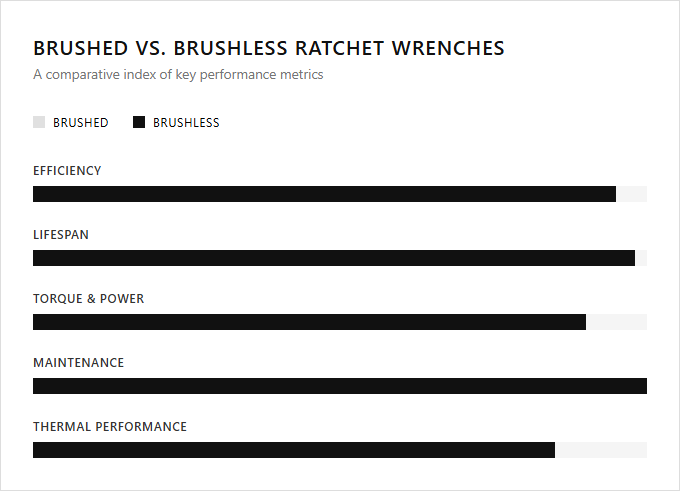
| Factor | Summary |
|---|---|
| Efficiency | Brushless ratchets utilize an electronic controller rather than physical brushes, significantly reducing energy loss through friction and optimizing battery run-time. |
| Lifespan | The absence of mechanical friction on a commutator allows brushless motor ratchets to achieve superior operational longevity. |
| Torque and Power | Brushless models deliver higher torque density and maintain constant speed under heavy fastening loads. |
| Maintenance | Brushed ratchets require periodic replacement of carbon brushes due to physical wear, whereas brushless designs are completely maintenance-free. |
| Thermal Performance | Brushless motors experience minimal heat dissipation during operation, reducing the risk of thermal overloading under continuous use. |
Brushless Motor Efficiency vs. Carbon Brush Wear
Traditional brushed cordless ratchets rely on physical carbon brushes contacting a spinning commutator to deliver electrical current. This mechanical contact generates significant friction, heat, and gradual wear, which eventually degrades tool efficiency and requires eventual component replacement.
Conversely, brushless motor ratchets utilize electronic circuitry instead of physical brushes to manage energy transfer. This frictionless design optimizes energy conversion efficiency, resulting in longer runtimes, cooler operating temperatures, and a virtually maintenance-free lifespan.
Budget-conscious DIYers performing occasional repairs will find brushed ratchets highly suitable, whereas automotive professionals requiring maximum daily reliability and torque are best served by brushless models.
Integration of an electronic speed controller for dynamic torque-to-weight optimization
In cordless ratchet wrenches, the transition from brushed to brushless motor technology represents a significant advancement in tool efficiency. Traditional brushed ratchets rely on mechanical commutation, which inherently limits real-time speed and power adjustments. In contrast, brushless ratchets integrate an advanced Electronic Speed Controller (ESC) that continuously monitors rotor position to adjust current frequency, enabling precise, dynamic torque-to-weight optimization. This electronic regulation allows the tool to maximize torque output under heavy loads while maintaining a lightweight, compact footprint.
While brushed models offer a simpler mechanical design, they lack the sophisticated power management of their brushless counterparts. Budget-conscious DIYers appreciate the straightforward, cost-effective utility of brushed ratchets for occasional light repairs, whereas automotive technicians and industrial professionals require the high-efficiency, lightweight, and high-torque performance of brushless models for demanding, daily operations.
Advanced Stator Cooling in Brushless Motors
When selecting a cordless ratchet wrench, the primary distinction lies in motor design. Brushed models rely on physical carbon brushes that generate friction and internal heat, limiting operation during high-demand tasks. In contrast, brushless configurations eliminate mechanical contact, which greatly reduces thermal buildup. This design delivers superior thermal dissipation, effectively preventing stator overheating during peak loads and ensuring consistent torque delivery under heavy resistance.
By keeping internal temperatures low, brushless ratchets offer extended tool longevity and sustained efficiency compared to their brushed counterparts. Budget-conscious DIY hobbyists will find brushed ratchets perfectly adequate for light, occasional repairs, while professional automotive mechanics requiring continuous, heavy-duty fastening will benefit most from the high-endurance capabilities of brushless models.
Brush and commutator wear limits brushed motor lifespan
When selecting a cordless ratchet wrench, the choice between brushed and brushless motor technologies heavily impacts tool longevity. Brushed ratchets rely on physical carbon brushes and a rotating commutator to transfer electrical current. Over time, the constant friction between these components causes inevitable mechanical wear, leading to carbon dust buildup and excessive heat generation. This degradation restricts the operational lifespan and duty cycle of brushed models, requiring periodic maintenance or tool replacement under demanding workloads.
In contrast, brushless ratchets utilize electronic circuitry to manage current, eliminating physical contact. Removing the brushes minimizes internal friction and thermal stress, allowing for a vastly extended tool lifespan and superior continuous performance. Budget-conscious DIYers find brushed models adequate for occasional maintenance, whereas automotive professionals requiring daily, high-frequency reliability are better served by brushless ratchets.
Reduced current draw maximizing battery ampere-hour capacity and overall runtime
When selecting a cordless ratchet wrench, the underlying motor technology directly impacts battery efficiency and tool performance. Brushless motors utilize electronic controllers instead of physical carbon brushes, significantly reducing internal friction and heat. This design results in a lower current draw from the battery, allowing the tool to maximize the utility of its available ampere-hour capacity and deliver extended runtime on a single charge.
Brushed motors experience continuous energy loss through brush-to-commutator contact, drawing more current under identical workloads. By eliminating this physical resistance, brushless ratchets optimize energy conservation and prolong overall battery lifespan. Traditional brushed ratchets remain an economical choice for occasional DIY hobbyists performing light repairs, while highly efficient brushless models are indispensable for professional automotive technicians requiring uninterrupted, high-volume daily performance.
Neodymium Magnets Boost Brushless Rotor Power Density
When selecting a cordless ratchet wrench, the choice between brushed and brushless technology directly impacts tool performance and longevity. Brushless ratchet wrenches deliver superior torque and efficiency due to their advanced rotor design. By utilizing high-energy permanent neodymium magnets in the rotor instead of traditional carbon brushes, these motors achieve exceptional power density. This magnetic efficiency allows manufacturers to produce more compact, lightweight tools that maintain maximum torque output under heavy loads without overheating.
Standard brushed motor ratchets rely on physical contact to transfer current, which generates friction and limits overall power density. Traditional brushed models are highly suitable for budget-conscious DIY enthusiasts performing occasional garage maintenance, while high-efficiency brushless ratchets are ideal for professional automotive technicians who demand maximum durability and daily, heavy-duty fastening power.
Maintaining Flat Torque Across RPM via Electronic Feedback
In cordless ratchet wrenches, the transition from brushed to brushless motor technology represents a significant advancement in power delivery. Traditional brushed ratchets rely on mechanical commutation, which inherently suffers from torque drop-off as rotational speed increases. In contrast, brushless ratchets integrate digital controllers and electronic feedback loops that continuously monitor motor speed, dynamically adjusting power to maintain a flat torque curve across the entire RPM spectrum.
This precise electronic regulation ensures consistent fastening power and prevents stalling under heavy resistance. While brushed ratchets are well-suited for budget-conscious DIY enthusiasts performing occasional light maintenance, brushless models are the superior choice for high-volume automotive technicians who require sustained torque and maximum durability.
Leave a comment