
Woodworkers and shop managers constantly battle the frustrating reality of declining suction power and fine dust bypassing their filtration systems. Traditionally, operators attempt to resolve this by upgrading to larger standard dust collectors or frequently replacing clogged filter bags.
However, integrating a cyclone separator grants your workshop sustained static pressure and superior air filtration by capturing up to 99% of debris before it ever reaches the filter. It is important to stipulate that while two-stage cyclone setups require more vertical clearance and a higher upfront investment than standard single-stage units, the long-term savings in filter life are undeniable. Indeed, real-world setups utilizing a cyclone pre-separator paired with a cartridge HEPA filter prove that this combination maximizes airflow efficiency.
In this article, we will compare cyclone separators against standard dust collectors, analyzing how each impacts static pressure, filtration levels, and overall workshop safety.
| Factor | Summary |
|---|---|
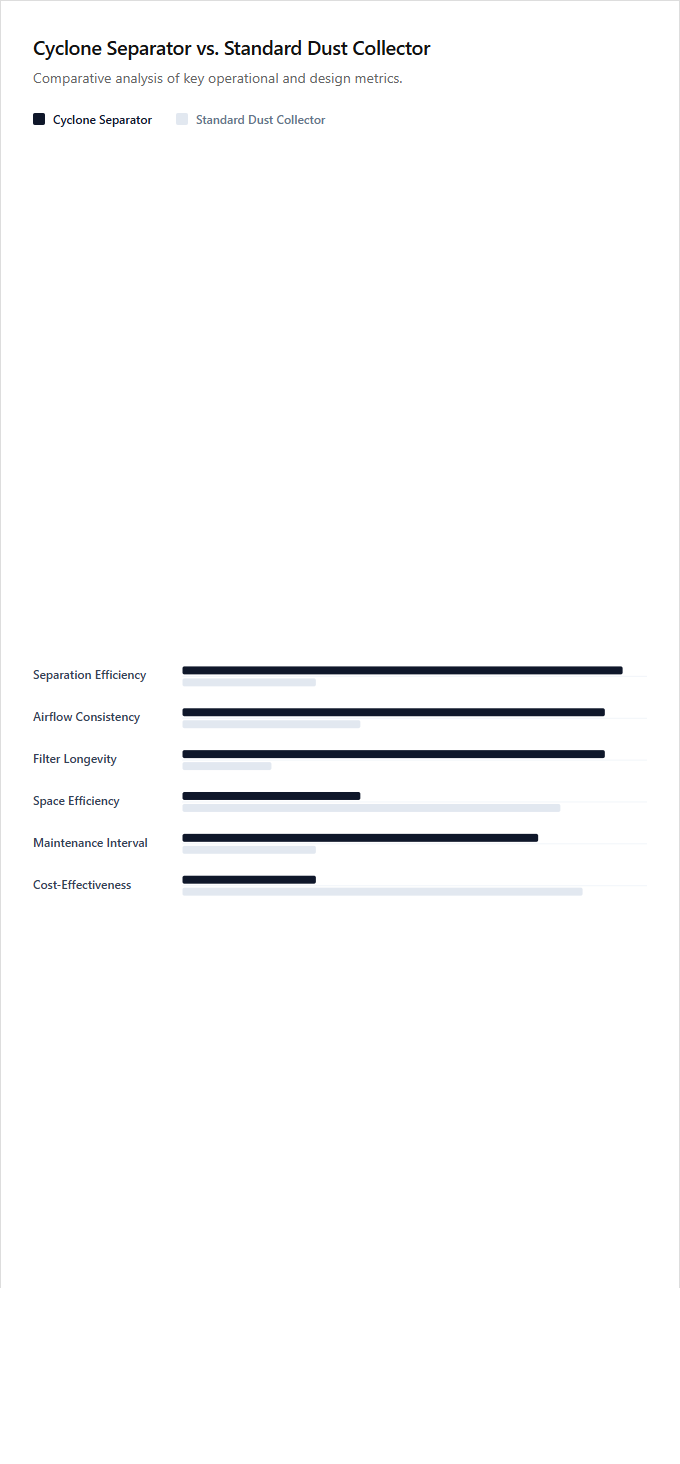
| Separation Mechanism | Cyclone separators utilize centrifugal force to deposit heavy debris into a primary collection bin, whereas standard dust collectors rely on a single-stage filtration process where all waste is pulled directly against the filter medium. |
| Airflow Consistency | A cyclone system maintains a stable volumetric flow rate (CFM) because the filter remains clear, while standard dust collectors suffer from a rapid loss of static pressure as dust cakes onto the main filter bag. |
| Filter Longevity | By pre-separating up to 99% of particulate matter before it reaches the pleated canister filter, cyclone separators drastically reduce wear and clogging compared to standard systems. |
| Space Requirements | Standard dust collectors feature a compact, horizontal footprint ideal for tight workshops, whereas cyclone separators require significant vertical clearance to accommodate the cyclonic cone and waste drum. |
| Maintenance Frequency | Cyclone separators require less frequent maintenance due to a high-capacity collection drum, whereas standard dust collectors require constant manual cleaning of the filter bag to prevent airflow restriction. |
| Capital Cost | Standard dust collectors provide a highly cost-effective and plug-and-play solution, whereas cyclone separators demand a larger financial investment and a more complex ductwork configuration. |
Cyclonic Separation vs. Barrier Filtration in Single-Stage Units
Standard single-stage dust collectors rely on direct barrier filtration, pulling wood chips and debris directly into a filter bag or canister. This process quickly cakes the filter surface with fine dust, which restricts airflow and reduces suction efficiency. In contrast, cyclone separators utilize centrifugal force to spin the incoming air. This rapid rotation forces heavy waste particles outward to the perimeter, where they gravity-feed into a collection bin before the air stream ever reaches the pleated filter.
By separating the bulk waste from the fine particulate, cyclonic systems prevent premature filter clogging and maintain consistent static pressure. Standard dust collectors are ideal for hobbyists with limited shop space and occasional tool use, whereas cyclone separators are best suited for high-volume professional woodworkers requiring continuous, heavy-duty extraction without performance loss.
Reducing Static Pressure Drop in Pleated Filters
Standard dust collectors draw particulate-laden air directly toward the filtration unit, causing fine dust to rapidly cake the primary pleated filter media. This accumulation increases static pressure drop across the filter, which restricts system airflow and reduces suction efficiency during operation.
A cyclone separator mitigates this pressure loss by utilizing centrifugal force to deposit heavy debris and fine dust into a primary containment drum before the airstream reaches the pleated filter. Pre-separating the bulk of the particulate load upstream maintains stable static pressure and ensures consistent pneumatic performance.
Standard collectors are best suited for hobbyists with intermittent, small-scale extraction needs, whereas cyclone separators are ideal for high-volume professional woodworkers requiring continuous, uninterrupted airflow.
Prevention of rapid filter blinding through progressive particulate loading separation
Standard dust collectors draw all captured debris directly into a single-stage filter, which leads to rapid filter blinding as fine dust quickly clogs the filter media. In contrast, cyclone separators utilize progressive particulate loading separation to protect the filtration system. By employing centrifugal force, the cyclonic action deposits heavy chips and large debris into a primary collection bin before the air stream reaches the canister filter, leaving only the finest micro-dust to be captured by the final stage. This multi-stage separation prevents premature clogging and maintains consistent static pressure.
By isolating fine dust from bulk waste, the cyclone design drastically reduces filter maintenance and extends the overall life of the machinery. Standard dust collectors are best suited for occasional hobbyists with low-volume waste needs, while cyclone separators are ideal for professional woodworkers requiring continuous, heavy-duty extraction without performance degradation.
Maintaining Consistent Airflow and Duct Velocity in CFM
In dust collection, maintaining consistent volumetric airflow, measured in Cubic Feet per Minute (CFM), is critical for preventing debris from settling in the ductwork. Standard single-stage dust collectors suffer from rapid CFM degradation as fine dust accumulates directly on the filter medium, restricting airflow and reducing duct velocity. This progressive reduction diminishes the system's ability to transport waste effectively over time.
Cyclone separators address this limitation by utilizing centrifugal force to separate heavy debris and fine dust before the air stream reaches the final filter. By keeping the filter clear, cyclone systems preserve consistent CFM and maintain the high duct velocity necessary for continuous extraction. Standard collectors suit hobbyists engaging in intermittent, low-volume woodworking, whereas cyclone separators are designed for professional operators requiring sustained, high-capacity dust mitigation.
Pre-Filtration Waste Classification by Particle Size
Cyclone separators employ centrifugal force to pre-classify waste prior to final filtration. By spinning the incoming airflow, these systems deposit heavy wood chips and large debris into a primary collection bin before the air reaches the filter. This mechanical classification ensures that only the finest microscopic particulate matter is directed to the final cartridge filter, preventing premature clogging and maintaining consistent suction pressure.
In contrast, standard single-stage dust collectors draw the entire spectrum of waste particle sizes directly into the main filtration bag or canister. Without prior particle size classification, the filter media faces rapid loading from large shavings, which reduces system efficiency. Cyclone systems are highly suitable for professional woodworkers requiring continuous, high-volume extraction, whereas standard collectors are better utilized by hobbyists operating smaller shops with intermittent tool usage.
Two-Stage HEPA/MERV Canister Filter Integration
Standard single-stage dust collectors pull all waste directly through the impeller and into a filter, which can quickly clog when using high-efficiency HEPA or MERV-rated canisters. In contrast, two-stage cyclone separators employ centrifugal force to precipitate heavy chips and large debris into a primary bin before the air stream reaches the filter. This separation prevents premature filter loading and maintains optimal airflow.
Integrating high-efficiency canisters onto a cyclone system ensures that only the finest microscopic dust reaches the pleated media. This configuration drastically extends filter life and preserves static pressure, whereas standard systems require frequent manual cleaning to prevent performance drops. Standard collectors suit hobbyists with intermittent, low-volume needs, while two-stage cyclone systems are ideal for professional woodworkers requiring continuous, high-volume fine dust capture.
Fan Static Pressure and System Curve Optimization
Standard dust collectors operate on a direct system curve, where progressive filter loading quickly increases static pressure resistance, reducing overall airflow efficiency. In contrast, cyclone separators optimize the system curve by pre-separating heavy debris before air reaches the filtration media. This cyclonic action prevents premature filter caking, allowing the fan to operate closer to its peak static pressure efficiency for extended periods.
While cyclone units require higher initial static pressure to overcome internal vortex resistance, they maintain a stable, efficient operating curve under heavy loads. Standard collectors offer high initial CFM but suffer rapid performance degradation as the dust bag fills. Standard systems are best suited for hobbyists engaged in light, intermittent woodworking, whereas cyclone separators are ideal for professional workshop operators requiring continuous, high-volume dust extraction.
Leave a comment