
Managing workshop dust extraction is a constant battle; operators frequently find their creative momentum broken by repeatedly walking across the shop to toggle a manual switch, or they risk their respiratory health by making "quick cuts" without extraction. While standard workshop budgets are typically allocated toward primary machinery investments like cabinet saws and planers, the control interface of the extraction system itself is often overlooked. Upgrading this interface grants operators seamless workflow continuity and guaranteed particulate capture. However, achieving this efficiency requires adhering to specific electrical stipulations, particularly matching your shop's voltage and amperage thresholds with the appropriate relay switch. For example, pairing a heavy-duty miter saw with an automated controller like the iVAC Pro system demonstrates how automated coordination keeps the air clean without manual intervention. Below, we examine the operational differences between manual switches and auto-start systems, evaluating how each impacts workshop safety, power consumption, and overall project throughput.
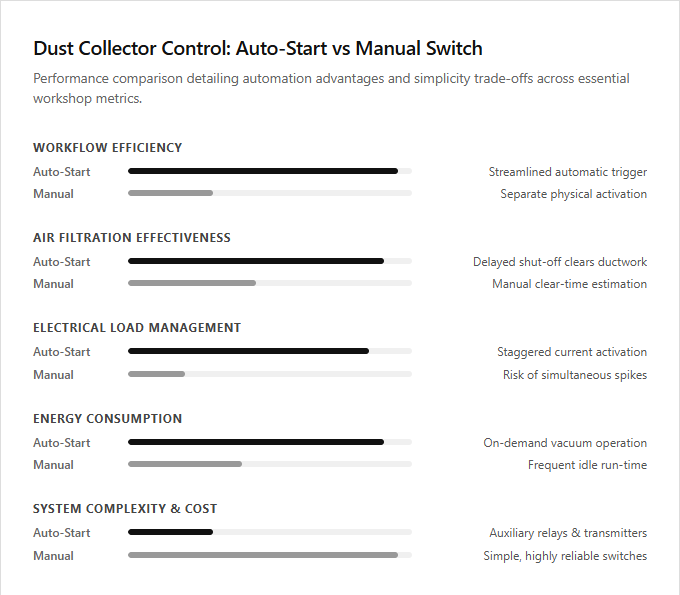
| Factor | Summary |
|---|---|
| Workflow Efficiency | Auto-start systems streamline the workshop workflow by utilizing current-sensing technology to automatically trigger the dust collector, whereas manual switches require the operator to perform separate physical activations for each device. |
| Air Filtration Effectiveness | Auto-start mechanisms often feature a delayed shut-off sequence to evacuate remaining suspended particulates from the ductwork, while manual switches rely on the user to estimate and manage post-operation clearing times. |
| Electrical Load Management | Auto-start modules can mitigate inrush current spikes by staggering the activation of the tool and the collector, whereas manual switches increase the risk of tripping circuit breakers if both high-draw motors are started simultaneously on a shared circuit. |
| Energy Consumption | Manual switches often lead to increased idle power consumption when operators leave the collector running between cuts, whereas auto-start systems optimize power draw by operating the vacuum exclusively during active tool engagement. |
| System Complexity and Cost | Manual switch configurations rely on simple, highly reliable single-pole single-throw switches, while auto-start integration requires more sophisticated auxiliary relays, current-sensing transformers, or wireless RF transmitters. |
Current-sensing relays for automatic tool-activation detection
Selecting between manual switches and auto-start systems for workshop dust collection significantly impacts efficiency and air quality. Modern auto-start systems utilize current-sensing relays clamped around the power cord of the primary woodworking tool. When the tool activates, this sensor detects the magnetic field generated by the electrical current draw, automatically triggering the dust collector. This hands-free approach ensures dust extraction begins instantly and continues for a brief delay after the tool stops to clear the hoses.
Manual switches require operators to physically activate the vacuum system prior to starting each task, which is highly reliable but depends entirely on user discipline. Busy professionals managing multi-tool environments require the seamless workflow of auto-start current-sensing systems, whereas occasional hobbyists operating a single, dedicated machine typically prefer the simplicity and lower cost of manual switches.
Overrun timer integration to clear ductwork particulate matter
Selecting between manual switches and auto-start systems for dust collectors significantly impacts workshop safety and air quality. While manual switches offer basic, reliable control, they rely entirely on the operator to initiate extraction. Auto-start systems automate this process by syncing the collector with the primary power tool, ensuring immediate dust extraction upon tool activation.
A critical advantage of premium auto-start systems is the integration of an overrun timer. This feature keeps the collector running for a brief period after the tool is switched off, effectively clearing remaining particulate matter from the ductwork to prevent clogging. Manual switches are best suited for occasional hobbyists prioritizing budget and simplicity, whereas automated systems with overrun timers are ideal for high-production professionals requiring seamless workflow and optimal air filtration.
Pneumatic blast gates synchronized with machine power states
Manual switch dust collection requires operators to physically activate the vacuum unit and manually adjust blast gates before beginning a cut. In contrast, advanced automated systems utilize current-sensing relays paired with pneumatic blast gates synchronized directly with machine power states. When a woodworking or metalworking tool is switched on, the dedicated pneumatic gate opens instantly and the central dust collector activates without human intervention.
This seamless synchronization optimizes static pressure, prevents ductwork clogging, and significantly reduces energy consumption by running the collector only during active tool operation. Manual setups are best suited for hobbyists or solitary craftspeople managing a few machines, whereas automated pneumatic systems are indispensable for high-volume commercial workshops requiring streamlined workflows and strict air-quality maintenance.
Inrush current mitigation to extend induction motor lifespan
Induction motors in dust collectors experience significant inrush current during startup, which subjects internal windings to intense thermal and mechanical stress. Mitigating this initial electrical surge is essential for preventing premature degradation and extending the overall operational lifespan of the machinery.
Traditional manual switches deliver instant full-line voltage, causing maximum current spikes with every activation. In contrast, modern auto-start systems often stagger power loads or integrate electronic delays, effectively dampening peak electrical demand and reducing thermal wear on the motor.
Manual switches are best suited for budget-conscious hobbyists with intermittent workshop tasks, while auto-start systems are ideal for high-frequency professionals requiring automated convenience and maximum equipment longevity.
Static pressure optimization through localized CFM distribution
Efficient dust extraction relies on maintaining high static pressure by directing maximum Cubic Feet per Minute (CFM) exclusively to the active machinery. Auto-start systems, when integrated with automated blast gates, instantly open the correct line and activate the collector upon tool startup, preventing pressure drops from open, unused branches. Manual switches require operators to physically open gates and start the collector, which can lead to static pressure loss if lines are left open.
Automated systems ensure consistent capture velocity at the tool hood, maximizing system efficiency without user intervention. Automated setups are ideal for high-production multi-user shops prioritizing workflow efficiency, whereas manual switches suit solo hobbyists managing single-line configurations.
Programmable Logic Controllers managing multi-branch dampers
In industrial environments, managing dust collection efficiently hinges on the choice between manual switches and automated, PLC-driven systems. Manual operation requires operators to physically activate the collector and adjust blast gates, which frequently leads to wasted energy and forgotten ventilation. Conversely, automated systems utilize Programmable Logic Controllers (PLCs) to sync the central extractor with individual power tools. When a tool activates, the PLC senses the electrical current, opens the corresponding pneumatic branch damper, and starts the vacuum.
This PLC-managed approach optimizes airflow by directing suction only to active machinery, which significantly reduces system wear and energy costs. Manual switches are best suited for independent hobbyists with single-operator stations, whereas automated PLC systems are ideal for high-production facility managers requiring seamless, multi-user air management.
Reactive power reduction by eliminating idle blower operation
Managing workshop energy efficiency requires evaluating how dust collectors are activated. Standard manual switches often lead to prolonged idle blower operation, as operators frequently leave the collector running between cuts. This idle time contributes significantly to unnecessary reactive power draw, lowering the overall power factor of the facility and increasing utility costs.
Auto-start systems mitigate this waste by synchronizing the dust collector directly with the primary power tool. This automation ensures the blower only operates during active cutting, drastically reducing idle runtime and optimizing reactive power consumption. Manual switches remain ideal for solitary hobbyists performing occasional, extended tasks, whereas auto-start integration is essential for high-throughput commercial shops seeking automated efficiency and lower energy overhead.
Leave a comment