
Industrial workshop operators and facility managers constantly struggle to capture microscopic, airborne particulates that bypass basic collection systems, settling on surfaces and compromising respiratory health. When addressing these safety concerns, decision-makers typically rely on standard funding sources, such as annual maintenance budgets or localized safety grants, to procure baseline machinery upgrades.
However, upgrading to specialized filtration grants operations complete compliance with strict OSHA silica dust standards and unparalleled air purification. We must stipulate, however, that retrofitting HEPA filters requires careful evaluation of your fan curve to ensure the system maintains sufficient static pressure and airflow velocity.
This comparative guide will analyze the mechanical differences between standard and HEPA filters, examine their impact on dust collector performance, and outline how to optimize your system for maximum particulate filtration efficiency.
| Factor | Summary |
|---|---|
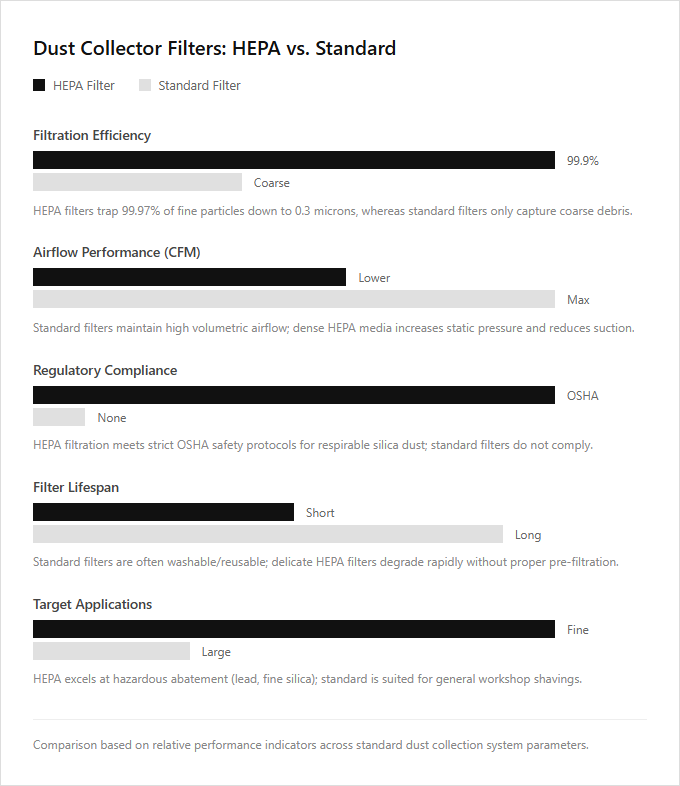
| Filtration Efficiency | HEPA filters capture 99.97% of particulate matter down to 0.3 microns, whereas standard filters typically only trap larger airborne dust particles. |
| Airflow Performance | Standard filters maintain a higher volumetric airflow rate measured in cubic feet per minute, while the dense weave of HEPA media increases static pressure and can reduce suction. |
| Regulatory Compliance | HEPA filtration is required to meet OSHA standards for mitigating respirable crystalline silica on construction sites, whereas standard filters do not comply with these safety protocols. |
| Filter Lifespan | Standard filters are often washable and reusable, while delicate HEPA filters degrade faster without a multi-stage pre-filter system to capture coarse debris first. |
| Target Applications | HEPA filters are engineered for hazardous lead paint abatement and fine wood dust extraction, whereas standard filters are suited for general workshop cleanup of larger shavings. |
Efficiency Divergence: 0.3-Micron MPPS vs. MERV
In dust collection, the critical divergence between HEPA and standard filters lies in their efficiency at the sub-micron level. True HEPA filters are strictly rated to capture 99.97% of particles at the Most Penetrating Particle Size (MPPS) of 0.3 microns, which represents the most difficult particle size to trap. Standard filters rely on the MERV rating system, which measures efficiency across larger particle ranges and often allows dangerous, microscopic respirable dust to bypass the media and recirculate into the workspace.
Standard media manages bulk debris effectively but fails to mitigate the invisible airborne hazards that pose long-term health risks. Standard filters are ideal for general woodworkers managing high-volume shavings and coarse sawdust, whereas HEPA filtration is necessary for industrial operators and contractors handling toxic materials like crystalline silica, lead paint, or hazardous fine particulates.
How Pressure Drop Affects Fan Performance and Flow
In dust collection systems, the choice between HEPA and standard filters directly impacts aerodynamic efficiency. HEPA filters feature a dense media that creates a significantly higher static pressure drop. According to fan performance curves, this added resistance forces the system to operate at a lower volumetric flow rate, reducing overall air volume (CFM). Standard filters impose minimal static pressure, allowing the fan to maintain higher velocity and airflow capacity.
Standard filters suit general woodworkers prioritizing high-volume bulk chip collection, whereas HEPA filters are vital for professionals handling hazardous particulates like silica, asbestos, or fine hardwoods requiring maximum respiratory protection.
HEPA vs. Standard Filters: Particle Capture Mechanisms
Standard dust collector filters primarily rely on inertial impaction to capture larger airborne particles. As dust-laden air flows through the filter media, heavier particles fail to follow the airstream's rapid changes in direction, colliding directly with the fibers. This mechanism is highly efficient for bulk debris but allows microscopic, hazardous dust to pass through the system.
HEPA filters utilize a combination of interception and Brownian diffusion to capture fine particulate matter down to 0.3 microns. Interception traps medium particles traveling close to a fiber, while Brownian diffusion governs the smallest particles, causing them to move erratically and collide with the filter matrix.
Standard filters are ideal for general woodworking hobbyists managing large wood chips, whereas HEPA filters are essential for professional contractors and remediators working with hazardous silica, lead paint, or fine drywall dust.
Optimizing Air-to-Cloth Ratio to Prevent Media Blinding
Standard filters accommodate a higher air-to-cloth ratio because their coarser media permits elevated face velocities. Upgrading to a denser HEPA filter requires a deliberate reduction in the air-to-cloth ratio. Lowering the face velocity across the HEPA membrane prevents fine particulates from wedging into the tight pores, successfully preventing premature media blinding.
Managing this ratio involves expanding the filtration surface area or modulating the system's volumetric airflow. This adjustment maintains balanced static pressure and extends the operational lifespan of the media. Standard filters are ideal for general workshop hobbyists processing large-volume wood shavings, whereas HEPA filtration is necessary for industrial specialists and contractors handling toxic lead dust or crystalline silica.
Zero-Bypass Housing Seals for Particulate Leak Prevention
When selecting a dust collector, the distinction between standard and HEPA filtration extends beyond the media itself to the structural design of the filter housing. Standard filters typically manage larger debris with basic friction fits, which are prone to minor leaks. In contrast, true HEPA filtration demands a certified zero-bypass housing seal to prevent microscopic particulate leakage around the filter frame, ensuring that all airflow is forced directly through the high-efficiency media rather than escaping through marginal gaps.
Standard filtration systems are ideal for general woodworking hobbyists requiring basic bulk chip collection, whereas HEPA systems equipped with zero-bypass seals are essential for commercial professionals and contractors mitigating hazardous respirable dust like silica, lead, or concrete.
Pulse-Jet Pleated Cartridges vs. Static HEPA Filters
Standard pleated cartridges are engineered to withstand the rigorous mechanical stress of pulse-jet cleaning systems. These durable elements tolerate reverse pulses of compressed air that dislodge caked dust, ensuring continuous airflow and sustained suction during heavy-duty extraction operations.
In contrast, HEPA filters feature delicate, densely packed micro-fibers designed solely for static operation. Subjecting HEPA elements to pulse-jet blasts can easily rupture the media, compromising their high-efficiency filtration capabilities. Standard pleated cartridges are ideal for high-volume woodworking and construction professionals requiring self-cleaning systems, while static HEPA filtration is best suited for technicians handling hazardous fine dust in controlled, health-sensitive environments.
Cyclonic Pre-Filtration to Reduce HEPA Dust Loading
Standard filters are highly effective for capturing bulk woodworking debris, maintaining high airflow under heavy dust loads. However, capturing fine, respirable particulates requires terminal HEPA filtration. Integrating a cyclonic pre-separator upstream of these filters is crucial for system efficiency. The cyclone centrifugally removes the vast majority of bulk waste before the air stream reaches the primary filters, drastically reducing the particulate load on downstream elements.
In standard systems, this pre-filtration prevents caking and extends suction performance during heavy planing or sawing. For HEPA-equipped systems, cyclonic separation is vital to shield the dense, delicate HEPA media from rapid clogging, preserving both expensive filter life and critical static pressure. Standard filtration systems suit general hobbyists managing large volumes of non-toxic wood waste, while HEPA-equipped systems are essential for professional contractors and restorers working with hazardous materials like silica, lead paint, or fine hardwood dust.
Leave a comment