
Woodworkers and fabrication professionals frequently struggle with weak suction at the tool port, often blaming their dust collector's horsepower when the real culprit is airflow resistance and static pressure loss within the duct network. When designing a workshop layout, many builders naturally turn to standard, budget-friendly sources like hardware-store PVC or flexible hoses as their primary infrastructure.
However, understanding the physics of your system grants an immediate advantage: selecting the optimal ducting material can dramatically maximize CFM and ensure long-term collection efficiency. As a necessary stipulation, readers must note that air velocity and static pressure are deeply influenced by run lengths and grounding requirements. For example, replacing a ribbed flexible hose with a 6-inch spiral metal main line can drastically reduce friction loss.
This article will compare metal versus PVC ducting, examine the math behind static pressure drop, and outline actionable steps to optimize your dust collector's airflow performance.
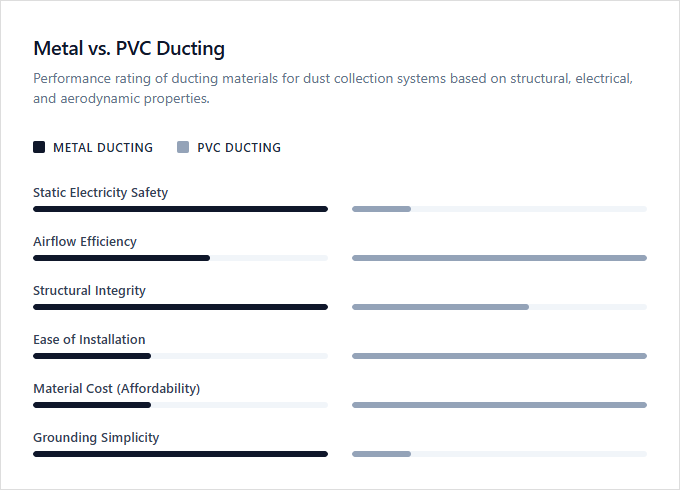
| Factor | Summary |
|---|---|
| Static Electricity | Metal ducting naturally dissipates electrostatic charges, whereas PVC ducting is prone to static buildup that requires grounding to mitigate combustible dust hazards. |
| Airflow Resistance | PVC ducting features a smoother interior profile that reduces skin friction loss, while metal ducting may suffer from turbulence at corrugated seams and adjustable elbows. |
| Structural Integrity | Rigid spiral metal ducting withstands high negative static pressure without collapsing, unlike thin-walled schedule 40 PVC which can implode under high-vacuum conditions. |
| Ease of Installation | PVC ducts are easily cut and joined using solvent welding, whereas metal ducts require specialized crimping tools and mastic sealant. |
| Material Cost | PVC ducting generally offers a lower initial capital expenditure, whereas snap-lock metal ducting involves a higher cost of goods sold due to raw metal material expenses. |
| Grounding Requirements | Metal systems provide an inherent continuous electrical ground path when properly riveted, while non-conductive PVC requires a dedicated bare copper wire network to prevent electrostatic discharge. |
Roughness and Friction: Spiral Metal vs. PVC
In dust collection systems, the choice between ducting materials significantly impacts static pressure. Polyvinyl chloride (PVC) ducting features an exceptionally smooth interior, with an absolute roughness value of approximately 0.0015 mm. This ultra-smooth surface minimizes boundary layer friction losses, ensuring highly efficient airflow. In contrast, spiral metal ducting exhibits a higher absolute roughness of about 0.15 mm due to internal seams and construction ripples. This profile disturbs the boundary layer, creating micro-turbulences that increase friction losses over long runs.
While PVC provides superior aerodynamic performance, spiral metal offers unmatched durability and safety. High-volume commercial workshops requiring strict fire-code compliance and static grounding are best suited for spiral metal ducting, while residential hobbyists seeking cost-effective, high-airflow efficiency in smaller layouts are ideal candidates for PVC.
Triboelectric charging hazard and electrostatic discharge prevention
In dust collection systems, the high-speed movement of wood particles generates static electricity through triboelectric charging. Non-conductive PVC ducting is highly susceptible to this phenomenon, accumulating significant electrostatic charges on its surface that can lead to unpredictable electrostatic discharges. Metal ducting, being naturally conductive, inherently dissipates these charges when properly grounded, mitigating the risk of sparks that could ignite airborne dust.
Preventing electrostatic discharge requires a continuous path to the ground. While PVC can be modified with grounding wires, this method is less reliable than the contiguous ground path offered by rigid metal pipes. Rigid metal systems are ideal for high-volume commercial workshops requiring strict safety compliance, whereas grounded PVC is suitable for casual hobbyists operating on a limited budget.
Duct wall structural integrity under high negative static pressure
In high-performance dust collection systems, negative static pressure places significant stress on the ductwork walls. Thin-walled PVC ducting, while cost-effective and easy to install, risks catastrophic implosion under the high vacuum pressures generated by larger cyclonic collectors. To mitigate this risk of collapse, robust systems require rigid materials that maintain their cross-sectional integrity without deflection.
Spiral metal ducting offers superior structural integrity, easily resisting extreme negative pressure due to its rigid steel construction and locked seams. This durability prevents wall collapse and maintains optimal airflow velocity throughout the system. Rigid metal systems are ideal for commercial operators requiring continuous, high-vacuum industrial extraction, while PVC is best suited for weekend hobbyists running smaller, low-pressure utility vacuums.
Minor Loss Coefficients: Metal vs. PVC Fittings
In dust collection system design, minimizing static pressure loss is critical for maintaining adequate airflow velocity. Long-radius metal elbows offer a distinct aerodynamic advantage over standard PVC Drain, Waste, and Vent (DWV) fittings. The larger centerline radius of metal elbows yields a significantly lower minor loss coefficient, which reduces air turbulence as waste material changes direction.
Standard PVC DWV fittings often utilize tighter bends that increase resistance and restrict CFM. Although the interior surface of PVC is exceptionally smooth, the abrupt geometry of these common fittings creates localized pressure drops that diminish extraction efficiency. Rigid metal systems suit high-volume industrial operators requiring optimized airflow and strict fire safety compliance, while PVC ducting remains ideal for budget-conscious hobbyists seeking simple installation in small workshops.
Leakage Rates: PVC Joints vs. Metal Seams
When designing a dust collection system, joint integrity is critical for maintaining optimal static pressure. Solvent-welded PVC ducting excels in preventing air loss, as the chemical welding process fuses the joints into a continuous, hermetic seal with virtually zero leakage. Conversely, gasketed metal seams rely on mechanical connections and rubber seals. While highly robust, these metal joints are susceptible to minor air bypass over time as gaskets age, dry out, or shift under system vibration.
Each material serves distinct operational needs. Budget-conscious hobbyists seeking a highly sealed, cost-effective system often choose PVC, while industrial operators requiring strict fire-code compliance and resistance to abrasive debris prefer gasketed metal.
Maintenance of minimum transport velocity via standard nominal diameters
Maintaining a minimum transport velocity-typically 3,500 to 4,000 feet per minute-is critical to prevent dust from settling in run lines. Rigid metal ducting is engineered in standard nominal diameters, such as five-inch and six-inch pipes, which align precisely with standard dust collector ports to optimize airflow. Conversely, PVC ducting relies on plumbing standards like Schedule 40, where the actual internal diameter restricts velocity and introduces static pressure losses at critical junctions.
Additionally, metal ducting naturally dissipates static electricity, whereas PVC requires auxiliary grounding to mitigate fire hazards in high-velocity systems. Spiral metal ducting is ideal for professional fabricators requiring code-compliant, continuous-duty filtration, while PVC remains a viable alternative for hobbyist woodworkers managing light-duty, intermittent operations.
Dynamic pressure losses from abrupt internal diameter transitions
In woodshop dust collection systems, maintaining optimal airflow velocity is critical. Dynamic pressure losses frequently occur due to abrupt internal diameter transitions. Standard PVC piping, while cost-effective, often relies on molded fittings with sudden internal shoulders and step-downs. These sharp transitions disrupt the laminar boundary layer, creating turbulence and significant static pressure drops that reduce overall collection efficiency.
Spiral metal ducting and its corresponding machine-pressed fittings offer gradual taper transitions and smooth interior seams. This design minimizes frictional drag and prevents the abrupt diameter changes that choke airflow. Rigid metal systems provide highly efficient, aerodynamically optimized pathways that maximize the CFM of the dust collector. Heavy-duty industrial shops requiring maximum CFM and strict safety compliance benefit most from metal ducting, whereas hobbyists and smaller workshops seeking an affordable, easily modified setup are well-suited for PVC.
Leave a comment