
For many trim carpenters and DIY enthusiasts, deciding between a 15-gauge and a 16-gauge finish nailer is a common source of frustration. Choosing the wrong tool risks splitting expensive timber or, conversely, failing to provide enough holding power to keep heavy trim flush over time.
Before allocating your standard equipment budget or workshop funding to a new pneumatic system, it is vital to understand how each tool functions in a professional workflow. Making the correct choice grants you flawless, gap-free joints while eliminating hours of tedious wood-putty application and sanding.
Stipulation: This comparison assumes standard interior installation parameters using typical trim substrates such as MDF, pine, and hardwoods.
Whether your immediate project involves securing heavy crown molding, anchoring wide baseboards, or pinning delicate door casings, the nail diameter dictates your success. Below, we analyze holding strength, nail hole profiles, and tool angles to help you choose the best finish nailer for your needs.
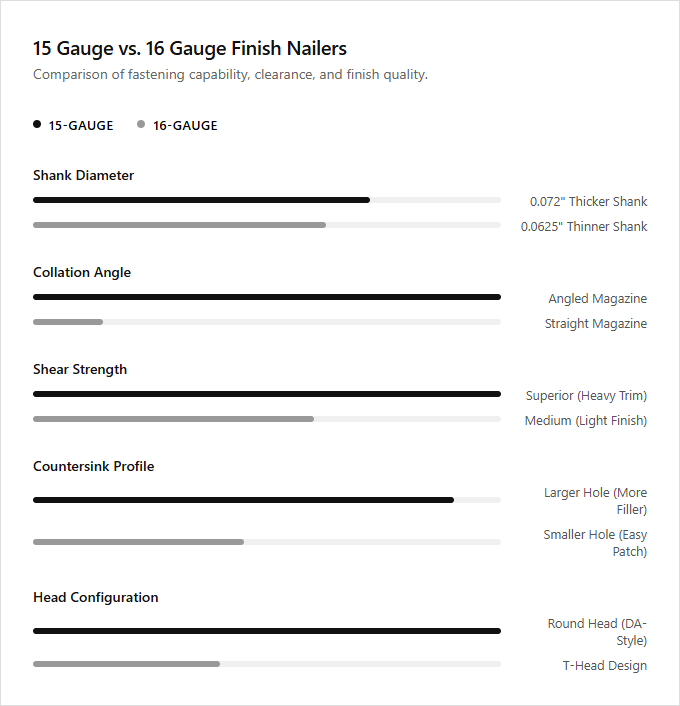
| Factor | Summary |
|---|---|
| Shank Diameter | The 15-gauge nail features a thicker shank diameter of 0.072 inches, providing more structural hold than the 0.0625-inch 16-gauge nail. |
| Collation Angle | While 16-gauge nailers often feature a straight collation angle, 15-gauge nailers utilize an angled magazine to access tight corners. |
| Shear Strength | Due to the thicker wire, 15-gauge nails provide superior shear strength for heavy trim, whereas 16-gauge nails are better suited for lighter-duty finish work. |
| Countersink Profile | The larger countersink profile of a 15-gauge nail requires more wood filler to conceal, whereas the smaller footprint of a 16-gauge nail simplifies the patching process. |
| Head Configuration | Many 15-gauge nails feature a DA-style angled collation with a larger round head, whereas 16-gauge nails typically utilize a smaller T-head design. |
15-Gauge Nails Are Thicker Than 16-Gauge
When selecting a finish nailer, understanding the physical differences between fastener sizes is essential for ensuring structural integrity. The primary distinction lies in the thickness of the wire; 15-gauge fasteners have a thicker shank diameter of 1.8mm compared to the 1.6mm diameter of 16-gauge nails. This variance in thickness directly impacts both the holding power of the fastener and the size of the hole left behind in the work surface.
The robust 1.8mm profile of the 15-gauge nail provides superior shear strength for heavy-duty applications, while the slimmer 1.6mm 16-gauge nail reduces the risk of splitting delicate wood. Professional contractors installing heavy exterior trim and interior door jambs will benefit most from the strength of the 15-gauge nailer, whereas finish carpenters and DIY enthusiasts focused on detailed cabinetry and thin moulding will find the precision of the 16-gauge more appropriate.
15-Gauge Angled vs. 16-Gauge Straight Nailers
When choosing between a 15-gauge and a 16-gauge finish nailer, the primary differentiator lies in their magazine configuration and structural capability. Angled magazine configurations are standard for 15-gauge nailers, allowing the tool to access tight corners and awkward angles easily. Conversely, 16-gauge nailers are predominantly designed with straight magazines, which excel in open-face nailing applications where maneuvering space is unrestricted.
The thicker 15-gauge nails offer superior holding power for heavy trim, while the thinner 16-gauge fasteners leave smaller holes that require less filling. Professional trim carpenters installing heavy exterior casing and door jambs benefit most from the robust 15-gauge angled nailer, whereas furniture makers and general DIY enthusiasts find the lighter, straight 16-gauge nailer ideal for versatile, detail-oriented trim work.
15-Gauge DA and FN Nails: Superior Shear Strength
Selecting between a 15-gauge and a 16-gauge finish nailer depends on the structural demands of the project. The 15-gauge nailer utilizes thicker fasteners, with both DA-style and FN-style nails providing superior shear strength. This robust holding power is essential for heavy-duty applications such as installing door jambs and heavy casing, where structural integrity and resistance to movement are paramount.
The 16-gauge nailer fires a thinner wire that leaves smaller holes, preserving the appearance of delicate trim, cabinetry, and baseboards. Heavy-duty trim installers and framing carpenters will benefit most from the robust 15-gauge system, whereas furniture makers and general DIYers will find the 16-gauge tool ideal for precision finish work.
16-Gauge Nails Prevent Splitting in Delicate Moldings
When selecting between a 15-gauge and a 16-gauge finish nailer, understanding the structural impact on your workpiece is essential. The primary distinction lies in the nail thickness and the resulting entry point. Specifically, 16-gauge nails create a smaller countersink hole, significantly reducing the risk of wood splitting in delicate moldings. This smaller profile requires less wood filler and sanding, preserving the pristine surface of fine woodwork.
Conversely, 15-gauge nailers utilize thicker, often angled nails that provide superior holding strength for heavy-duty trim applications. Detail-oriented trim carpenters focusing on intricate crown molding and softwoods prefer the precise, split-resistant 16-gauge model, while residential framing contractors installing heavy interior door jambs require the robust holding power of the 15-gauge system.
T-Head Fasteners Minimize Prep for Paint-Grade Trim
When selecting between a 15-gauge and a 16-gauge finish nailer, the decision often hinges on the balance between holding power and surface preservation. The 16-gauge nailer utilizes thinner T-head fasteners that leave a remarkably small footprint upon entry. Because of this smaller profile, these T-head fasteners require less wood putty and minimal sanding to achieve a flawless, paint-grade trim finish, which significantly reduces preparation time during the painting stage.
Conversely, the thicker 15-gauge nailer drives heavier nails at an angle, offering superior structural holding strength for dense materials. Heavy-duty carpenters installing thick exterior casing and interior door jambs will benefit most from the robust holding power of the 15-gauge, while detail-oriented trim carpenters and DIYers focusing on delicate interior moldings and cabinetry will find the precise, clean-finishing 16-gauge to be the ideal tool.
34-Degree Nailers: Perfect for Tight Inside Corners
When choosing between a 15-gauge and a 16-gauge finish nailer, the magazine angle is a key differentiator. The 15-gauge nailer features a distinct 34-degree collation angle, providing superior clearance in tight spaces like inside corners and crown molding joints. This steep angle allows the tool to fit into compact areas where straight or lesser-angled 16-gauge models would obstruct your work.
While the 16-gauge nailer leaves smaller holes and reduces the risk of splitting thin wood, it lacks the extreme maneuverability of its angled counterpart. Professional trim carpenters requiring maximum holding power and access to tight angles will find the 15-gauge indispensable, while weekend DIYers and general contractors prefer the versatile, clean-finishing 16-gauge for standard trim and baseboards.
Ergonomic 16-Gauge Pneumatics Reduce Overhead Fatigue
When selecting between a 15-gauge and a 16-gauge finish nailer, tool ergonomics and weight play a critical role in long-term productivity. Pneumatic 16-gauge models offer a distinct advantage in physical handling, as they are generally lighter and more compact than their 15-gauge counterparts. This weight reduction significantly minimizes user fatigue, particularly during demanding, repetitive tasks like overhead crown molding installation.
While the 15-gauge nailer utilizes thicker, angled nails that provide superior holding power for heavy-duty trim, the 16-gauge system balances adequate structural integrity with a smaller tool footprint. The robust 15-gauge model is best suited for professional contractors installing heavy exterior casing, whereas the nimbler 16-gauge model is ideal for finish carpenters and DIY enthusiasts prioritizing comfort during intricate, prolonged overhead work.
Leave a comment