
For contractors and serious builders, selecting the wrong pneumatic tool can quickly lead to split hardwood, compromised structural integrity, and costly callbacks. While standard equipment budgets and tool-acquisition funding often prioritize general-use pneumatic systems to save upfront capital, investing in application-specific nailers grants immediate gains in joint strength, production speed, and code compliance.
The essential stipulation, however, is that these systems are highly specialized; a framing nailer cannot safely fasten tongue-and-groove flooring, nor can a flooring cleater secure load-bearing walls. Real-world applications-such as using 16-gauge L-cleats to prevent splitting in premium white oak, versus driving 3-inch, 21-degree framing nails into Douglas fir studs-demonstrate how tool selection dictates project quality.
Below, we will analyze the mechanical differences, fastener requirements, and specific use cases of flooring versus framing nailers, providing a clear roadmap to help you choose the right tool for your next project.
| Factor | Summary |
|---|---|
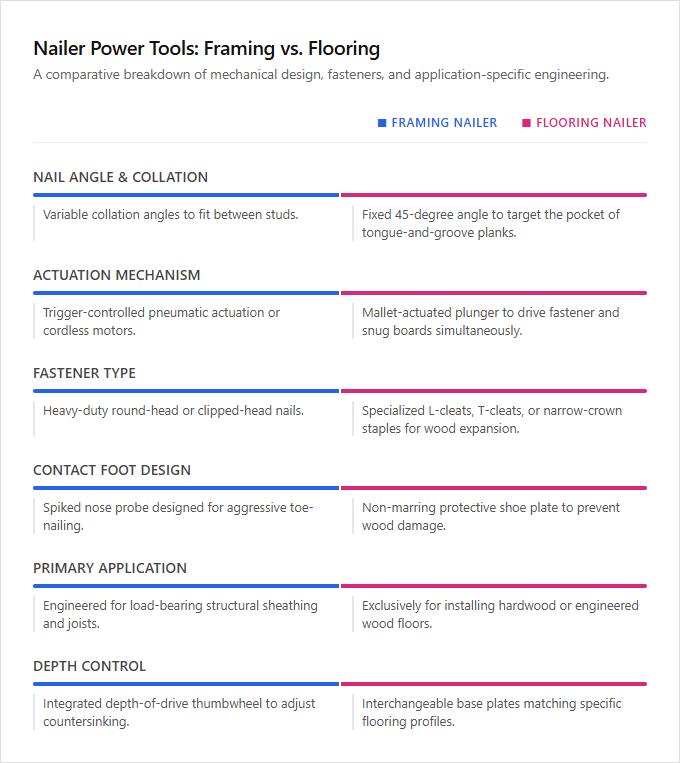
| Nail Angle and Collation | Framing nailers use variable collation angles to fit between studs, whereas flooring nailers operate at a fixed forty-five-degree angle to target the pocket of tongue-and-groove planks. |
| Actuation Mechanism | Framing nailers utilize trigger-controlled pneumatic actuation or cordless motors, while flooring nailers require a mallet-actuated plunger to drive the fastener and snug the floorboards together simultaneously. |
| Fastener Type | Framing nailers drive heavy-duty round-head or clipped-head nails, whereas flooring nailers utilize specialized L-cleats, T-cleats, or narrow-crown staples to allow for wood expansion. |
| Contact Foot Design | Framing nailers feature a spiked nose probe designed for aggressive toe-nailing, while flooring nailers use a non-marring protective shoe plate to prevent damaging the prefinished wood. |
| Primary Application | Framing nailers are engineered for load-bearing structural sheathing and joist construction, whereas flooring nailers are designed exclusively for installing hardwood or engineered wood floors. |
| Depth Control | Framing nailers employ an integrated depth-of-drive thumbwheel to adjust countersinking, while flooring nailers rely on interchangeable base plates to match the specific thickness of the flooring profile. |
Pneumatic Cleat Nailers for Hardwood Flooring
Framing nailers and flooring nailers serve distinct structural purposes in residential construction and renovation. For hardwood installations, mallet-actuated pneumatic flooring nailers drive L-cleats or T-cleats at a precise forty-five-degree angle for blind-nailing hardwood. This specialized mechanism secures the tongue of the floorboards while leaving the surface immaculate and allowing the wood to expand and contract naturally.
Framing nailers deploy heavy-duty fasteners to rapidly assemble structural components like wall studs, roof trusses, and subfloors. Dedicated flooring contractors require the precision of a flooring nailer to guarantee flawless wood alignment, while framing carpenters and home builders need the robust power of a framing nailer to handle heavy timber assembly.
Pneumatic Framing Nailers: Rapid Structural Fastening
Selecting the correct nailer is essential for ensuring both structural integrity and project efficiency. Pneumatic framing nailers utilize contact actuation for rapid structural fastening of framing studs and sheathing. This high-speed capability allows operators to quickly secure heavy timber components, making these tools indispensable for rough carpentry and major construction tasks.
In contrast, flooring nailers are specialized tools designed specifically for installing hardwood or engineered flooring. They employ a mallet-actuated system to drive cleats or staples at a precise 45-degree angle, ensuring tight joints without damaging the wood surface. Professional home builders and structural contractors require the high-volume speed of framing nailers, whereas dedicated flooring installers and detail-oriented DIY enthusiasts need the specialized precision of flooring nailers to achieve seamless finishes.
Prevent Flooring Splits with 16- or 18-Gauge Fasteners
Framing nailers are robust power tools designed for heavy-duty structural applications such as building wall frames, roof trusses, and subfloors. These tools drive thick, high-gauge nails into dense lumber, providing the immense holding power required for load-bearing connections.
Securing hardwood floorboards requires a different level of precision. Flooring installation requires sixteen-gauge or eighteen-gauge fasteners to prevent splitting of the wood tongue during penetration. These thinner cleats or staples preserve the integrity of the tongue-and-groove system while holding the planks firmly to the subfloor.
Structural contractors need the high-velocity power of framing nailers for rapid, heavy-duty construction, whereas detail-oriented finish carpenters and professional flooring installers require the specialized precision of flooring nailers to ensure flawless wood placement.
Heavy-Duty Nails for High-Shear Structural Framing
Selecting the appropriate pneumatic nailer depends entirely on the structural and mechanical demands of the project. Framing nailers are engineered for heavy-duty construction where load-bearing integrity is paramount. Structural framing demands high shear strength achieved through heavy-duty ten-penny or sixteen-penny common nails. These robust fasteners ensure that wall assemblies, joists, and roof trusses can withstand significant lateral forces and environmental stress over time.
Conversely, flooring nailers are highly specialized instruments designed to secure tongue-and-groove hardwood boards. They utilize specific cleats or staples to allow for the natural expansion and contraction of wood without splitting the planks. Professional framing contractors and home builders rely on the heavy-duty power of framing nailers for structural integrity, while specialized flooring installers and finish carpenters require the precision of flooring nailers to ensure tight, blemish-free floorboards.
Framing Nailer Angles for Tight Stud Bays
Flooring nailers and framing nailers serve highly distinct roles in residential construction, each optimized for specific phases of a build. Flooring nailers are specialized pneumatic tools designed to drive cleats or staples at a precise angle into tongue-and-groove hardwood, ensuring a tight, gap-free fit without damaging the finished wood surface.
Framing nailers are engineered for heavy-duty structural assembly and high-impact tasks. Notably, framing nailers feature magazine collation angles ranging from twenty-one to thirty-four degrees for maneuverability in tight stud bays, allowing operators to easily navigate congested framing structures and wall joists.
Flooring nailers are ideal for detail-oriented flooring installers seeking seamless hardwood finishes, whereas heavy-duty framing nailers are best suited for structural carpenters and general contractors managing rough construction phases.
Protecting Prefinished Hardwood with Non-Marring Base Plates
While both framing and flooring nailers are essential pneumatic tools in construction, they serve highly specialized functions. Flooring nailers are engineered to drive fasteners at a precise angle into the tongue and groove of wooden planks. To preserve the aesthetic integrity of the floor, these specialized tools utilize interchangeable, non-marring base plates that protect the delicate wear layer of prefinished hardwood during installation.
Framing nailers are built for heavy-duty structural applications, driving larger fasteners into dimensional lumber for framing, decking, and sheathing. These tools prioritize raw driving power and rapid operation over surface protection. Professional hardwood installers and flooring specialists benefit most from the delicate precision of a flooring nailer, while residential builders, carpenters, and DIY remodelers require the heavy-duty utility of a framing nailer.
How Framing Nailer Toe-Nailing Teeth Grip Lumber
Framing nailers and flooring nailers serve distinct structural roles in residential and commercial construction. A framing nailer is engineered for heavy-duty timber fabrication, notably featuring an aggressive, serrated toe-nailing teeth nosepiece. This specialized tip bites firmly into lumber at an angle, preventing slippage during crucial structural assembly and ensuring secure joint connections in wall framing and roof trussing.
In contrast, flooring nailers are designed specifically to secure hardwood planks at precise angles without damaging the finished wood surface. Framing nailers are ideal for carpenters and framing contractors undertaking heavy structural timber construction, while flooring nailers are best suited for professional floor installers and dedicated DIYers seeking flawless, tight floor alignment.
Leave a comment