
Selecting the wrong impact wrench drive size for high-torque applications often leads to stripped fasteners, shattered sockets, or costly project delays. For fleet managers and industrial technicians, this mismatch translates directly to wasted labor and damaged capital. Typically, procurement departments justify these tool acquisitions through standard capital equipment funding sources, assuming a single tool size can universally satisfy all shop demands.
However, matching the precise anvil size to the job grants operators a critical safety margin and optimal power transfer, with the stipulation that raw torque output must always be balanced against tool weight and workspace accessibility. In demanding sectors like structural steel erection and heavy equipment diesel repair, deploying a heavy-duty 3/4-inch drive instead of a struggling 1/2-inch model is the difference between seamless productivity and catastrophic tool failure.
This article compares the mechanical differences, torque thresholds, and specific application profiles of 1/2-inch and 3/4-inch impact wrenches to help you optimize your tool fleet investment.
| Factor | Summary |
|---|---|
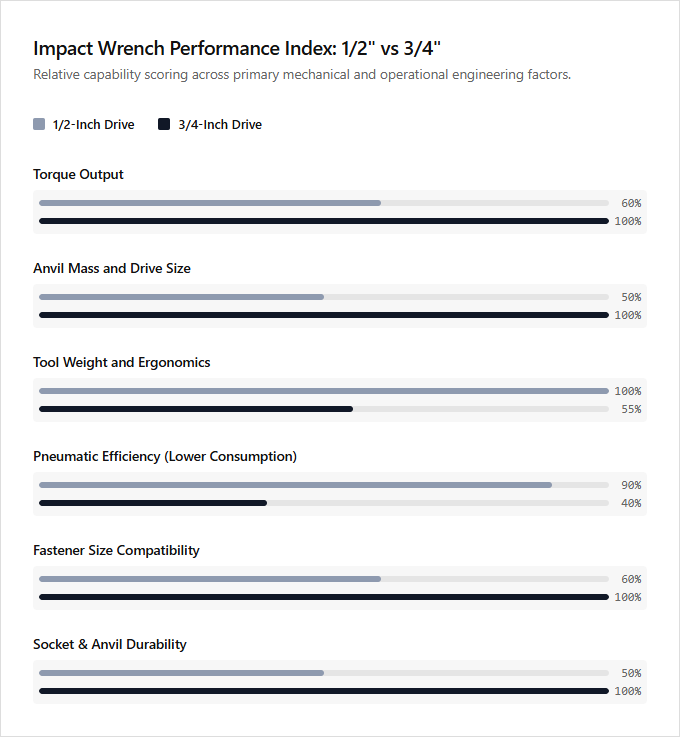
| Torque Output | While 1/2-inch impact wrenches typically max out around 1,000 ft-lbs of breakaway torque, 3/4-inch models deliver significantly higher fastening torque, often exceeding 1,500 ft-lbs for demanding applications. |
| Anvil Mass and Drive Size | The larger rotational inertia of a 3/4-inch square drive anvil prevents energy loss and resists shear stress much better than a standard 1/2-inch anvil under high-load conditions. |
| Tool Weight and Ergonomics | A 1/2-inch impact wrench offers a superior power-to-weight ratio for minimizing operator fatigue, whereas the heavier 3/4-inch housing is optimized for stability during high-torque reactions. |
| Pneumatic Consumption | Operating a 3/4-inch pneumatic impact wrench requires a much higher volumetric flow rate measured in cubic feet per minute (CFM) compared to the lower air consumption of a 1/2-inch tool. |
| Fastener Compatibility | The 1/2-inch drive is engineered for standard automotive lug nuts and medium-duty fasteners, whereas the 3/4-inch drive is designed for heavy industrial structural bolts and agricultural equipment. |
| Socket Durability | Using adapters to run large sockets on a 1/2-inch drive risks catastrophic shear failure of the anvil, whereas 3/4-inch impact sockets are engineered with thicker walls to withstand extreme torsional stress. |
Breakaway torque threshold limitations
Selecting between a 1/2-inch and a 3/4-inch impact wrench depends heavily on the breakaway torque required to loosen stubborn fasteners. A standard 1/2-inch impact wrench typically tops out around 1,000 to 1,400 foot-pounds of nut-busting torque. While highly versatile for standard applications, this threshold limits its effectiveness against heavily rusted, seized, or large-diameter bolts commonly found in heavy industrial machinery.
Upgrading to a 3/4-inch platform significantly raises the breakaway threshold, often delivering well over 2,000 foot-pounds of torque. The larger anvil and internal mechanism prevent energy loss during high-load impacts, ensuring stubborn fasteners yield without overheating the tool. The compact 1/2-inch model is ideal for automotive technicians handling daily light-to-medium repairs, whereas the high-torque 3/4-inch version is best suited for heavy equipment mechanics and industrial maintenance crews.
Rotational inertia and anvil mass energy transfer
The core performance difference between 1/2-inch and 3/4-inch impact wrenches lies in the physics of rotational inertia and anvil mass energy transfer. The larger 3/4-inch anvil possesses significantly greater mass, which yields higher rotational inertia once in motion. When the internal hammer strikes, this increased mass transfers substantially more kinetic energy to the fastener per blow, preventing energy loss during high-torque applications. Conversely, the lighter 1/2-inch anvil offers lower inertia, allowing for rapid acceleration and quicker run-down speeds on standard fasteners.
Choosing the correct drive size depends on the specific demands of your mechanical tasks and the torque thresholds required. Technicians working on passenger vehicles and light assembly benefit from the agility and sufficient power of the 1/2-inch model, while heavy equipment mechanics and industrial operators require the brute force and massive energy transfer of the 3/4-inch tool.
Torsional shear stress and drive anvil fatigue limits
The choice between a 1/2-inch and a 3/4-inch impact wrench centers on the physics of torque delivery. A 3/4-inch anvil possesses a significantly larger cross-sectional area, which drastically reduces the torsional shear stress experienced during high-torque applications. Because torsional stress is inversely proportional to the cube of the anvil diameter, the smaller 1/2-inch drive reaches its material fatigue limits much faster under repetitive, high-impact loads, making it more susceptible to fracturing over time.
The 1/2-inch drive offers an optimal power-to-weight ratio for standard fastening tasks where space is limited and torque demands are moderate. The larger 3/4-inch platform is engineered to withstand extreme cyclical fatigue during continuous, heavy-duty industrial operations. Automotive technicians and DIY hobbyists will find the highly maneuverable 1/2-inch wrench ideal for light-to-medium chassis work, whereas heavy equipment diesel mechanics and industrial millwrights require the robust fatigue limits of the 3/4-inch wrench for large-diameter fasteners.
Fastener thread diameter and impact socket compatibility range
The 1/2-inch impact wrench serves as the industry standard for medium-duty applications, typically handling fastener thread diameters from M10 to M20 (3/8 to 3/4 inches). This drive size is compatible with a vast range of impact sockets, generally spanning 8mm to 36mm, which offers an optimal balance of torque and maneuverability for general automotive chassis and suspension work.
For heavy-duty operations, the 3/4-inch impact wrench is engineered for larger fastener thread diameters, ranging from M18 to M30 (3/4 to 1-1/4 inches). Its compatible impact socket range typically extends from 19mm to over 50mm to deliver the high torque necessary for commercial fleet maintenance and industrial assembly. While automotive technicians and DIY enthusiasts favor the versatile 1/2-inch model for everyday repairs, industrial mechanics and heavy equipment operators require the robust power of the 3/4-inch variant for large-scale construction.
Cubic feet per minute pneumatic consumption rates
Pneumatic impact wrenches rely heavily on compressed air volume, measured in cubic feet per minute (CFM), to deliver torque. A standard 1/2-inch impact wrench typically requires between 4 to 5 CFM at 90 PSI under load. This lower consumption rate makes these tools highly compatible with smaller, portable air compressors commonly found in residential garages and light commercial workshops.
Heavy-duty 3/4-inch impact wrenches demand significantly more air volume, often requiring 7 to 10 CFM or more to reach their full torque potential. Operating these larger tools requires high-capacity commercial compressors with large receiver tanks to prevent rapid pressure drops during heavy fastening operations.
The highly maneuverable 1/2-inch model is ideal for automotive technicians and DIY enthusiasts performing general vehicle maintenance, while the robust 3/4-inch model is suited for heavy equipment mechanics and industrial operators servicing large-scale agricultural or commercial machinery.
Twin hammer impact mechanism energy delivery
The twin hammer impact mechanism relies on two symmetrical hammers striking the anvil simultaneously, delivering balanced, instantaneous torque. In a 1/2-inch impact wrench, this system is engineered for rapid energy delivery, producing a high frequency of lighter blows. This configuration maximizes speed and provides sufficient power for standard fastening tasks while minimizing vibration for the user.
In comparison, a 3/4-inch impact wrench scales up the mass of the twin hammers to deliver substantially higher kinetic energy per blow. This increased hammer weight generates the massive, concentrated torque necessary to break loose large, stubborn industrial fasteners. The versatile 1/2-inch tool is ideal for automotive technicians performing daily chassis work, whereas the heavy-duty 3/4-inch model is best suited for industrial maintenance crews and commercial fleet mechanics handling large-scale machinery.
Power-to-weight ratio and operator fatigue constraints
The 1/2-inch impact wrench offers an optimal power-to-weight ratio for standard fastening tasks. Weighing significantly less than its larger counterparts, this tool delivers substantial torque without placing excessive physical strain on the user. It minimizes operator fatigue during prolonged overhead work or inside tight automotive bays where maneuverability is essential.
In contrast, the 3/4-inch impact wrench yields vastly superior torque output at the expense of a much heavier chassis. This increased mass accelerates muscle fatigue, requiring greater physical stamina and careful handling during operation. The 1/2-inch model suits automotive technicians and assembly workers needing continuous, lightweight agility, whereas the heavy-duty 3/4-inch version is designed for industrial millwrights and heavy equipment mechanics tackling high-torque, intermittent fasteners.
Leave a comment