
Contractors and serious builders often struggle to balance the heavy-duty demands of structural construction with the physical constraints of tight workspaces, frequently risking project delays or hand fatigue by forcing the wrong tool into the job. While standard tool procurement typically relies on general equipment funding sources to invest in a single, multi-purpose system, this compromise often fails on the active job site.
Selecting the right pneumatic nailer grants your crew unmatched operational efficiency and precision. However, this advantage comes with the stipulation that users must recognize the strict operational boundaries of each tool design. For example, while a heavy-duty framing nailer excels at rapid-fire structural tasks like building wall frames, a compact palm nailer is indispensable for driving connector nails into tight, hard-to-reach joist hangers.
In this guide, we will compare palm and framing nailers across power, accessibility, and utility to help you make the optimal investment for your toolkit.
| Factor | Summary |
|---|---|
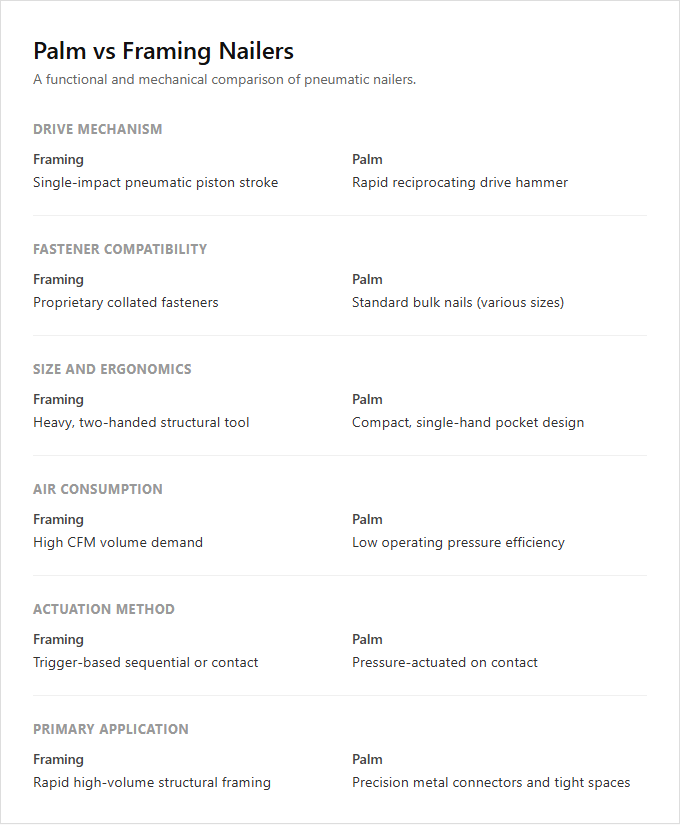
| Drive Mechanism | Framing nailers utilize a single-impact pneumatic piston stroke to instantly seat fasteners, whereas palm nailers rely on a rapid reciprocating drive hammer that repeatedly strikes the nail head. |
| Fastener Compatibility | While framing nailers require proprietary collated fasteners bound by paper, plastic, or wire, palm nailers offer the versatility of driving standard bulk nails of various lengths and gauges. |
| Size and Ergonomics | Framing nailers are heavy, two-handed tools optimized for high-volume structural framing, whereas palm nailers feature a compact, ergonomic design specifically engineered for tight clearances. |
| Air Consumption | Both tools operate pneumatically, but framing nailers demand a high CFM volume from the compressor, whereas palm nailers operate efficiently on much lower air pressure. |
| Actuation Method | Framing nailers employ trigger-based sequential or contact actuation modes for rapid firing, while palm nailers are pressure-actuated, initiating the driving cycle only when the tool is pressed directly against the fastener. |
| Primary Application | Framing nailers are ideal for rapid, mass-fastening tasks like house framing and decking, whereas palm nailers excel in precision installations of metal connector plates and joist hangers. |
Framing vs. Palm Nailers: Single Stroke vs. Rapid Impact
When selecting the appropriate fastening tool for construction or renovation, understanding the mechanical distinction between framing and palm nailers is essential. Framing nailers utilize a single, high-force piston stroke to instantly drive large fasteners into engineered lumber. In contrast, palm nailers rely on rapid pneumatic impact cycles, delivering continuous micro-blows to guide individual nails into place with greater control.
These differing mechanisms directly influence their application and physical footprint. Framing nailers deliver speed and efficiency on open job sites, while the compact palm nailer excels in confined joist bays and tight corners. Professional builders tackling structural house framing require the high-speed output of a framing nailer, whereas renovation contractors and DIYers find the maneuverability of a palm nailer ideal for detailed metal connector installation.
Framing vs. Palm Nailer Trigger Mechanisms
Framing nailers are engineered for heavy-duty structural construction, utilizing advanced selectable sequential actuation triggers. This mechanism allows operators to switch seamlessly between rapid bump firing for high-speed production and precise single-placement nailing for critical joints, ensuring optimal efficiency on the job site.
In contrast, palm nailers employ pressure-actuated guide sleeves that drive individual fasteners only when direct physical pressure is applied against the workpiece. This compact, hammer-free design allows users to install bulk nails in exceptionally tight joists, corners, and hard-to-reach areas where larger pneumatic tools cannot fit.
Professional framing contractors requiring high-volume structural assembly benefit most from robust framing nailers, whereas finish carpenters and DIYers tackling tight-space retrofits find palm nailers indispensable.
Framing vs. Palm Nailers: Collated vs. Loose Fasteners
Framing nailers and palm nailers serve distinct roles in construction, primarily distinguished by their fastener compatibility. Framing nailers are high-speed tools designed for rapid deployment. They require specialized, collated strip nails held together by paper or plastic, allowing for continuous firing during major structural tasks.
Palm nailers offer a compact, highly adaptable alternative. These tools accept standard, loose bulk fasteners, eliminating the need for expensive collated ammunition. Users simply place a single loose nail into the magnetic guide and let the pneumatic action drive it home. Framing nailers are ideal for professional contractors undertaking large-scale structural construction, whereas palm nailers are best suited for DIY enthusiasts and carpenters requiring precision in tight, hard-to-reach spaces.
Palm vs. Framing Nailers for Tight Spaces
When selecting fastening equipment for structural carpentry, spatial constraints dictate the choice between palm nailers and traditional framing nailers. Palm nailers excel in confined areas, providing optimal spatial clearance within tight joist bays, under stairs, and inside pre-existing framing where larger pneumatic tools physically cannot fit.
Framing nailers are engineered for rapid, high-volume assembly but demand substantial operational clearance. Their bulky bodies, coupled with a protruding 21-degree or 30-degree magazine angle, require significant physical space to position the tool nose accurately against the workpiece.
Palm nailers are ideal for remodelers tackling retrofits and tight joist hangers, while framing nailers are best suited for production carpenters executing large-scale, open-concept home construction.
Framing vs. Palm Nailers: Air Consumption Differences
When selecting pneumatic fastening tools, understanding the air consumption difference between framing nailers and palm nailers is critical for optimal compressor pairing. Framing nailers demand high instantaneous SCFM per shot, requiring a rapid, high-volume burst of air to sink large fasteners instantly into structural lumber. This high-demand pattern necessitates a compressor with sufficient tank storage to maintain standard operating pressure during successive firings.
Palm nailers operate with lower but continuous air consumption at standard operating PSI, utilizing a rapid-hammering action to drive nails gradually. Professional contractors engaged in heavy timber construction rely on the speed of framing nailers, while DIY enthusiasts and specialty installers working in tight joist spaces benefit most from the maneuverable palm nailer.
Framing Nailers vs. Palm Nailers: Best Uses
Framing nailers and palm nailers serve distinct roles in modern timber construction. Framing nailers excel in high-velocity structural shear wall framing, rapidly driving large fasteners into heavy lumber to secure structural sheathing. Their high-capacity magazines and powerful pneumatic or cordless driving force are engineered for speed, making them indispensable for erecting the primary skeletal framework of a building.
In contrast, palm nailers are optimized for metal connector plate installation, particularly in confined joist bays and tight corners. By utilizing rapid micro-blows rather than a single massive strike, these compact tools allow operators to guide individual fasteners precisely into pre-punched metal connector holes without damaging the hardware.
Professional framing contractors require the high-volume speed of framing nailers for rapid house construction, whereas residential renovators and joist installers utilize palm nailers for precise retrofitting in restricted spaces.
Tool-Free vs. Manual Depth Control in Nailers
When selecting the appropriate fastening tool, understanding the operational differences between framing nailers and palm nailers is essential. Framing nailers utilize tool-free depth of drive adjustment mechanisms, allowing operators to quickly preset precise penetration depths for consistent, high-volume output. In contrast, palm nailers rely on manual pressure for flush countersinking, requiring the operator to physically guide the tool and feel when the fastener is fully seated.
These distinct drive mechanisms dictate the ideal application and user profile for each tool. Framing nailers are ideal for professional contractors executing rapid, large-scale structural builds, whereas palm nailers are best suited for remodelers and DIYers who frequently work in tight, hard-to-reach spaces where maneuverability is paramount.
Leave a comment