
Selecting the wrong nailer actuation mode often leads to ruined workpieces, wasted fasteners, and compromised job site safety-a frustrating reality for many professional contractors. While acquiring high-quality pneumatic tools through standard equipment funding sources ensures your crew has capable hardware on hand, physical ownership is only the first step. Mastering these specific firing mechanisms grants operators the precise control needed to optimize both production speed and craftsmanship.
However, this operational efficiency comes with a critical stipulation: rapid speed must never supersede safety guidelines, as contact trip modes inherently increase accidental discharge risks. For example, while framing crews utilizing Bostitch nailers rely on rapid bump firing for high-volume roof decking, custom furniture makers strictly employ single-fire sequential actuation to prevent delicate timber split-outs.
This article will analyze the mechanical differences between sequential and contact triggers, compare their efficiency rates, and outline safety protocols to help you choose the optimal actuation mode for your specific applications.
| Factor | Summary |
|---|---|
| Actuation Mechanism | Single fire requires the safety contact trip to be depressed before the trigger is pulled for each shot, whereas bump fire allows the trigger to be held down continuously to actuate the nailer upon surface contact. |
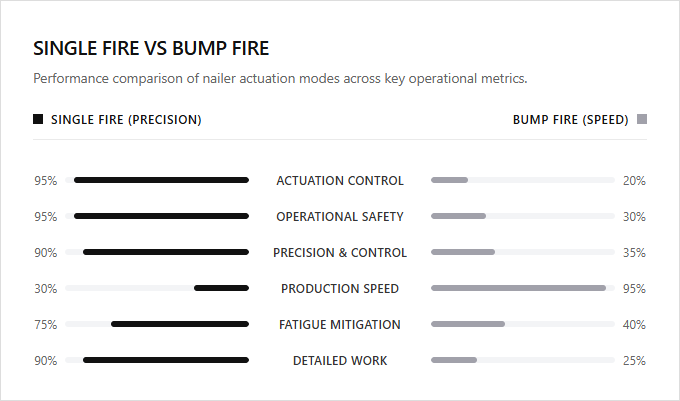
| Operational Safety | Single fire mode drastically reduces the risk of accidental discharge and dangerous double-firing, making it the safer choice for novice operators. |
| Precision and Control | Single fire provides superior accuracy for exact fastener placement and consistent countersink depth during delicate trim and finish carpentry. |
| Production Speed | Bump fire maximizes the tool's duty cycle by enabling rapid-fire fastening, which is highly efficient for high-volume sheathing and decking applications. |
| User Fatigue | Bump fire can accelerate operator fatigue due to the repetitive recoil forces of rapid, continuous actuation against the workpiece. |
| Application Suitability | Single fire is the industry standard for structural framing and cabinetry, while bump fire is preferred for high-speed roof decking and subflooring installations. |
Single Sequential Actuation: Maximizing Safety and Accuracy
When selecting a power nailer, understanding the functional differences between single fire and bump fire actuation is critical for project success. Single sequential actuation ensures maximum user safety and fastener placement accuracy by requiring a specific mechanical sequence: the safety contact element must be fully depressed against the workpiece before the trigger is pulled for each individual drive. This deliberate process prevents accidental double-fires and allows for meticulous control over nail depth and positioning.
In contrast, bump fire actuation allows operators to hold the trigger down continuously and discharge fasteners rapidly each time the tool's nose bumps the work surface. Fine woodworkers and finish carpenters prioritize the safety and precision of the single-fire mode, whereas high-volume framing and roofing contractors require the speed and efficiency of the bump-fire system.
Contact Trip Actuation Speeds Up Framing and Decking
In production-grade construction, choosing the correct actuation mode on a nailer directly impacts project efficiency and safety. Bump fire, or contact trip actuation, maximizes duty cycle speed during high-volume framing and decking applications. By allowing the operator to keep the trigger depressed and drive nails instantly upon contacting the work surface, this mode significantly accelerates rapid-fire fastening.
Conversely, single fire, or sequential actuation, requires releasing and depressing the trigger for each individual shot to ensure precise placement. This method eliminates the risk of accidental double-firing, making it the industry standard for detailed carpentry. Single fire is ideal for precision finish carpenters seeking absolute control, while bump fire is best suited for experienced framing crews prioritizing high-speed production.
Unintended Double-Firing in Bump Fire Mode
Selecting the appropriate actuation mode for a power nailer depends on balancing speed with precision. Bump fire mode maximizes efficiency by discharging a nail every time the safety contact nose presses against the work surface while the trigger is held. This rapid operation introduces a common challenge: the physical recoil of the tool combined with a brief delay in operator reaction can cause the safety nose to bounce and strike the wood a second time, resulting in an unintended double-fire.
Single fire mode eliminates this hazard by requiring the operator to release and depress the trigger for each individual cycle, ensuring maximum placement control. Single-fire actuation is ideal for detail-oriented trim carpenters requiring meticulous accuracy, whereas bump firing is best suited for high-volume framing contractors prioritizing rapid production rates.
Depress Contact Element to Disengage Safety
When comparing single-fire and bump-fire modes on a power nailer, understanding the safety mechanics is paramount. In both firing profiles, the work contact element must be fully depressed against the workpiece to disengage the safety mechanism and allow actuation. This critical requirement prevents accidental discharge in mid-air, ensuring high safety standards regardless of the mode selected.
The primary difference lies in the trigger sequence: single-fire requires a deliberate trigger pull for each nail, while bump-fire allows rapid firing by holding the trigger and bouncing the contact element. Single-fire is best suited for detail-oriented carpenters requiring precise placement, whereas bump-fire is ideal for high-volume framing contractors prioritizing speed.
Single-Fire Mode Protects Delicate Trim and Cabinetry
Nail gun operating modes-specifically single-fire and bump-fire-fundamentally dictate a tool's precision and speed. Single-fire, or sequential mode, requires the operator to depress the safety contact trip before pulling the trigger for each individual drive. This deliberate firing method is critical for precision trim work and delicate cabinetry, as it eliminates double-firing and prevents the tool's nosepiece from bouncing and marring the finished wood surface.
Conversely, bump-fire mode allows high-speed fastening by holding the trigger depressed and driving a nail each time the nosepiece contacts the material. While highly efficient for framing and sheathing, this method lacks the exact placement required for fine carpentry. Single-fire operation is best suited for detail-oriented finish carpenters demanding flawless accuracy, whereas bump-fire is designed for high-production framers prioritizing rapid installation.
Selectable Trigger for On-the-Fly Firing Modes
Modern pneumatic and cordless nailers often feature a selectable trigger switch, allowing operators to toggle between restrictive and non-restrictive firing modes on the fly. This mechanical integration enhances job site efficiency by eliminating the need for tool disassembly or trigger replacements when switching tasks. Users can transition instantly from high-precision placement to rapid-velocity fastening, optimizing the tool's performance for the specific application at hand.
Single-fire mode requires a sequential sequence of depressing the safety nose before pulling the trigger to ensure maximum placement accuracy. In contrast, bump-fire mode permits continuous driving by keeping the trigger depressed and bouncing the safety contact against the work surface. Single-fire is ideal for detail-oriented carpenters performing trim work, while bump-fire is best suited for high-volume production workers framing or decking.
Rapid Bump Firing Demands Higher CFM
Selecting between single fire and bump fire actuation modes dictates both the speed and safety of a nailer. Single fire, or sequential trigger operation, requires the safety nose piece to be depressed before pulling the trigger for each individual nail, ensuring maximum placement accuracy. Conversely, bump fire allows the user to hold the trigger down and drive nails continuously by bouncing the safety utility against the work surface.
This rapid bump firing action drastically increases pneumatic consumption rates. Delivering multiple fasteners in quick succession depletes the air reservoir rapidly, requiring a compressor with a significantly higher Cubic Feet per Minute (CFM) output to maintain consistent driving depth. Single fire operation utilizes air much more conservatively due to the pauses between shots.
Single fire is ideal for detail-oriented trim carpenters and woodworkers who prioritize precise placement and safety, while bump fire is best suited for high-volume framing and roofing contractors who value production speed over exactness.
Leave a comment