
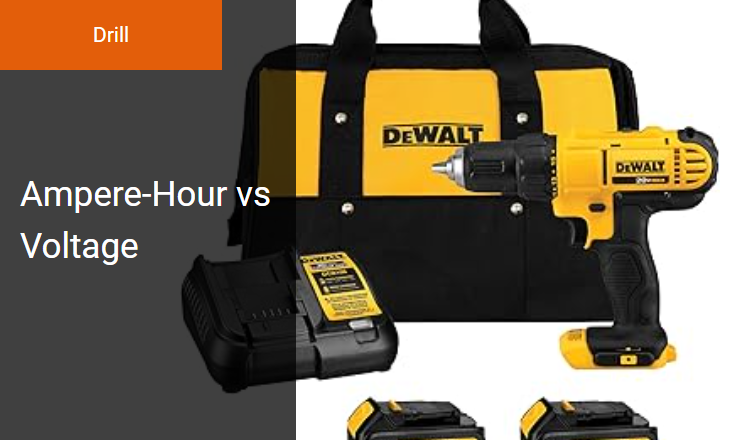
Selecting the right cordless drill often leaves professionals caught in a frustrating trade-off between raw motor power and sustained runtime, frequently leading to costly tooling errors. Traditionally, procurement managers rely on standard equipment funding sources and baseline manufacturer specs to guide their purchasing, assuming that higher voltage alone resolves all operational deficits.
However, mastering the precise interplay between Ampere-Hours (Ah) and Voltage (V) grants operators the ability to optimize tool weight, minimize daily downtime, and significantly extend overall battery lifecycles. To establish a proper baseline, we must stipulate that capacity and torque are distinct electrical properties that must be balanced rather than scaled independently.
For instance, deploying a high-voltage 20V drill with a meager 1.5Ah battery for continuous timber driving will quickly stall productivity, whereas a balanced 18V platform paired with a 5.0Ah battery offers the ideal industrial duty cycle.
In the following sections, we will deconstruct the science of Ah versus Voltage, compare real-world performance metrics, and provide a definitive framework for selecting your optimal battery configuration.
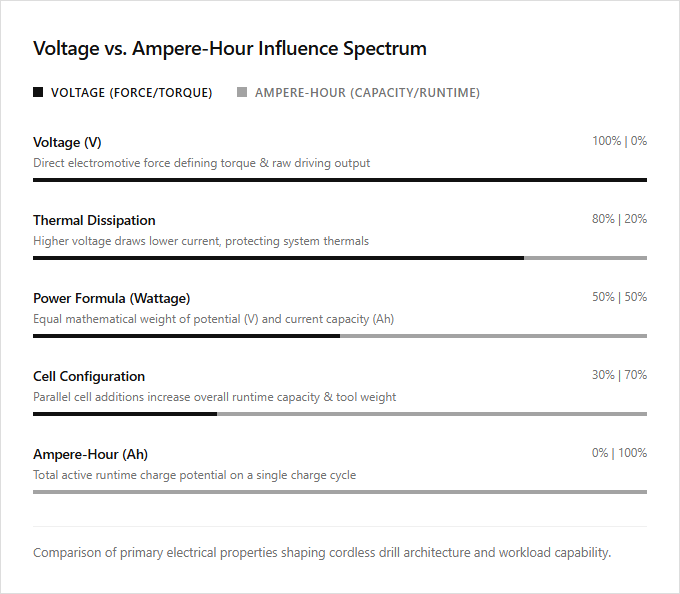
| Factor | Summary |
|---|---|
| Voltage (V) | Voltage represents the electromotive force that determines the drill's torque and overall power output for driving fasteners into tough materials. |
| Ampere-Hour (Ah) | Ampere-hour measures the battery's charge capacity, which directly dictates the runtime of the power tool on a single charge. |
| Power Formula (Wattage) | The absolute power of the drill is calculated as wattage, which is the mathematical product of voltage and amperage. |
| Cell Configuration | Increasing the ampere-hour rating requires adding more lithium-ion cells in parallel, which increases the energy density but also adds weight to the tool. |
| Thermal Dissipation | Higher voltage platforms draw less current to achieve the same work, reducing thermal dissipation and extending the lifespan of the brushless motor. |
Nominal voltage determines maximum electromotive force and motor torque
When selecting cordless drill power tools, understanding the distinction between voltage and ampere-hour (Ah) ratings is essential for optimal performance. Nominal voltage represents the electrical pressure of the battery, which directly determines the tool's maximum electromotive force and motor torque. Higher voltage systems deliver the raw power and turning force required to penetrate dense materials and drive large fasteners efficiently.
Conversely, the ampere-hour rating measures the battery's energy capacity, dictating how long the tool can operate under load before requiring a recharge. High-voltage, high-Ah drills are ideal for heavy-duty commercial contractors requiring sustained, high-torque performance on job sites, whereas compact, lower-voltage drills are best suited for technicians and DIY enthusiasts prioritizing lightweight ergonomics for precision assembly work.
Ampere-Hour Rating: Key to Capacity and Runtime
When selecting cordless drill power tools, understanding the distinction between voltage and ampere-hour (Ah) ratings is essential for optimizing job site performance. Voltage represents the tool's raw power and torque capability, determining the intensity of applications the motor can drive. In contrast, the ampere-hour rating directly correlates to the battery's charge capacity and total runtime, serving as the fuel tank that dictates how long the tool can operate under load before requiring a recharge.
Balancing these two specifications allows users to tailor their equipment to specific task demands. Lightweight, lower-voltage drills with compact Ah batteries are ideal for casual DIY homeowners performing quick, occasional household maintenance, whereas high-voltage, high-Ah systems are designed for professional contractors requiring sustained power and extended runtimes for heavy-duty construction work.
Calculating Watt-Hours: Voltage Times Ampere-Hours
When evaluating cordless drill performance, understanding the relationship between voltage and ampere-hours (Ah) is essential. Voltage determines the tool's maximum power and torque capability, while ampere-hours measure the battery charge capacity. To find the true total energy capacity of a battery pack, calculate the Watt-hours (Wh) by multiplying the nominal voltage by the ampere-hours. This calculation provides an objective metric to compare runtime and work output across different battery platforms.
Different combinations of voltage and capacity serve distinct operational needs. High-voltage drills deliver the force required for demanding applications, whereas high-ampere-hour batteries sustain prolonged operation under moderate loads. Professional contractors tackling heavy-duty masonry require high-voltage platforms, while cabinet installers and DIY hobbyists benefit more from lightweight, high-ampere-hour compact systems.
How Cell Configuration Balances Li-Ion Voltage and Current
In cordless drill batteries, the relationship between voltage and ampere-hours is determined by the internal configuration of the lithium-ion cells. Wiring cells in series multiplies the total voltage, which directly increases the motor's torque and speed for demanding tasks. Conversely, placing cells in parallel increases the overall capacity, measured in ampere-hours, allowing the tool to run longer under a sustained workload.
Achieving the optimal balance between these two metrics depends on the specific power and runtime requirements of the application. High-voltage systems excel in high-resistance drilling, whereas high-ampere-hour packs sustain prolonged, repetitive tasks without frequent recharging. High-voltage setups are ideal for heavy-duty contractors requiring maximum torque for masonry or timber, while high-ampere-hour configurations suit assembly technicians who prioritize continuous, uninterrupted runtime throughout the workday.
How Internal Resistance Reduces Torque Under High Current
In cordless drill performance, the relationship between voltage and Ampere-hour (Ah) ratings dictates both peak power and sustained efficiency. While voltage determines the motor's baseline potential, high current demands during heavy applications test the battery's internal limits. Under intense loads, internal resistance within the battery pack causes voltage sag, directly reducing the operational torque delivered to the chuck. Packs with higher Ah ratings typically utilize parallel cell configurations that lower this internal resistance, preserving torque during demanding tasks.
Selecting the optimal configuration depends entirely on the specific application and operator needs. High-voltage, high-Ah systems are engineered for industrial contractors requiring sustained maximum torque for heavy-duty drilling, whereas compact, lower-voltage setups suit technicians who prioritize ergonomics and maneuverability for overhead installations.
Discharge Rate: Key to Preventing Thermal Runaway
In cordless drill performance, voltage dictates the motor's torque potential, while Ampere-Hour (Ah) measures overall battery capacity. Crucially, the continuous discharge rate of the battery pack determines the maximum current delivery the system can sustain without causing thermal runaway. While high voltage provides the raw force needed for demanding applications, a high continuous discharge rate ensures this power is delivered safely and consistently under heavy, prolonged loads.
Balancing these two specifications is essential for optimizing tool longevity and operational safety during intense tasks. High-voltage drills are ideal for heavy-duty construction professionals demanding maximum torque for masonry and structural boring, whereas high Ampere-hour models suit woodworkers and assembly technicians requiring extended runtimes for repetitive fastening.
Voltage-Dependent Torque in Brushless DC Motors
In battery-powered drills, voltage and ampere-hour (Ah) ratings dictate distinct aspects of tool performance. Voltage directly governs the motor's power output and rotational force. Notably, electromagnetic torque production in brushless DC motors is heavily dependent on voltage input, as higher voltage increases the current flow through the stator windings, strengthening the electromagnetic field to overcome high resistance.
In contrast, the ampere-hour rating defines the battery's fuel tank capacity, determining overall runtime rather than raw power. High-voltage platforms are suited for heavy-duty contractors tackling dense timber or masonry, while high-ampere-hour, lower-voltage drills are ideal for bench assembly technicians and maintenance personnel who require prolonged, lightweight operation.
Leave a comment