
Mechanics and assembly technicians frequently struggle with the frustrating trade-off between rapid fastener rundown and the raw power required to break seized bolts in confined spaces. Traditionally, facilities relied on cumbersome pneumatic lines or manual hand ratchets to navigate these tight clearance zones, though these legacy options often compromise both ergonomics and output. Transitioning to cordless battery platforms resolves these operational bottlenecks, granting operators unmatched mobility and a significant reduction in physical strain.
However, a critical engineering stipulation must be addressed: no single cordless tool can maximize both rotational velocity and peak fastening force simultaneously. For instance, high-volume automotive interior assembly demands swift, low-torque operations, whereas heavy-duty suspension maintenance requires massive breakaway torque.
To guide your tooling investments, this article examines the essential distinctions between high-speed and high-torque cordless ratchet wrenches, outlining how to match tool performance profiles to your specific fastening workflows for optimal efficiency.
| Factor | Summary |
|---|---|
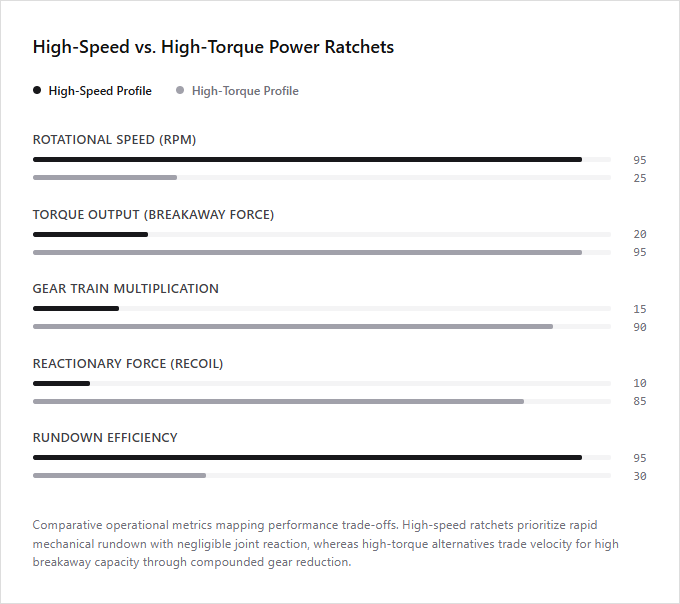
| Rotational Speed | High-speed power ratchets deliver elevated RPM to rapidly run down loose fasteners, whereas high-torque models operate at a lower velocity to prioritize raw turning force. |
| Torque Output | High-torque ratchets utilize robust internal gearing to generate substantial breakaway torque for loosening stubborn or rusted bolts, while high-speed variants lack the force required for heavy-duty fastening tasks. |
| Gear Train Design | High-torque models feature a reinforced epicyclic gear train to multiply mechanical advantage, whereas high-speed models employ simplified gear ratios to maximize spindle velocity. |
| Reactionary Force | Users of high-torque power ratchets experience significant recoil force upon fastener seat, necessitating a firm grip to prevent wrist strain, unlike the negligible kickback of high-speed models. |
| Primary Application | High-speed ratchets excel in high-volume assembly requiring rapid fastener rundown, while high-torque counterparts are preferred for heavy mechanical maintenance where structural yield strength must be overcome. |
| Motor Efficiency | Modern high-torque cordless ratchets leverage brushless DC motors to optimize thermal dissipation and sustain torque density under heavy mechanical loads. |
High RPM Optimizes Thread Engagement and Run-Down
When selecting a cordless power ratchet, the choice between high-speed and high-torque models determines overall workflow efficiency. High-speed power ratchets prioritize maximum RPM, which significantly optimizes initial thread engagement and accelerates fastener run-down speed. This rapid rotation allows operators to quickly spin long fasteners into place, minimizing the time spent on low-resistance driving tasks.
In contrast, high-torque power ratchets focus on sheer rotational force to break loose stubborn, rusted, or highly tensioned fasteners. While these models operate at a lower RPM, they eliminate the need for manual hand-breaking of tight bolts. High-speed ratchets are ideal for assembly line workers and electronics installers requiring rapid repetition, whereas high-torque models suit automotive technicians and industrial mechanics managing heavy-duty machinery.
How High Breakaway Torque Conquers Seized Fasteners
When selecting a cordless power ratchet, professionals must weigh the operational trade-offs between high-speed and high-torque models. For heavy-duty applications, high-torque ratchets are indispensable. Superior breakaway torque, measured in Newton-meters (Nm), is critical for overcoming rusted or seized fasteners that would stall lesser tools. These high-torque options deliver the raw mechanical force required to break loose stubborn bolts without requiring manual assistance.
High-speed power ratchets prioritize rapid fastening rates, measured in revolutions per minute (RPM), making them ideal for assembly tasks with pre-threaded, free-spinning fasteners. While they lack the brute force to dislodge corroded components, they significantly reduce cycle times in high-volume environments. High-speed models suit assembly-line technicians and electronics installers requiring rapid throughput, whereas high-torque models are designed for automotive mechanics and industrial millwrights regularly tackling seized fasteners on heavy machinery.
Efficient, Cool-Running High-Torque Brushless Motors
When selecting a power ratchet, professionals must evaluate the trade-offs between high-speed and high-torque configurations. Modern cordless ratchets rely heavily on brushless motor technology to optimize these performance profiles. By eliminating mechanical brushes, this technology maximizes energy efficiency and enhances heat dissipation under sustained high-torque loads, preventing thermal degradation during intensive fastening applications.
High-speed ratchets prioritize rapid fastening cycles, whereas high-torque models focus on delivering substantial breakaway force for stubborn fasteners. High-speed units are ideal for assembly line technicians and interior automotive installers, while high-torque models are best suited for diesel mechanics and industrial millwrights managing heavy-duty machinery.
Planetary Gear Ratio: Balancing Speed and Torque
When selecting a cordless power ratchet, the primary performance distinction lies within the configuration of the tool's planetary gearbox. The internal gear ratio of the planetary gearbox determines the trade-off between rotational velocity and twisting force. High-speed ratchets utilize lower gear reduction ratios to maximize revolutions per minute, which facilitates the rapid rundown or extraction of loose fasteners.
In contrast, high-torque configurations employ higher gear reduction ratios to multiply motor output, delivering substantial breakaway and tightening force at the expense of rotational speed. Assembly line workers requiring rapid, low-resistance fastening benefit most from high-speed models, whereas diesel mechanics and heavy-duty technicians demanding maximum breakaway power to crack stubborn bolts are best served by high-torque variants.
How Battery Specs Dictate Tool Torque and Runtime
High-speed and high-torque power ratchets serve distinct mechanical functions, with their performance capabilities heavily governed by battery specifications. The battery voltage and Amp-hour (Ah) ratings directly dictate the tool's maximum torque output and runtime. Higher voltage platforms provide the electrical pressure necessary to sustain maximum twisting force under load, while elevated Amp-hour ratings ensure prolonged runtime and consistent power delivery during extended use.
Selecting the appropriate tool depends on the specific demands of the task. High-speed ratchets excel at rapid fastener rundown, whereas high-torque models deliver the raw muscle needed to break free stubborn fasteners. High-speed units are ideal for precision assembly technicians prioritizing rapid turnaround, while high-torque models are best suited for automotive mechanics routinely managing heavy-duty chassis and engine bolts.
Prevent Stripping and Over-Torqueing with Variable-Speed Triggers
When selecting a power ratchet, the choice between high-speed and high-torque configurations depends on the specific demands of the task. High-speed models prioritize rapid fastener rundown, whereas high-torque variants provide the mechanical leverage necessary to break stubborn bolts loose. To manage these forces, manufacturers equip both styles with variable-speed triggers. These triggers allow operators to precisely regulate kinetic energy, preventing the common pitfalls of fastener stripping, cross-threading, and over-torqueing delicate assemblies.
Maintaining control over tool velocity ensures that tasks are completed efficiently without compromising material integrity. High-speed ratchets are ideal for automotive interior specialists and assembly line workers requiring rapid, repetitive fastening, whereas high-torque models are best suited for heavy machinery mechanics and industrial technicians managing high-load structural fasteners.
Manage Duty Cycle to Prevent Stator Overheating
When selecting between high-speed and high-torque cordless ratchets, understanding thermal management is critical. High-speed models excel at rapid fastener rundown but can quickly encounter resistance, while high-torque variations deliver the brute force necessary to break stubborn fasteners. During continuous high-load fastening, both configurations generate significant internal heat. Operators must carefully manage duty cycle limits to prevent stator overheating and subsequent motor insulation failure.
Allowing the tool sufficient cooling periods between heavy cycles preserves the integrity of the electromagnetic windings and extends overall tool life. High-speed ratchets are ideal for assembly technicians requiring rapid throughput on low-tolerance fasteners, whereas high-torque models are best suited for heavy machinery mechanics frequently confronting seized or high-resistance bolts.
Leave a comment