
Achieving precise torque in cramped engine bays is a constant struggle for technicians, where a single over-rotated turn can shear a bolt or strip delicate threads. To mitigate this risk, professionals traditionally rely on manual hand ratchets or standard pneumatic lines to maintain physical control. However, modern cordless advancements bridge this gap; choosing the right actuation mechanism grants operators the precise throttle command needed to mimic manual feedback at assembly-line speeds. As a baseline stipulation, users must recognize that trigger sensitivity cannot override the physical torque limits of the tool itself.
In precision environments-such as servicing aluminum threads with a Milwaukee M12 FUEL cordless ratchet-the debate centers on ergonomics and feathering. This guide compares paddle triggers and variable-speed triggers, analyzing their design mechanics, user control, and ideal applications to help you choose the optimal fastening interface.
| Factor | Summary |
|---|---|
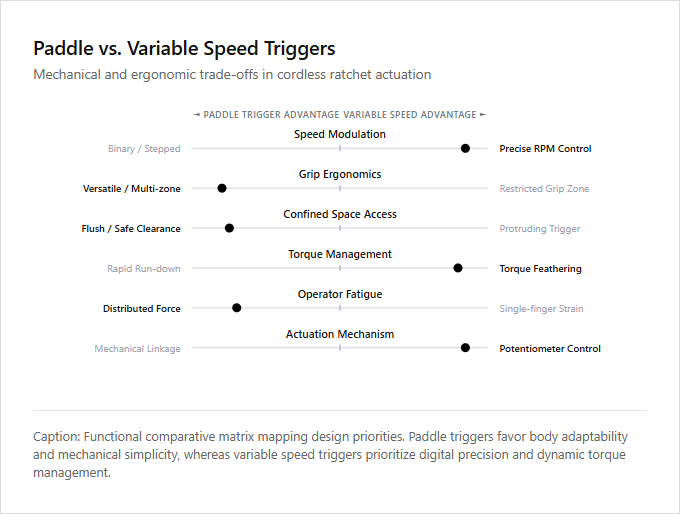
| Speed Modulation | Variable speed triggers allow the operator to precisely modulate the motor's RPM based on finger pressure, whereas paddle triggers typically offer more limited, stepped speed control or simple binary actuation. |
| Grip Ergonomics | Paddle triggers facilitate versatile hand placement along the tool body, whereas variable speed triggers restrict the operator to a designated grip zone to maintain access to the trigger mechanism. |
| Confined Space Access | The flush, low-profile design of a paddle trigger reduces the risk of accidental tool activation in tight automotive clearances compared to a protruding variable speed trigger. |
| Torque Management | Variable speed triggers enable precise torque feathering to prevent fastener cross-threading, while paddle triggers are optimized for rapid, high-torque fastening tasks. |
| Operator Fatigue | Paddle triggers distribute the actuation force across the palm or multiple fingers to mitigate repetitive strain injury during high-frequency assembly cycles. |
| Actuation Mechanism | Variable speed triggers rely on potentiometer-based electronics to translate physical displacement into voltage variance, whereas paddle triggers often utilize a simpler mechanical linkage to engage the internal microswitch. |
Progressive Speed Modulation Prevents Cross-Threading
When selecting a cordless power ratchet, the trigger mechanism directly dictates fastening precision and control. Variable speed triggers employ progressive speed modulation, allowing operators to initiate rotation at extremely low RPMs. This controlled, incremental startup is essential during initial fastener engagement, as it prevents cross-threading and ensures threads align perfectly before the tool applies maximum torque.
Conversely, paddle triggers typically deliver immediate, rapid engagement, prioritizing speed in open workspaces where delicate hand-starting is less of a concern. High-precision technicians and automotive mechanics who frequently handle delicate aluminum threads prefer variable speed triggers, whereas industrial assemblers requiring rapid, repetitive rundown in spacious areas are better suited for paddle trigger models.
Multi-Grip Actuation via Extended Paddle Triggers
Paddle trigger cordless ratchets are engineered for maximum accessibility in confined automotive and industrial environments. These components leverage an extended contact profile to facilitate actuation from multiple grip orientations along the tool chassis. This ergonomic design allows operators to engage the power tool effortlessly, even when reaching deep into engine bays or behind structural obstacles where a standard hand position is restricted.
In contrast, traditional variable speed triggers offer precise rotational velocity control, allowing operators to modulate torque and RPM incrementally through targeted finger pressure. Paddle triggers are ideal for heavy-duty automotive mechanics requiring rapid, flexible tool activation from awkward angles, while standard variable speed triggers suit precision assembly technicians who demand meticulous fastener control.
How Variable Speed Triggers Control RPM
In professional fastening applications, selecting the appropriate actuation mechanism for a cordless ratchet wrench significantly impacts operational efficiency and control. Traditional paddle triggers offer robust, immediate engagement, which is excellent for rapid, high-torque run-downs. In contrast, variable speed trigger ratchets incorporate sophisticated internal electronics to deliver nuanced power. These systems utilize integrated potentiometers to convert analog finger pressure into precise RPM adjustments, allowing operators to modulate rotational speed dynamically based on real-time tactile feedback.
This technological distinction dictates the tool's effectiveness across various mechanical environments. Paddle triggers are best suited for heavy-duty automotive technicians requiring swift, repetitive fastener removal, while variable speed models are ideal for precision assembly specialists who need delicate torque control to prevent cross-threading delicate materials.
Integrated Paddle Trigger Lockouts Prevent Accidental Activation
When selecting a power ratchet wrench, the choice of trigger design significantly influences both safety and operational control. Paddle triggers are particularly advantageous in confined automotive or industrial environments where accidental activation is a constant risk. Because of their elongated profile, mechanical safety lockout mechanisms are more seamlessly integrated into paddle designs, requiring a deliberate dual-action press to engage the tool and preventing accidental starts when bumped against tight engine components.
Conversely, variable speed triggers offer precise RPM modulation directly through finger pressure, allowing for greater control over delicate fastening tasks. Heavy-duty mechanics working in dense, hazardous spaces are best suited for the safety-first design of paddle triggers, while precision assembly technicians requiring meticulous torque control will find variable speed triggers more appropriate for their workflow.
Feathering Triggers Enhance Final Torque Control
When selecting a cordless power ratchet, the choice of trigger mechanism directly impacts fastening efficiency and precision. Paddle triggers offer rapid, broad-surface engagement that is highly effective for quickly running down fasteners in restricted engine bays. Conversely, variable speed triggers provide progressive power delivery, allowing operators to carefully modulate the tool's RPM throughout the fastening process.
Fine torque development control is significantly enhanced by the feathering capability of variable speed triggers during the final seating phase. This incremental power adjustment prevents fastener over-tightening and minimizes the risk of stripping delicate threads. In contrast, the binary nature of a standard paddle trigger demands highly seasoned physical feedback to avoid sudden torque spikes.
Paddle triggers are best suited for high-volume industrial assembly workers prioritizing rapid run-down speeds, while variable speed triggers are ideal for precision automotive technicians performing delicate engine and electronic component installations.
Paddle Triggers Reduce Hand Strain by Distributing Force
Selecting the appropriate actuation mechanism for a power ratchet wrench directly impacts both operator comfort and tool control. Paddle triggers minimize musculoskeletal strain by distributing actuation force across the operator's entire hand rather than concentrating pressure on a single digit. This ergonomic design reduces localized fatigue during prolonged use, making it highly effective for high-frequency assembly environments.
Variable speed triggers, typically operated by the index finger, offer precise rotational control to prevent over-tightening. This design allows technicians to modulate torque output dynamically throughout the fastening cycle. Paddle triggers are ideal for high-volume assembly line workers requiring ergonomic relief, while variable speed triggers suit automotive diagnostics technicians who demand precise speed modulation for sensitive components.
Variable Speed Triggers Optimize Tool Duty Cycle Efficiency
When selecting a cordless ratchet wrench, the trigger mechanism significantly influences both operational control and tool longevity. Variable speed trigger assemblies offer superior duty cycle efficiency by utilizing precise electronic throttle control. This advanced regulation manages current flow to the motor, minimizing energy waste and heat generation during prolonged fastening tasks.
In contrast, paddle triggers provide straightforward, rapid engagement that is highly effective for high-repetition tasks where modulated speed is secondary. Paddle triggers are ideal for high-volume assembly line workers requiring quick, repetitive actuation, whereas variable speed triggers are best suited for precision mechanics who demand exact torque control when handling delicate fasteners.
Leave a comment