
For professional metalworking shops, choosing between the uninterrupted runtime of corded units and the untethered mobility of cordless models remains a persistent challenge that directly impacts daily productivity. While procurement departments traditionally rely on standard equipment financing or annual capital allocation budgets to fund fleet upgrades, selecting the wrong power platform can quietly erode these investments through lost labor efficiency. Fortunately, aligning your tool selection with specific workflow demands grants your team unmatched operational throughput and significantly reduced operator fatigue.
To manage expectations, one vital stipulation must be understood: neither technology serves as a universal solution. For example, continuous heavy-duty beveling of structural steel plates demands corded endurance, whereas rapid, high-altitude weld-prep on field installations requires cordless agility. Below, we analyze power consistency, battery duty cycles, and lifetime cost-per-hour metrics to help you select the ideal angle grinder for your specific industrial application.
| Factor | Summary |
|---|---|
| Power Source | Corded grinders draw continuous alternating current (AC) from electrical outlets, whereas cordless models rely on direct current (DC) powered by rechargeable lithium-ion batteries. |
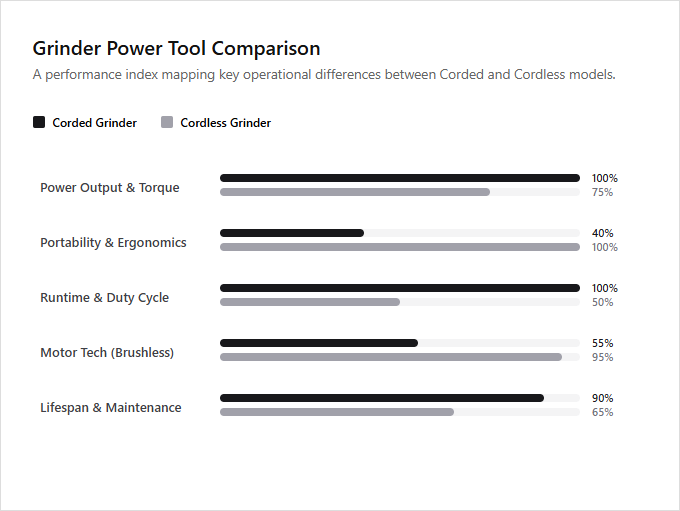
| Power Output and Torque | Corded grinders provide uninterrupted maximum wattage and high torque, while cordless grinders can experience reduced rotational speed (RPM) as battery voltage depletes. |
| Portability and Ergonomics | Cordless grinders offer superior mobility free from cord management, but the attached battery pack increases overall tool weight and shifts the center of gravity. |
| Runtime and Duty Cycle | Corded models support an infinite duty cycle for continuous industrial fabrication, whereas cordless runtime is strictly governed by the battery's Ampere-hour (Ah) rating. |
| Motor Technology | Many modern cordless grinders utilize brushless DC (BLDC) motors to optimize energy efficiency, while standard corded units often employ carbon-brushed motors requiring periodic maintenance. |
| Lifespan and Maintenance | Corded grinders typically feature a longer operational lifespan due to the absence of battery degradation and cell wear over multiple charge cycles. |
Sustained RPM under load consistency
When comparing corded and cordless grinders, sustained RPM under load is a key performance differentiator. Corded angle grinders draw continuous power directly from the electrical grid, allowing them to maintain consistent rotational speed during heavy-duty cutting or grinding. This constant energy supply ensures the motor does not bog down under intense resistance, delivering predictable torque throughout operation.
Battery-operated units, by contrast, rely on onboard power. While modern brushless motors have vastly improved cordless performance, these models can still experience a decline in RPM as the battery depletes or during prolonged, high-pressure tasks. Internal electronics help manage this power delivery, but sustained heavy loads will eventually challenge battery endurance.
A corded grinder is best suited for industrial fabricators requiring continuous, high-torque operation, while a cordless model is ideal for mobile tradespeople prioritizing portability for quick, on-site tasks.
Power-to-weight ratio and ergonomic fatigue
Corded angle grinders offer a superior power-to-weight ratio. Because they rely on a continuous external electrical source, they do not require a heavy onboard battery. This keeps the tool lightweight and highly maneuverable, significantly reducing operator fatigue during prolonged grinding and polishing operations. The consistent power feed ensures maximum, uninterrupted torque without the physical strain of supporting a bulky power cell.
Cordless grinders provide unparalleled mobility but present a different ergonomic profile. The addition of a high-capacity lithium-ion battery increases the overall weight of the tool, which can accelerate wrist and arm fatigue during extended overhead tasks. While modern brushless motors help balance the tool's center of gravity, the physical payload remains higher than corded counterparts.
Corded models are ideal for industrial fabricators requiring continuous, high-intensity workshop production, while cordless alternatives best suit mobile contractors needing rapid portability for short-duration cuts in remote areas.
Duty cycle limitations and continuous power delivery
Corded angle grinders excel in demanding environments due to their unlimited continuous power delivery. Operating directly from an electrical outlet, these tools experience no voltage drop over extended periods. This allows operators to maintain high torque during heavy-duty grinding without concern for duty cycle limitations.
In contrast, cordless grinders rely on battery power, which introduces specific duty cycle constraints. Continuous heavy loads draw high current, generating heat within the battery pack. To prevent damage, modern cordless systems employ thermal protection, requiring cool-down periods that interrupt prolonged tasks.
Corded models are ideal for industrial fabricators requiring uninterrupted performance in fixed workshops, while cordless units best serve mobile contractors needing portability for quick, intermittent tasks.
Brushless DC motor efficiency versus brushed AC motors
When selecting an angle grinder, the decision between corded and cordless models centers on motor technology. Cordless grinders utilize brushless DC (BLDC) motors, which offer superior efficiency by eliminating carbon brush friction. This design maximizes battery runtime and reduces tool maintenance. In contrast, corded grinders rely on brushed AC motors. While these motors exhibit lower energy efficiency and require eventual brush replacements, they deliver continuous, unrestricted power directly from the electrical grid to sustain high torque during intensive applications.
Corded grinders are ideal for industrial fabricators who require uninterrupted power for stationary, heavy-duty grinding, whereas cordless brushless grinders are best suited for mobile contractors needing maximum portability and runtime on remote jobsites.
Amp-hour capacity and battery runtime degradation
Selecting between a corded and cordless angle grinder requires a careful evaluation of power delivery and long-term performance. Cordless grinders offer unmatched portability, yet their utility depends heavily on battery specifications. Higher Amp-hour (Ah) capacity batteries extend operational runtime under heavy loads, but users must account for gradual battery runtime degradation over repeated charge cycles, which eventually diminishes field efficiency.
Corded grinders bypass these battery limitations entirely, delivering consistent, uninterrupted power without the risk of performance decay over time. Because they draw continuous power directly from an electrical outlet, they remain highly reliable for prolonged, high-demand applications. Stationary workshop professionals requiring continuous, heavy-duty cutting favor corded models, whereas mobile contractors needing quick, remote portability are better served by cordless designs.
Electronic kickback protection and active braking response time
When selecting a grinder, evaluating the safety mechanisms of corded versus cordless models is essential. Electronic kickback protection, which instantly shuts down the motor during a wheel bind-up, is highly sophisticated in modern cordless tools due to their integrated electronic communication. While premium corded grinders also feature this technology, budget-friendly corded options often rely on traditional mechanical clutches that react slower to sudden resistance.
Active braking systems also highlight a performance variance. Cordless grinders leverage brushless motors and electronic braking to halt the accessory in under two seconds, whereas standard corded models can coast for several seconds after power-off. Heavy-duty fabricators requiring uninterrupted power are best suited for advanced corded models, while maintenance technicians prioritizing portability and rapid, repetitive cuts will benefit most from cordless grinders.
Max Watts Out equivalence compared to utility grid amperage
When comparing corded and cordless grinders, performance is measured by Max Watts Out (MWO) relative to traditional utility grid amperage. Standard 120V corded grinders operating on 15-amp circuits deliver a continuous power ceiling of approximately 1,800 watts. Modern brushless cordless grinders utilize advanced high-voltage battery platforms to match this capability, achieving MWO ratings that exceed 1,600 watts. This battery technology effectively replicates the torque and material removal rate of a 13-amp corded tool without the physical restriction of a power cord.
Heavy-duty industrial fabricators requiring continuous, stationary operation benefit most from the reliable power of a corded grinder, while mobile contractors demanding high-performance portability on remote jobsites are better suited for cordless models.
Leave a comment