
Selecting the wrong angle grinder abrasive for rapid stock removal often leads to scorched workpieces, premature disc wear, and wasted labor hours-a frustrating bottleneck for any fabricator. While relying on standard bonded grinding wheels remains the default baseline in most shops, this conventional choice is not always the most efficient path forward.
Optimizing your abrasive selection yields a massive operational dividend, granting you faster metal removal rates alongside a significantly cleaner finish that reduces secondary prep work. However, achieving these productivity gains requires adhering to key operational stipulations, particularly regarding material hardness, operator pressure, and grinder RPM compatibility.
For instance, heavy weld beveling on structural steel demands a vastly different abrasive profile than blending welds on thin-gauge stainless steel. Below, we will contrast the performance, lifespan, and surface quality of flap discs versus traditional grinding discs, helping you select the precise tool to maximize your workshop's throughput.
| Factor | Summary |
|---|---|
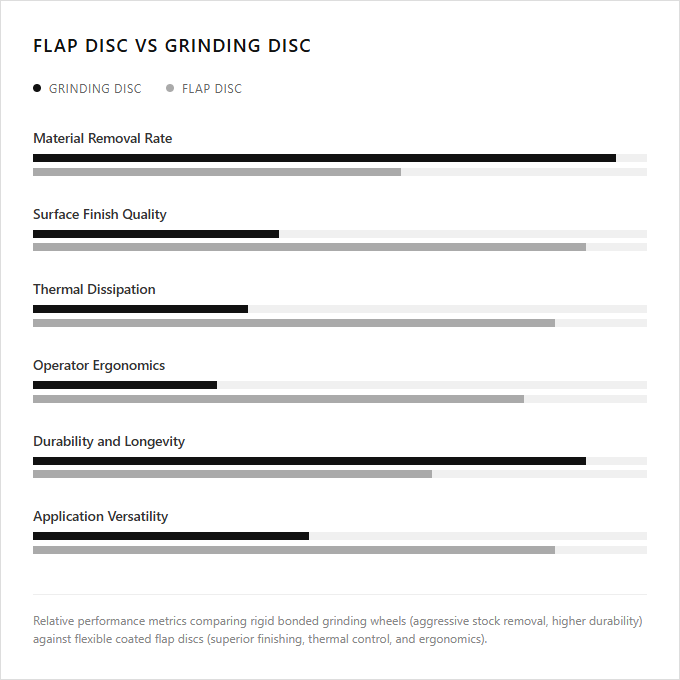
| Material Removal Rate | Rigid grinding discs utilize coarse bonded abrasives for rapid, heavy stock removal, whereas flap discs offer a slower and more controlled rate of cut. |
| Surface Finish Quality | Flap discs employ overlapping coated abrasive flaps to achieve a superior, paint-ready surface finish with lower Ra (roughness average) values than solid grinding wheels. |
| Thermal Dissipation | The flexible construction of flap discs promotes airflow to minimize heat buildup and prevent workpiece discoloration, unlike the high friction generated by solid grinding discs. |
| Operator Ergonomics | Flap discs absorb vibration through their layered design, significantly reducing operator fatigue and the risk of hand-arm vibration syndrome compared to rigid wheels. |
| Durability and Longevity | Bonded grinding discs offer exceptional structural integrity and extended operational life when subjected to heavy deburring and aggressive weld reduction on hard metals. |
| Application Versatility | Flap discs allow operators to perform both stock removal and surface blending in a single step, eliminating the need for secondary finishing processes required by grinding wheels. |
High-MRR Grinding Wheels for Heavy Weld Gouging
When selecting between a flap disc and a grinding disc for angle grinders, material removal efficiency is a primary consideration. Rigid bonded abrasive grinding wheels are engineered for heavy-duty applications, offering the maximum material removal rate (MRR) necessary for aggressive weld gouging and beveling. Their rigid structure allows operators to apply significant pressure, rapidly eroding thick steel and smoothing down heavy weld beads.
In contrast, flap discs utilize overlapping abrasive cloth flaps to provide a more cushioned, controlled grind. While they cannot match the sheer MRR of a bonded wheel, flap discs grind and finish in a single step, reducing the risk of gouging the workpiece. Heavy fabricators requiring rapid stock removal depend on grinding discs, while finishing specialists and DIYers seeking a smooth surface finish prefer flap discs.
Micro-Fracturing Flap Discs for High Stock Removal
When selecting between a flap disc and a grinding disc for angle grinders, the choice depends on the required material removal rate and surface finish. Flap discs utilizing advanced ceramic alumina or zirconia alumina grains offer a distinct advantage in productivity. These specialized grains undergo a micro-fracturing process during operation, constantly exposing sharp new cutting edges to ensure sustained high stock removal and cooler operating temperatures throughout the life of the abrasive.
Standard bonded grinding discs provide a rigid, aggressive interface ideal for heavy-duty weld beveling and notch grinding where surface finish is secondary. Industrial fabricators requiring rapid material removal with a smooth, paint-ready finish will benefit most from high-performance flap discs, while heavy structural welders prioritizing raw metal-hogging durability are best served by rigid grinding discs.
Type 29 Flap Discs for Aggressive Contour Stock Removal
When selecting an abrasive for an angle grinder, the choice between a grinding disc and a flap disc depends on the required material removal rate and surface finish. Traditional rigid grinding discs excel at rapid, heavy-duty stock removal on flat metal surfaces. In comparison, Type 29 conical flap discs provide an optimal 15-to-25-degree angle of attack for aggressive contour stock removal and weld blending.
The built-in angle of the Type 29 disc maximizes surface contact, allowing for a more ergonomic user experience and a smoother finish. Heavy grinding discs are best suited for high-volume fabricators focused strictly on rapid beveling and bulk weld removal, while flap discs are ideal for detail-oriented metalworkers who require a single tool to transition from stock removal to fine surface finishing.
Overlapping Abrasive Flaps Prevent Grinding Discoloration
Choosing between a flap disc and a traditional grinding disc depends on your specific material removal and finishing needs. A key advantage of the flap disc is its unique design: overlapping coated abrasive flaps reduce thermal loading and prevent workpiece discoloration during grinding. This construction allows for a much cooler cut by promoting constant airflow and exposing fresh abrasive grains, which protects heat-sensitive metals from heat damage.
Rigid grinding discs offer rapid stock removal but generate higher temperatures and a rougher surface finish. Finishing specialists and sheet metal fabricators aiming for a flawless surface choose flap discs, whereas heavy fabrication welders performing aggressive beveling on thick structural steel are best suited for grinding discs.
Rigid Grinding Discs Increase Hand-Arm Vibration
Selecting the right angle grinder accessory requires careful consideration of ergonomic impact. Traditional rigid grinding discs generate high hand-arm vibration levels due to their inflexible construction. This intense vibration increases operator fatigue and elevates the risk of long-term physical strain during extended use.
Flap discs feature overlapping abrasive flaps mounted on a fiberglass backing plate. This specialized design naturally dampens vibrations, cushioning the impact of the grinding process to deliver a smoother, more controlled user experience.
Rigid grinding discs are ideal for heavy fabrication professionals requiring aggressive material removal on tough welds, whereas flap discs are best suited for operators seeking a precise blend of light grinding, blending, and finishing with enhanced physical comfort.
Flap Discs: One-Step Grinding and Finishing
When selecting between a flap disc and a traditional grinding disc, the choice depends on your specific surface finish requirements. Rigid grinding discs excel at rapid, aggressive material removal but often leave a coarse finish. In contrast, flap discs utilize overlapping abrasive flaps that provide a cushioning effect, allowing them to achieve a significantly lower Ra surface roughness value. This capability enables operators to combine substantial stock removal and fine finishing into a single, efficient step, reducing both process time and labor costs.
While grinding discs remain the standard for heavy beveling and weld leveling, they typically require a secondary sanding step to prepare the metal for painting or coating. Industrial fabricators requiring high-volume material removal and weld preparation benefit most from grinding discs, while precision metal workers and refinishers seeking a controlled, paint-ready finish in a single pass are better suited for flap discs.
Resin Disc Glazing on Non-Ferrous Metals
When selecting between a flap disc and a grinding disc for metal preparation, material compatibility is a critical consideration. Traditional resin-bonded grinding discs excel at rapid stock removal on ferrous metals but perform poorly on non-ferrous materials like aluminum or copper. These softer metals melt under the intense heat generated by rigid grinding wheels, leading to loading and glazing where the disc pores clog with debris.
Flap discs offer a cooler cut and resist loading because their overlapping abrasive flaps discard worn particles to expose fresh grit. This self-sharpening mechanism prevents the surface glazing that renders standard grinding wheels ineffective on soft metals. Rigid grinding discs are ideal for heavy fabrication professionals working strictly with carbon steel, while flap discs are best suited for operators requiring a dual-purpose tool for both material removal and blending on diverse metal alloys.
Leave a comment