
Managing workshop dust control is a persistent challenge; operators frequently battle rapid suction loss and hazardous fine particulate bypass that compromises shop safety. While standard capital equipment budgets or facility safety grants are typically leveraged to acquire these heavy-duty extraction systems, simply owning the machinery is not enough. Truly maximizing this investment grants facilities both long-term compliance and optimal tool performance.
To achieve this, we must stipulate that a collector's rated CFM is only as reliable as its air-to-cloth ratio and media resistance under load. For instance, swapping a standard 30-micron polyester felt filter bag for a 1-micron pleated spunbond cartridge filter can dramatically decrease static pressure and capture hazardous sub-micron particles. In this guide, we will contrast cartridge filters and filter bags, analyzing how each impacts dust collector CFM, filtration efficiency, and maintenance cycles to help you choose the right media for your operational needs.
| Factor | Summary |
|---|---|
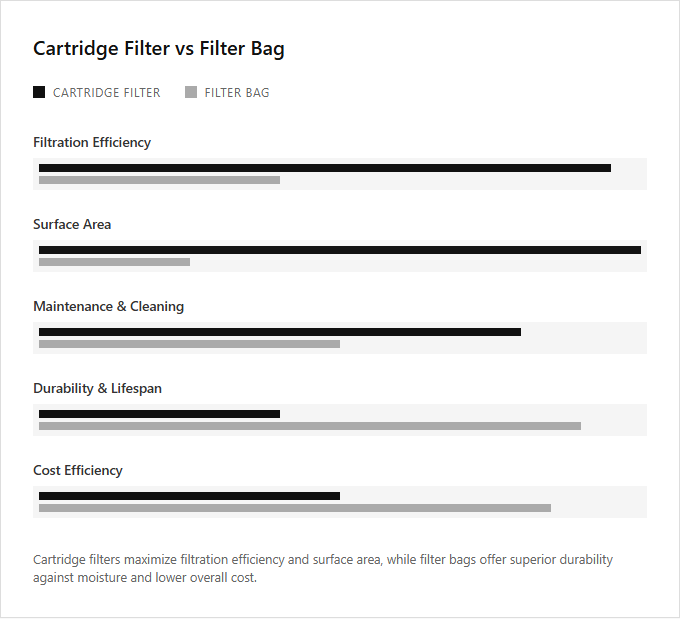
| Filtration Efficiency | Cartridge filters offer superior filtration efficiency by capturing sub-micron particles down to 0.3 microns, whereas standard filter bags typically only capture larger particulate matter. |
| Surface Area | The pleated design of a cartridge filter drastically increases the total surface area compared to a fabric filter bag, allowing for a much higher air-to-cloth ratio. |
| Maintenance and Cleaning | Cartridge filters often utilize internal mechanisms for cake release, while filter bags require manual shaking or reverse-flow pulsed jet cleaning to dislodge accumulated dust. |
| Durability and Lifespan | Filter bags made of woven polyester resist blinding from moisture and last longer in heavy-duty applications, whereas standard paper-element cartridges degrade rapidly when exposed to wet particulates. |
| Cost Efficiency | Filter bags require a lower initial capital expenditure and are cheaper to replace, whereas cartridge filters represent a higher investment but offer better air quality protection. |
Air-to-Cloth Ratio comparison for volumetric flow rate CFM optimization
The air-to-cloth ratio, which measures volumetric flow rate (CFM) against total filter media area, is critical for optimizing dust collector performance. Cartridge filters utilize a pleated design that dramatically maximizes surface area within a compact housing. This design achieves a low air-to-cloth ratio, allowing the system to maintain high CFM and capture extremely fine particulate matter without restricting airflow.
In contrast, traditional filter bags possess less surface area, resulting in a higher air-to-cloth ratio that requires a larger physical footprint to process equivalent air volumes. Bag filters excel in managing heavy, coarse dust loads that would quickly clog pleated media. Cartridge systems are ideal for precision woodworkers requiring fine filtration in tight spaces, whereas bag filters suit high-production industrial operators managing heavy, coarse waste.
MERV 15 and 16 Sub-Micron Filtration Efficiency
When managing workshop air quality, the choice between cartridge filters and filter bags depends heavily on filtration efficiency. Cartridge filters offer superior performance for sub-micron particulate collection, typically achieving MERV 15 or MERV 16 ratings. These pleated systems capture between 85% to over 95% of microscopic dust particles as small as 0.3 microns, preventing fine hazardous dust from recirculating into the workspace.
In contrast, standard filter bags generally provide lower filtration ratings, allowing invisible, sub-micron particles to escape back into the air. While bags handle high-volume waste and larger chips efficiently without clogging, they lack the dense surface area of pleated cartridges. High-efficiency cartridges are best suited for professional woodworkers requiring strict respiratory protection, while traditional filter bags remain practical for hobbyists handling coarser debris.
PTFE membrane lamination versus standard depth filtration media
Cartridge filters featuring PTFE membrane lamination utilize advanced surface-loading technology to capture fine dust. Unlike standard media, the micro-porous PTFE layer traps particles directly on the surface, preventing them from embedding deep within the filter backing. This design maintains high airflow, ensures exceptional filtration efficiency for sub-micron particulate, and facilitates easy dust cake release during cleaning cycles.
Standard filter bags rely on depth filtration media, where dust penetrates the material to build a cake layer that assists in the filtration process. This traditional method is highly durable and tolerant of moisture, making it effective for heavy, coarse debris. Professionals handling hazardous, ultra-fine dusts like silica or MDF require the high-efficiency performance of PTFE cartridges, whereas high-volume industrial operators managing large chips and abrasive sawdust are better suited for robust filter bags.
Differential pressure limits under high interstitial velocity
High interstitial velocity-the upward airflow speed between filter media-significantly impacts dust collector performance. In systems with elevated interstitial velocities, cartridge filters often experience rapid differential pressure spikes because their tight pleat spacing traps dust, hindering effective pulse-jet cleaning and causing premature blinding. Conversely, filter bags maintain lower, more stable differential pressure under these demanding conditions, as the wider spacing between bags allows dislodged dust to settle into the hopper against the upward air currents.
Selecting the appropriate filtration design depends on your specific workflow and material load. Cartridge filters are highly suitable for laboratory technicians or fine woodworkers managing dry, sub-micron dust in low-velocity setups, while filter bags are ideal for heavy industrial operators and metalworkers handling large volumes of coarse, abrasive particulate in high-velocity environments.
Needle-punched felt versus spunbond polyester tensile strength
When selecting dust collector filtration media, tensile strength dictates long-term durability under high operational pressure. Cartridge filters typically utilize spunbond polyester, a media characterized by its continuous filament structure. This bonded design provides exceptional tensile strength and resistance to tearing, allowing the pleated cartridge to withstand frequent pulse-cleaning cycles and high differential pressures without structural failure.
In contrast, traditional filter bags employ needle-punched felt. While highly effective for depth filtration, its mechanically interlocked fibers offer lower tensile strength, making the material more susceptible to stretching and degradation under heavy physical stress over time. Industrial operators requiring heavy-duty, continuous pulse-jet cleaning will benefit from the high-strength spunbond cartridge filters, while hobbyists or smaller workshops managing intermittent, non-abrasive dust collection are well-suited for needle-punched felt bags.
Pulse-jet cleaning mechanics and dust cake release
Cartridge filters utilize pleated media to maximize filtration surface area. During pulse-jet cleaning, compressed air travels through the cartridge, expanding the pleats to release the dust cake. While highly efficient for fine particulates, the narrow pleat spacing can sometimes retain cohesive dust, requiring dry, free-flowing conditions for optimal cake release.
Filter bags employ a flexible fabric sleeve over a metal cage. The pulse-jet blast causes the bag to expand rapidly and snap back, aggressively flexing the fabric to shed heavy dust cakes. Cartridge collectors are best for facility managers requiring compact, high-efficiency filtration for fine powders, while baghouses suit heavy-industrial operators managing high grain loadings and sticky materials.
Max continuous operating temperature limits of aramid versus cellulose media
Industrial dust collection efficiency depends heavily on selecting the correct filter media based on thermal demands. Cartridge filters utilizing cellulose media are standard for ambient air applications, but they exhibit a limited maximum continuous operating temperature of approximately 180°F (82°C). Exceeding this thermal threshold degrades the organic fibers, leading to premature filter failure and compromised system performance.
Fabric filter bags employ synthetic aramid media designed for severe thermal environments, maintaining structural integrity at continuous operating temperatures up to 375°F (190°C). Cellulose cartridge systems are ideal for woodworking hobbyists and small workshop professionals handling dry, ambient-temperature debris, while aramid bag systems are essential for industrial operators managing high-heat processes like metalworking, smelting, or asphalt production.
Leave a comment