
Selecting the ideal hot melt adhesive applicator often presents a frustrating compromise between continuous thermal output and physical maneuverability. For workshop managers and craftspeople, a poorly matched tool leads to premature adhesive cooling, compromised bonds, and restricted workflows. Historically, workshops have secured tooling through standardized equipment budgets, balancing initial capital expenditure against long-term utility.
Investing in the correct power configuration grants operators uninterrupted productivity and superior bond integrity. Crucially, a key stipulation must be noted: the thermal demands of your specific adhesive-such as high-delivery polyamide vs. standard EVA sticks-must ultimately dictate your tool's wattage. For instance, high-volume cabinetry assembly requires the relentless heat of a corded industrial gun, while rapid prototyping benefits from the agility of a cordless model.
This comprehensive analysis compares corded and cordless glue guns across heating efficiency, runtime, and ergonomic utility, providing a clear framework to optimize your workshop's adhesive capabilities.
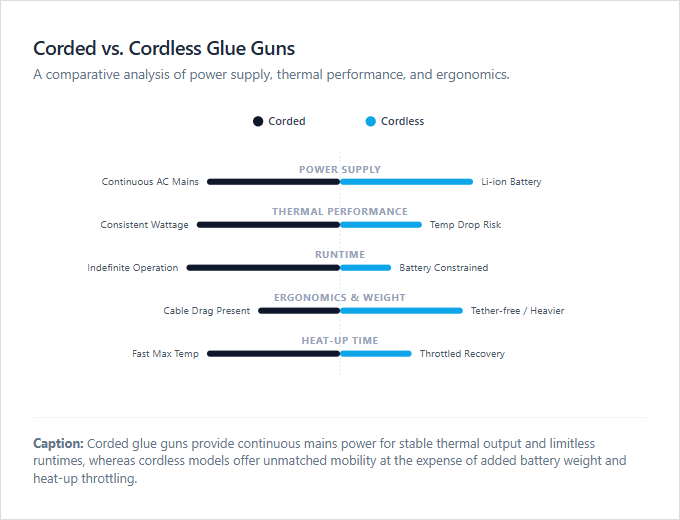
| Factor | Summary |
|---|---|
| Power Supply | Corded glue guns rely on continuous AC mains voltage, whereas cordless models utilize rechargeable lithium-ion battery chemistry for tether-free operation. |
| Thermal Performance | Corded units maintain a consistent wattage for rapid thermal recovery, while cordless models can suffer from temperature drop during prolonged extrusion. |
| Runtime | Corded tools offer indefinite operational runtime, whereas cordless alternatives are constrained by the amp-hour capacity of their battery pack. |
| Ergonomics & Weight | Cordless models eliminate cable drag but feature increased tool mass and an altered center of gravity due to the onboard battery. |
| Heat-up Time | High-wattage corded elements reach optimal operating temperature quickly, while cordless guns must throttle power consumption to extend battery life. |
Continuous wattage and rapid thermal recovery rate of corded models
Selecting the right glue gun depends heavily on power delivery and operational demands. Corded glue guns excel in heavy-duty applications due to their direct connection to an electrical outlet. This constant power supply enables high continuous wattage, allowing the heating element to maintain a stable, elevated temperature. Because they do not suffer from battery depletion, corded models offer a rapid thermal recovery rate, quickly reheating the adhesive during high-volume dispensing.
In contrast, cordless glue guns prioritize portability and maneuverability, though they often experience temperature drop-offs during extended use. Corded models are ideal for industrial manufacturers and high-volume crafters requiring uninterrupted thermal performance, whereas cordless models suit mobile technicians and DIY enthusiasts needing quick, cable-free repairs.
Amp-hour capacity of lithium-ion batteries in cordless models
When selecting a professional glue gun, the choice between corded and cordless models depends heavily on operational needs. Cordless glue guns offer unmatched portability, powered by modern lithium-ion batteries. The performance of these cordless tools is directly tied to their Amp-hour (Ah) capacity, which determines operational run-time. Lower capacity batteries (1.5 Ah to 2.0 Ah) offer a lightweight design for quick repairs, while high-capacity options (4.0 Ah or greater) provide sustained heating for extended industrial applications without the need for frequent recharging.
In contrast, corded models provide uninterrupted power and consistent thermal regulation without the limitations of battery management. Corded tools are best suited for stationary workshop crafters requiring continuous, high-volume adhesive flow, while cordless models are ideal for mobile technicians and contractors needing on-site flexibility.
Positive Temperature Coefficient heating elements for precise thermal regulation
Modern glue guns utilize self-regulating Positive Temperature Coefficient (PTC) heating elements to ensure precise thermal regulation. As the tool reaches its optimum operating temperature, electrical resistance increases, preventing overheating and maintaining a stable adhesive viscosity. In corded models, this PTC technology receives an uninterrupted power supply, guaranteeing consistent heat delivery during prolonged fabrication tasks.
In contrast, cordless glue guns leverage the efficiency of PTC elements to conserve battery power, drawing energy only as needed to maintain heat. While cordless designs offer exceptional maneuverability, they require strategic power management for long-term projects. High-volume industrial operators needing continuous, heavy-duty output are best suited for corded models, while field technicians and DIY enthusiasts requiring maximum portability will find cordless variants more appropriate.
Adhesive melt rate measured in grams per hour
When selecting a professional glue gun, the adhesive melt rate-measured in grams per hour (g/h)-serves as a critical performance metric. Corded models consistently deliver higher melt rates, often ranging from 500 to over 1,500 grams per hour. This sustained output is driven by a continuous electrical connection, which maintains the stable, high operating temperatures required for rapid, heavy-duty adhesive dispensing.
Cordless glue guns offer superior portability but generally feature lower melt rates, typically averaging between 100 and 350 grams per hour. Battery power limitations restrict the heating element's sustained thermal output, which affects the tool's ability to support continuous, high-volume applications.
Industrial operators requiring uninterrupted, high-capacity bonding are best suited for corded models, whereas mobile technicians and crafters prioritizing maneuverability for quick, intermittent tasks will find cordless designs more appropriate.
Anti-drip nozzle technology utilizing a spring-loaded ball-check valve
When evaluating professional glue guns, the choice between corded and cordless platforms significantly impacts runtime and maneuverability. To maintain a clean, efficient workspace, premium models in both categories integrate advanced anti-drip nozzle technology utilizing a spring-loaded ball-check valve. This internal mechanism immediately seals the adhesive chamber when trigger pressure is released, preventing gravity-fed oozing and ensuring highly precise application control.
Corded glue guns deliver unlimited, consistent thermal energy for prolonged operations, while cordless alternatives provide the dexterity needed for intricate or remote tasks. Stationary workshop assembly technicians requiring constant heat output are best suited for corded models, whereas field installers and hobbyists prioritizing maximum mobility will benefit most from cordless designs.
Compatibility with specific hot melt chemical formulations and stick diameters
Corded hot glue guns deliver the consistent thermal energy required for high-performance chemical formulations, including polyamides and polyurethane (PUR) adhesives. These tools excel in handling larger stick diameters, typically 11mm to 15mm, where sustained high temperatures are necessary to maintain a continuous, high-volume flow of dense polymers.
Cordless models prioritize portability, frequently pairing with standard ethyl-vinyl acetate (EVA) formulations and smaller 7mm stick diameters. While engineered for quick-setting, lower-temperature adhesives, advanced battery-powered systems increasingly support standard 11mm sticks for remote applications where power outlets are unavailable.
Stationary industrial operators requiring uninterrupted, heavy-duty bonding of specialized adhesives will benefit most from corded options, whereas field technicians and onsite installers are better served by the mobility and quick-setup capabilities of cordless tools.
Dual-temperature capability for high-viscosity polyamide and low-viscosity EVA adhesives
Selecting the right hot melt glue gun requires evaluating power delivery against specific adhesive requirements. Dual-temperature capability is essential when alternating between high-viscosity polyamide adhesives, which require high heat for strong structural bonds, and low-viscosity EVA adhesives, which melt at lower temperatures to prevent damage to delicate substrates.
Corded models provide uninterrupted, consistent thermal energy, making them highly efficient for sustaining the high temperatures needed for continuous polyamide extrusion. Conversely, cordless options offer unmatched portability, allowing quick, intricate applications of EVA or polyamide adhesives without the restriction of a power cord, though they may require thermal recovery time during heavy use.
Industrial operators requiring continuous high-heat output for structural assembly benefit most from corded models, whereas field technicians and crafters prioritizing maneuverability find cordless units ideal.
Leave a comment