
Woodworkers routinely struggle with the hazardous, invisible fine dust that lingers in the air long after machinery stops, settling on surfaces and compromising respiratory health. While shop owners frequently leverage standard capital equipment budgets or workplace safety grants to fund extraction upgrades, investing capital is only the first step. The true value-add lies in maximizing safety margins and protecting sensitive electronics, under the critical stipulation that primary source extraction rarely captures 100% of airborne micro-particulates.
To bridge this safety gap, high-efficiency facilities deploy hanging ambient air filtration units, such as the Powermatic PM1250 or JET AFS-1000B, as a secondary line of defense. Below, we analyze the mechanical differences between single-stage dust collectors and two-stage cyclone separators, and demonstrate how integrating an ambient air cleaner establishes a comprehensive, multi-layered workshop dust control strategy.
| Factor | Summary |
|---|---|
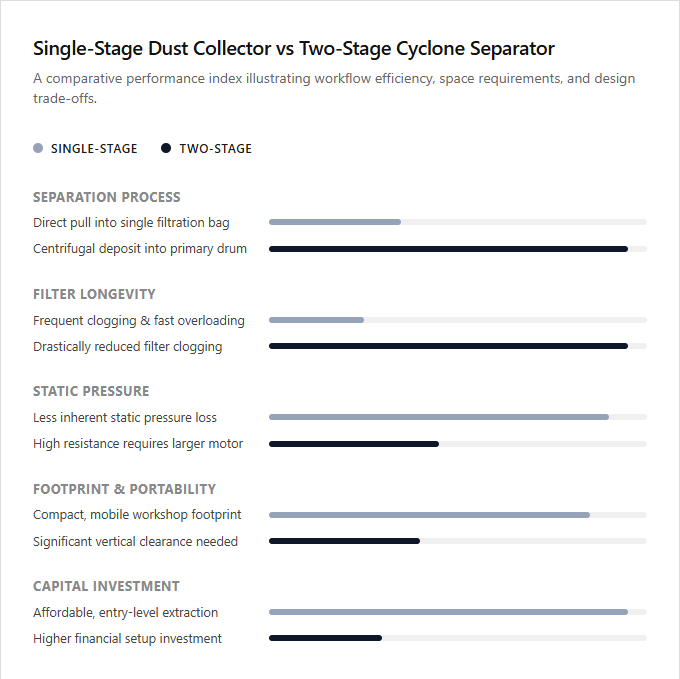
| Separation Process | While single-stage dust collectors pull all debris directly into a single filtration bag, two-stage cyclone separators utilize centrifugal force to deposit large chips into a primary drum before fine dust reaches the canister filter. |
| Filter Longevity | Two-stage systems drastically reduce filter clogging and maintain optimal suction by preventing fine particulate matter from prematurely overloading the pleated cartridge filter. |
| Static Pressure | Single-stage collectors experience less inherent static pressure loss within the machine, whereas the cyclonic cone design of two-stage units introduces resistance that requires a more powerful motor to overcome. |
| Footprint and Portability | Single-stage units feature a compact, mobile footprint suitable for tight workshop layouts, while two-stage systems require significant vertical clearance to accommodate the cyclone drum stack. |
| Capital Investment | Single-stage dust collectors offer an affordable, entry-level dust extraction solution, whereas two-stage cyclone separators demand a higher initial financial investment for advanced collection efficiency. |
Two-Stage Cyclones vs. Single-Stage: Airflow Consistency
Single-stage dust collectors pull waste directly through the fan impeller into a filtration bag or cartridge. While initial performance is strong, fine dust quickly coats the filter medium, leading to rapid static pressure loss and a significant reduction in volumetric airflow (CFM). This filter blinding requires frequent manual cleaning to maintain operational efficiency.
In contrast, two-stage cyclone separators employ centrifugal force to precipitate up to ninety-nine percent of debris into a primary containment bin before the air reaches the final filter. By preventing fine dust from clogging the filter media, these systems maintain constant airflow and consistent suction throughout operation. Single-stage units are best suited for hobbyists with intermittent tool usage, whereas two-stage cyclones are ideal for professional woodworkers requiring continuous, high-volume dust extraction.
Two-Stage Cyclone Separators Protect Radial-Fin Impellers
In workshop dust collection, choosing between a single-stage dust collector and a two-stage cyclone separator depends heavily on debris management. Two-stage cyclone separators utilize centrifugal force for pre-separation, directing heavy chips and abrasive debris into a primary collection bin before the air stream reaches the filtration unit. This crucial pre-separation step protects the radial-fin impeller from direct impact and abrasive wear, ensuring consistent airflow and extending the system's overall lifespan.
Single-stage units draw all waste directly through the fan impeller, which increases the risk of damage from larger wood fragments. While single-stage collectors are best suited for hobbyists seeking a compact, budget-friendly option for light woodworking, two-stage cyclone systems are the superior choice for professional cabinetmakers and high-production shops that generate large volumes of coarse debris.
Ambient Air Filters Capture Bypassed PM2.5 Dust
Single-stage dust collectors pull debris directly into a filtration bag, but standard 30-micron bags often allow hazardous, respirable PM2.5 dust to bypass the system and remain airborne. In contrast, two-stage cyclone separators deposit heavy wood chips into a primary drum before directing fine dust to a secondary pleated filter. Auxiliary ambient air filtration units are essential to supplement single-stage setups, capturing these escaped microscopic particles to ensure clean, breathable workshop air.
Choosing the right configuration depends entirely on your specific workspace volume and operational demands. Single-stage collectors paired with secondary air cleaners are highly suited for budget-conscious hobbyists working in smaller shops, whereas heavy-duty two-stage cyclones are best for high-volume professional woodworkers who require low-maintenance operation and maximum dust capture at the source.
Two-Stage System Extends MERV Pre-Filter Lifespan
In woodworking environments, choosing between a single-stage dust collector and a two-stage cyclone separator significantly impacts air filtration efficiency. While single-stage units pull all debris directly into a collection bag, a two-stage system utilizes centrifugal force to deposit heavy chips first. This mechanical separation decreases the dust-loading rate on ambient air cleaners, protecting their MERV-rated pre-filters and extending their operational lifespan.
Single-stage collectors offer a compact, economical setup, though they require more frequent filter maintenance. Two-stage systems provide superior pre-separation, protecting downstream filtration components from premature clogging during high-volume operations. Single-stage collectors suit hobbyists with limited space and occasional tool use, whereas two-stage cyclone separators are ideal for professional woodworkers requiring continuous, high-capacity debris management.
Single-Stage vs. Two-Stage Dust Collectors
When managing workshop air quality, the choice between dust collection systems heavily impacts maintenance frequency and airflow efficiency. Single-stage dust collectors pull all wood chips and debris directly through the impeller and into the main filter bag or cartridge. This design results in rapid dust cake buildup, requiring frequent manual cleaning of the filter media to prevent significant loss of suction power.
In contrast, two-stage cyclone separators utilize centrifugal force to deposit bulk waste and heavy chips directly into a sealed collection drum before the air stream ever reaches the filter. This process ensures that only the finest dust particles enter the final filtration stage, preserving consistent static pressure. Single-stage collectors are best suited for budget-conscious hobbyists with limited workspace and occasional tool use, while two-stage systems are ideal for high-volume professionals who require continuous, low-maintenance debris management.
Ambient Air Cleaners Capture Missed Fugitive Emissions
In workshop environments, primary source extraction often leaves microscopic dust suspended in the workspace. While single-stage dust collectors pull air directly through a filtration bag and two-stage cyclone separators pre-sort heavy debris to prevent suction loss, neither system captures 100% of airborne particulates. To address this, ambient air cleaners are integrated to achieve the necessary Air Changes per Hour (ACH), continuously cycling the facility's air to capture the fine fugitive emissions missed by primary hoods.
The choice between these primary extraction methods depends heavily on workshop volume and duty cycles. Budget-conscious hobbyists and light-duty DIY enthusiasts find single-stage collectors ideal for intermittent, localized tasks, whereas professional woodworkers and high-production commercial facilities require the sustained, high-efficiency performance of two-stage cyclone systems to maintain clean air.
HEPA Cyclones Reduce Workshop Air Scrubber Demand
Standard single-stage dust collectors draw both large wood chips and fine dust directly into a single filtration bag. This process quickly clogs the filter membrane, restricting airflow and allowing fine particulates to escape back into the workspace. In contrast, a two-stage cyclone separator pre-sorts heavy debris into a primary containment bin before the air stream reaches the final filter. Integrating a HEPA-filtered two-stage cyclone drastically reduces the background particulate concentration, lowering the demand on supplementary workshop air scrubbers and extending their filter life.
This advanced separation process maintains consistent static pressure and ensures that microscopic, airborne hazards are captured at the source. Single-stage collectors are best suited for budget-conscious hobbyists with limited floor space and occasional machinery use, whereas two-stage cyclone systems are ideal for professional woodworkers and high-volume commercial shops requiring continuous, heavy-duty dust extraction and superior ambient air quality.
Leave a comment