
Achieving clean, precise cuts in sheet metal often presents a frustrating challenge for fabricators, as material warping and edge distortion can easily ruin a workpiece. Standard workshop tools, such as the versatile jigsaw, are typically the first line of defense for these tasks; however, their lateral blade motion frequently bends thin metal sheets under stress.
A punch-and-die power nibbler bypasses this issue entirely, granting operators perfectly flat, distortion-free cuts by rapidly shearing away tiny metal curls. While using this tool comes with the stipulation of managing sharp metal waste chips and requiring a pre-drilled starting hole for internal cuts, its precision is unmatched. In professional automotive body restoration and custom HVAC ductwork, for example, the nibbler is the preferred choice for preserving material integrity.
In this article, we compare the punch-and-die nibbler against the jigsaw, examining their cutting mechanics, material limits, and operational differences to help you choose the right tool for your fabrication needs.
| Factor | Summary |
|---|---|
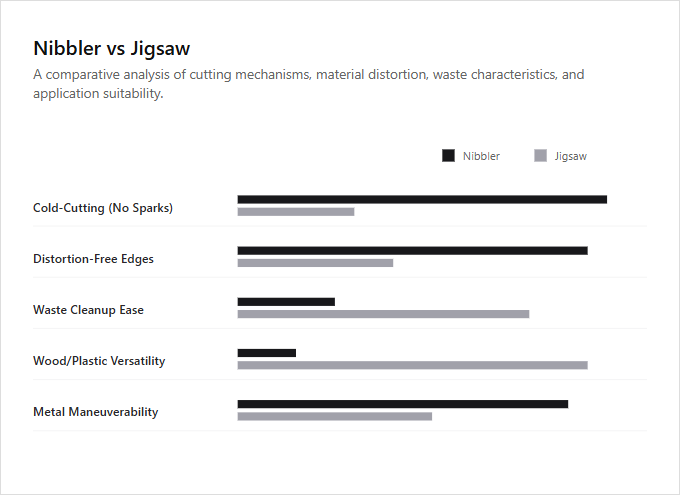
| Cutting Mechanism | The nibbler cuts material using a rapid, motorized punch-and-die system, whereas the jigsaw relies on the vertical reciprocating motion of a thin blade. |
| Material Distortion | Nibblers prevent kerf distortion in thin sheet metals by cutting clean paths, whereas a jigsaw can cause vibration and edge deformation if the workpiece is not securely clamped. |
| Waste Production | A nibbler produces thousands of tiny, sharp metal waste slugs, while a jigsaw generates traditional swarf or sawdust depending on the material being cut. |
| Curved Cuts | Jigsaws excel at cutting complex radius curves in thick wood or plastic, whereas nibblers are highly maneuverable in metal but limited to the diameter of their cutting head. |
| Primary Application | Nibblers are specialized for cold-cutting corrugated sheet metal without creating sparks, while jigsaws are versatile, general-purpose tools suited for customized woodworking. |
Reciprocating punch-and-die cutting mechanism
The nibbler operates using a unique reciprocating punch-and-die mechanism. As the punch rapidly moves up and down against a fixed die, it bites away small, crescent-shaped pieces of metal without distorting the surrounding workpiece. In contrast, a jigsaw utilizes a linear reciprocating blade that cuts with a sawing motion, which often induces material flexing, vibration, and edge burrs when applied to thin sheet metals.
Because the nibbler removes a continuous path of waste material, it excels at making tight-radius curves and internal cutouts without binding. Jigsaws offer greater versatility across diverse materials like wood and plastics, though they struggle with precision on thin metal. Metal fabricators requiring distortion-free sheet profiling will benefit most from a nibbler, while general carpenters and DIYers will find the jigsaw more suited to their multi-material cutting needs.
Elimination of heat-affected zone thermal distortion
A nibbler operates by punching out small pieces of metal in a rapid, cold-cutting process. Unlike a jigsaw, which relies on a reciprocating blade that generates significant friction and heat along the cut line, a nibbler minimizes thermal transfer. This mechanical shearing action entirely prevents the formation of a heat-affected zone, preserving the material's metallurgical properties.
Avoiding thermal distortion is critical when working with sensitive materials such as pre-painted sheets or stainless steel. Jigsaws can cause localized warping, discoloration, and micro-cracking due to heat buildup, whereas the nibbler leaves clean, stress-free edges. Nibblers are ideal for HVAC technicians and roofers requiring distortion-free metal fabrication, while jigsaws are best suited for general carpenters and DIYers prioritizing versatile curve-cutting in wood and plastics.
Prevention of blade deflection inherent in jigsaw cutting
In metal fabrication, selecting the appropriate cutting tool is critical for precision. Jigsaws, while versatile, are inherently susceptible to blade deflection. This issue occurs when the flexible blade bends under lateral pressure, resulting in skewed, inaccurate cuts in denser materials.
A power nibbler eliminates this structural limitation. Operating via a rapid punch-and-die mechanism, it removes small chips of waste without an unsupported blade. This process prevents deflection entirely, ensuring perfectly perpendicular, distortion-free edges along any cutting line.
Jigsaws are best suited for general carpenters needing versatile cuts in wood, whereas nibblers are ideal for metal fabricators requiring highly precise, deformation-free results in sheet metal.
Generation of uniform crescent-shaped kerf discharge
A nibbler and a jigsaw employ vastly different cutting mechanisms, particularly in how they evacuate material. While a jigsaw utilizes a reciprocating blade to produce fine sawdust or metal filings, a nibbler operates via a rapid punch-and-die action. This unique punching process yields a highly uniform, crescent-shaped kerf discharge, leaving clean, distortion-free edges on thin sheet metal.
The consistent, crescent-shaped chips produced by the nibbler prevent the heat buildup and material deformation often associated with the abrasive friction of a jigsaw blade. This controlled waste discharge also minimizes airborne dust, maintaining a safer and more manageable workspace.
Sheet metal fabricators requiring precise, distortion-free curved cuts in panels will find the nibbler indispensable, whereas general carpenters and DIY enthusiasts tackling diverse materials at various depths are better suited to the versatile jigsaw.
Zero-torsion cutting preventing mechanical deformation
When cutting sheet metal, choosing between a nibbler and a jigsaw depends heavily on material integrity. A nibbler operates by punching out tiny pieces of metal at high speed, which provides a zero-torsion cutting process. Because the tool exerts no lateral or twisting force on the workpiece, it prevents mechanical deformation, keeping thin sheets perfectly flat and preserving the original material structure.
In contrast, a jigsaw uses a reciprocating blade that pulls against the metal, often causing bending, vibration, and edge distortion on delicate sheets. While the jigsaw offers versatility for wood and thicker materials, it lacks the precision needed for warp-free metal fabrication. Professional metalworkers requiring distortion-free profiles on thin panels will benefit most from the specialized precision of a nibbler, whereas general carpenters and DIY hobbyists will find the jigsaw highly suited for diverse, multi-material applications.
360-degree omnidirectional cutting path maneuverability
When evaluating cutting tools for intricate metal fabrication, the choice between a nibbler and a jigsaw centers on maneuverability. A nibbler excels in delivering true 360-degree omnidirectional cutting paths. Because it operates by rapidly punching out tiny metal chips rather than reciprocating a rigid blade, a nibbler can pivot instantly in any direction without binding or distorting the workpiece. This allows operators to guide the tool through tight, complex curves and interior cutouts with unparalleled fluidity.
A jigsaw relies on a linear reciprocating blade. While highly versatile for straight lines and gentle sweeps, its directional changes are restricted by the blade's width, making immediate, omnidirectional pivots difficult. Professional metal fabricators requiring intricate, distortion-free scrollwork in sheet metal will benefit most from the precision of a nibbler, whereas general contractors and DIY enthusiasts needing versatile, multi-material cutting capabilities will find the jigsaw more suitable.
Burr-free edge profile minimizing post-processing
When cutting sheet metal, the choice between a nibbler and a jigsaw significantly impacts workflow efficiency. A nibbler excels by punching out tiny semi-circular chips, leaving a distortion-free, clean, and burr-free edge profile. This precise cold-cutting process eliminates the need for extensive post-processing, such as grinding or deburring, saving valuable production time.
In comparison, a jigsaw utilizes a reciprocating blade that can generate heat, leave rough edges, and warp thin materials, which demands additional finishing work. The nibbler is ideal for sheet metal fabricators requiring flawless, ready-to-assemble edges, while the jigsaw remains the preferred tool for general contractors needing versatile cuts across wood and plastics.
Leave a comment