
Achieving a clean, distortion-free cut in sheet metal is a notorious challenge for fabricators and DIYers alike, often resulting in jagged, warped edges and ruined materials. While standard cutting methods like traditional shears or reciprocating saws are the typical go-to tools for quick cuts, they often compromise the metal's structural integrity through heat and vibration.
This is where the punch-and-die nibbler excels; its rapid punching action grants operators absolute precision and warp-free edges on complex profiles. However, as an educational stipulation, users must anticipate the unique cleanup required for the sharp, crescent-shaped waste chips this method produces. Despite this caveat, for intricate applications like corrugated roofing installation and HVAC ductwork fabrication, the nibbler's performance is unmatched.
Below, we compare the punch-and-die nibbler directly against the reciprocating saw, evaluating cutting speed, curve execution, and finish quality to help you choose the ultimate tool for your metalworking projects.
| Factor | Summary |
|---|---|
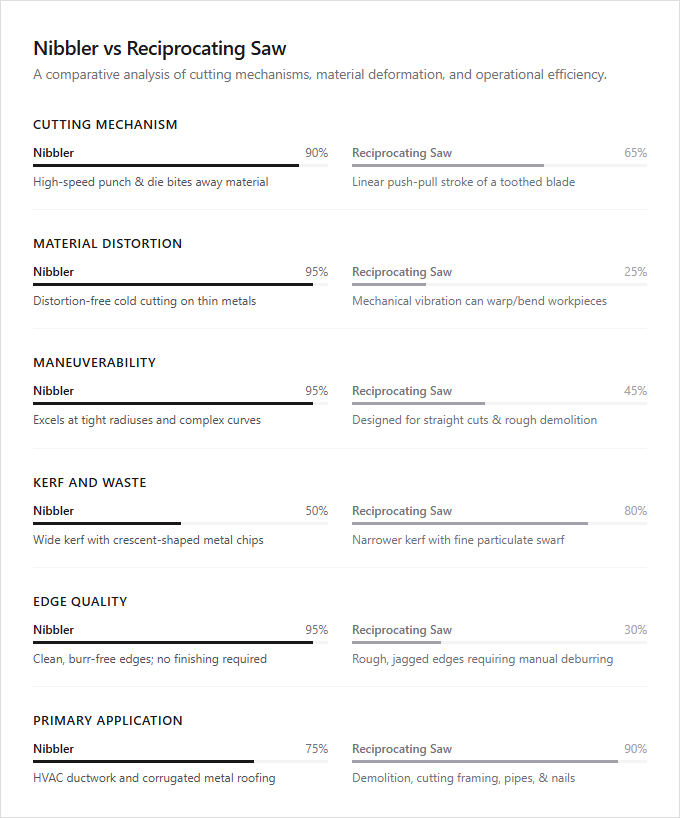
| Cutting Mechanism | While a nibbler utilizes a high-speed punch and die mechanism to bite away material, a reciprocating saw relies on the linear push-pull stroke of a toothed blade. |
| Material Distortion | Nibblers perform distortion-free cold cutting on thin sheet metals, whereas the intense mechanical vibration of a reciprocating saw can easily warp or bend delicate workpieces. |
| Maneuverability | Nibblers excel at cutting tight radiuses and complex, tight-angle curves in sheet metal, while reciprocating saws are primarily designed for straight-line cuts and rough demolition. |
| Kerf and Waste | A nibbler leaves a distinct wide kerf composed of tiny, crescent-shaped metal chips, whereas a reciprocating saw produces a narrower kerf with fine particulate swarf or sawdust. |
| Edge Quality | Nibblers produce clean, virtually burr-free edges that require no secondary finishing, whereas reciprocating saws leave rough, jagged edges requiring manual deburring. |
| Primary Application | The nibbler is a specialized tool for precision HVAC ductwork and corrugated roofing installation, while the reciprocating saw is a general-purpose demolition tool for cutting framing, pipes, and embedded nails. |
Punch-and-die mechanism prevents sheet material distortion
When cutting thin sheet metals, choosing the right tool directly impacts the structural integrity of the workpiece. A nibbler utilizes a high-speed punch-and-die mechanism that rapidly bites away tiny semi-circular chips of metal. Because this process applies minimal lateral pressure to the workpiece, it prevents sheet material distortion and leaves a clean, flat, burr-free edge along both straight lines and tight curves.
A reciprocating saw relies on a vigorous back-and-forth blade stroke that frequently causes thin metal sheets to bend, vibrate, and warp. While the saw is highly effective for fast, rough cuts through thicker materials, it lacks the delicacy needed for precise paneling. Sheet metal fabricators and roofing specialists require the distortion-free precision of a nibbler, whereas demolition technicians and general remodelers are best suited for the aggressive power of a reciprocating saw.
Burr-free edge creation eliminating the need for secondary deburring
When cutting sheet metal, the choice between a nibbler and a reciprocating saw significantly impacts post-processing efficiency. A nibbler operates by punching out tiny metal chips, delivering a perfectly clean, distortion-free, and burr-free edge. This precise cutting action entirely eliminates the need for secondary deburring, streamlining production workflows. Conversely, the aggressive tearing motion of a saw blade leaves behind rough, jagged edges and heavy burrs that require labor-intensive grinding.
While the saw generates friction heat that can warp thin materials, the nibbler performs cold cuts to preserve material integrity. Precision sheet metal fabricators requiring flawless, ready-to-assemble finishes benefit most from the surgical accuracy of a nibbler, whereas demolition contractors and rough-in carpenters prioritizing speed over edge quality find the versatile reciprocating saw indispensable.
Generation of crescent-shaped waste chips instead of abrasive metallic dust
When cutting sheet metal, the choice between a nibbler and a reciprocating saw significantly impacts both workspace safety and cleanup. A nibbler operates by punching out tiny, crescent-shaped metal chips that immediately fall to the ground. This cold-cutting process prevents the creation of airborne hazards and keeps the workpiece free from heat distortion, ensuring a safer and cleaner environment.
Conversely, a reciprocating saw relies on a rapid blade action that generates fine, abrasive metallic dust and hot sparks. This airborne particulate poses inhalation risks and can damage nearby finished surfaces, requiring extensive post-work cleanup. The precise, debris-conscious nibbler is ideal for HVAC technicians and roofers needing clean, distortion-free curves, while the aggressive reciprocating saw suits demolition contractors who prioritize rapid cutting through mixed materials over edge finish.
Minimal heat-affected zone preventing thermal warping of the workpiece
When cutting sheet metal, managing thermal output is critical to preserving material integrity. A nibbler operates via a rapid punching mechanism that creates a cold cut, leaving a minimal heat-affected zone. This absence of friction-induced heat prevents thermal warping, distortion, and damage to protective coatings on the workpiece. In contrast, a reciprocating saw relies on a high-speed blade that generates significant friction, transferring heat into the metal and increasing the risk of material discoloration and edge deformation.
Selecting the appropriate tool depends on the specific requirements of the application and the tolerance for thermal damage. Nibblers are ideal for precision metal fabricators and HVAC technicians who require clean, distortion-free cuts in thin sheet metal, whereas reciprocating saws are suited for demolition contractors and remodelers who prioritize rapid, rough cutting through diverse materials where edge aesthetics are secondary.
Micro-tight minimum cutting radius for intricate curve profiles
When executing precise metal fabrication, the choice between a nibbler and a reciprocating saw depends heavily on the required cutting radius. A nibbler excels in intricate profiling due to its micro-tight minimum cutting radius. Operating with a rapid punch-and-die action, it effortlessly navigates tight curves and complex patterns without distorting the workpiece.
A reciprocating saw relies on a linear, back-and-forth blade motion. While highly efficient for straight, high-volume demolition, its physical blade width inherently restricts its turning capacity, making micro-tight radii impossible to achieve without damaging the surrounding material.
Demolition contractors and utility installers will find the reciprocating saw indispensable for fast, rough cuts, whereas precision sheet metal fabricators and custom artistic metalworkers are ideal candidates for the highly maneuverable nibbler.
Variable strokes per minute control for precise material feed rate
When selecting between a nibbler and a reciprocating saw, speed control is essential for achieving optimal cutting performance. Both tools feature variable strokes per minute (SPM) control, which directly influences the material feed rate and the quality of the finished edge. A nibbler utilizes a rapid punch and die mechanism, where variable SPM allows operators to guide the tool smoothly through sheet metal. This precise speed regulation prevents material deformation and ensures clean, burr-free curves during intricate fabrication work.
A reciprocating saw employs a linear push-and-pull blade action designed for rapid cutting through a variety of materials. Adjusting the SPM on a reciprocating saw helps manage heat buildup in thick metals and prevents blade binding in lumber. Metal fabricators requiring precise, distortion-free shapes in sheet metal will benefit most from a nibbler, whereas demolition contractors and carpenters needing versatile, high-speed rough cutting are better suited for a reciprocating saw.
Elimination of workpiece chattering and blade-binding issues
When cutting sheet metal, a reciprocating saw often causes significant workpiece chattering and blade-binding due to its aggressive, back-and-forth stroke action. This violent movement can easily deform thin materials and pinch the blade if the metal is not rigidly clamped. A nibbler eliminates these issues by utilizing a rapid punch-and-die mechanism that bites out tiny metal chips. This continuous, localized cutting action exerts virtually no lateral force, preventing material distortion and completely bypassing the risk of blade binding.
This difference in mechanics dictates the ideal application and user profile for each tool. Metal fabricators requiring distortion-free, detailed curves will benefit most from a nibbler, while demolition contractors needing rapid, heavy-duty material destruction are best suited for a reciprocating saw.
Leave a comment