
Industrial facility managers frequently struggle to control the soaring energy costs of continuous-duty aeration without sacrificing vital system pressure and reliability. While traditional capital expenditure budgets and local utility efficiency grants are standard funding sources used to offset these rising operational overheads, the key to sustainable savings lies in motor optimization. Selecting the right motor configuration acts as a high-value catalyst, potentially slashing active utility consumption by up to 30%.
However, realizing these efficiency gains comes with a strict stipulation: success depends entirely on aligning your facility's existing electrical infrastructure with the blower's specific power demand. For example, municipal wastewater treatment plants and commercial aquaculture operations often face distinct voltage limits that dictate thermal performance. To guide your upgrade path, this article provides a comprehensive comparison of three-phase versus single-phase regenerative blower motors, analyzing torque efficiency, thermal management, and long-term ROI to optimize your aeration system.
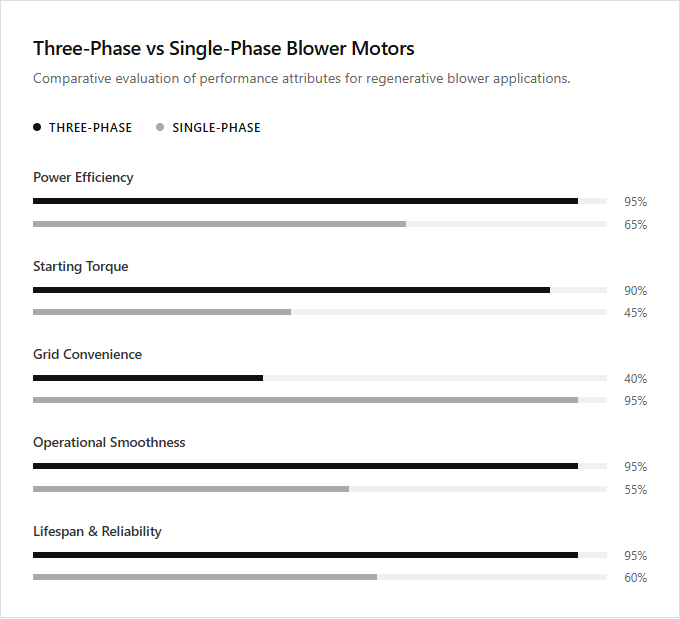
| Factor | Summary |
|---|---|
| Power Efficiency | Three-phase motors operate with higher energy efficiency and a superior power factor compared to single-phase motors, making them ideal for continuous-duty regenerative blowers. |
| Starting Torque | Single-phase motors require auxiliary start capacitors to initiate rotation, whereas three-phase motors inherently produce high self-starting torque without extra components. |
| Power Supply Requirements | Single-phase blowers run on standard utility grids, while three-phase motors require industrial-grade power distribution or a variable frequency drive (VFD) to operate. |
| Operational Smoothness | The constant power delivery of a three-phase system reduces harmonic vibration and heat generation compared to the pulsating torque of single-phase alternatives. |
| Maintenance and Lifespan | Lacking centrifugal switches and starting capacitors, three-phase motors have fewer failure points and offer a longer mean time between failures in demanding industrial blower applications. |
Precise Aeration Control with Three-Phase VFDs
When selecting a regenerative blower, the choice between single-phase and three-phase motors depends on power availability and flow control requirements. Single-phase motors are highly convenient for standard electrical grids but offer limited speed adjustment. In contrast, three-phase motors provide superior operational efficiency and seamless compatibility with Variable Frequency Drives (VFDs).
Integrating a VFD with a three-phase blower enables precise aeration flow control by modulating motor speed rather than using restrictive mechanical valves. This dynamic adjustment optimizes dissolved oxygen levels in wastewater treatment and aquaculture, significantly reducing energy consumption and mechanical wear during low-demand periods.
Single-phase blowers are best suited for small-scale operators seeking straightforward plug-and-play installation, while three-phase VFD systems are ideal for industrial facility managers requiring automated, high-precision flow regulation.
High-Efficiency, Low-Slip Industrial Three-Phase Motors
Regenerative blowers rely heavily on motor performance to sustain continuous industrial operations. Three-phase blower motors deliver significantly higher nominal efficiency compared to their single-phase counterparts. By distributing the electrical load evenly across three alternating currents, these systems minimize energy losses and experience reduced heat buildup during extended duty cycles.
Additionally, three-phase motors exhibit substantially lower motor slip under load. This minimal slip ensures stable rotational speeds and consistent airflow pressure, which are vital for maintaining process integrity in demanding applications. Single-phase alternatives, while simpler to integrate, suffer from greater speed fluctuations and higher thermal stress under constant resistance.
Single-phase blowers are ideal for utility operators performing intermittent, light-duty tasks in standard commercial settings, while three-phase units are best suited for industrial facility managers requiring uninterrupted, high-efficiency operation for heavy-duty manufacturing processes.
Boosting Three-Phase Reliability via Capacitor Elimination
In regenerative blower applications, selecting between three-phase and single-phase motors significantly impacts long-term operational efficiency. Single-phase motors rely on start and run capacitors to initiate and maintain rotation, components that are notoriously prone to thermal degradation under continuous-duty cycles.
Three-phase configurations eliminate these failure-prone capacitors entirely by utilizing a balanced, naturally rotating magnetic field. This mechanical simplification reduces maintenance overhead, minimizes unexpected downtime, and substantially improves the system's Mean Time Between Failures (MTBF).
Single-phase blowers are ideal for utility-constrained operators requiring intermittent service, while three-phase units are suited for industrial engineers demanding maximum reliability in continuous-duty environments.
Three-Phase Motor Power Factor: Reducing Utility Penalties
When selecting regenerative blowers, the choice between three-phase and single-phase motors significantly impacts operational efficiency. Three-phase blower motors offer a superior power factor compared to their single-phase counterparts. This inherent electrical efficiency minimizes reactive power demand on the power grid, optimizing energy consumption during continuous industrial operations.
By reducing reactive power draw, three-phase systems mitigate the risk of costly utility power factor penalties often imposed on high-capacity facilities. While single-phase motors are easier to integrate into standard electrical grids, they exhibit lower power factors and higher current draw. Single-phase blowers are ideal for small-scale workshop operators requiring straightforward installation, whereas three-phase models are best suited for industrial facility managers aiming to minimize utility surcharges in continuous-duty applications.
High-Torque Three-Phase Motors for Aeration Backpressure
Regenerative blowers require reliable motor configurations to handle demanding startup conditions, particularly in wastewater aeration and industrial processing. Three-phase blower motors offer a distinct mechanical advantage over single-phase counterparts due to their higher locked-rotor torque. This elevated starting torque allows three-phase systems to easily overcome the high initial backpressure caused by standing liquid columns before airflow is fully established.
Single-phase motors, while simpler to integrate into standard electrical grids, struggle with high startup resistance and often require auxiliary starting capacitors. They deliver lower starting torque, making them prone to stalling under heavy initial loads. Industrial facility managers with heavy-duty power infrastructure prefer three-phase blowers for continuous, high-pressure operations, whereas small-scale operators and workshop technicians benefit from the plug-and-play simplicity of single-phase units.
Power-Dense Three-Phase Motors Maximize Volumetric Flow
When selecting a regenerative blower, the choice between three-phase and single-phase motors significantly impacts operational efficiency. Three-phase motors offer a vastly superior power density compared to their single-phase counterparts. This elevated power density allows industrial systems to maximize volumetric flow rates within a highly compact physical footprint, delivering high-velocity air movement without requiring expansive equipment space.
Single-phase motors remain highly reliable for standard applications but require larger frames to match the output of three-phase alternatives. Three-phase units operate with greater electrical efficiency, reduced vibration, and consistent torque distribution. Heavy-duty industrial operators requiring continuous, high-capacity performance benefit most from three-phase models, while small-scale workshop technicians with standard utility access are ideal candidates for single-phase systems.
Balanced Phase Currents Extend Winding Insulation Life
In regenerative blowers, the choice between three-phase and single-phase motors significantly impacts long-term operational reliability. Three-phase motors deliver a balanced phase current distribution across three distinct electrical paths. This equilibrium minimizes winding thermal stress and prevents localized hotspots, directly extending the life of the motor's winding insulation. Single-phase motors experience higher current peaks and greater thermal fluctuations, putting more strain on internal components during continuous operation.
While single-phase blowers offer convenient compatibility with standard electrical grids, three-phase systems deliver superior mechanical efficiency and durability under demanding duty cycles. Single-phase models are ideal for utility-restricted operators in small workshops, whereas three-phase configurations are best suited for industrial facility managers requiring continuous, heavy-duty processing power.
Leave a comment