
Woodworkers and fabricators constantly battle the invisible threat of fine ambient dust, which easily bypasses standard dust collectors and compromises long-term respiratory health. While workshop owners typically direct machinery budgets and capital funding toward primary cutting tools, securing clean air requires a dedicated ambient filtration strategy.
Investing in the right workshop air cleaner grants operators a truly hazard-free breathing zone and prevents fine particulate settling. However, we must stipulate that ambient filtration systems are engineered to cycle suspended PM2.5 particles; they function as a secondary defense and are not a replacement for at-the-source dust extraction.
Proven industry standards, such as the Jet AFS-1000B, demonstrate the effectiveness of dedicated ceiling-mounted filtration. To help you select the optimal unit for your space, this article will compare induction motors against universal motors, analyzing their durability, noise levels, and overall power efficiency.
| Factor | Summary |
|---|---|
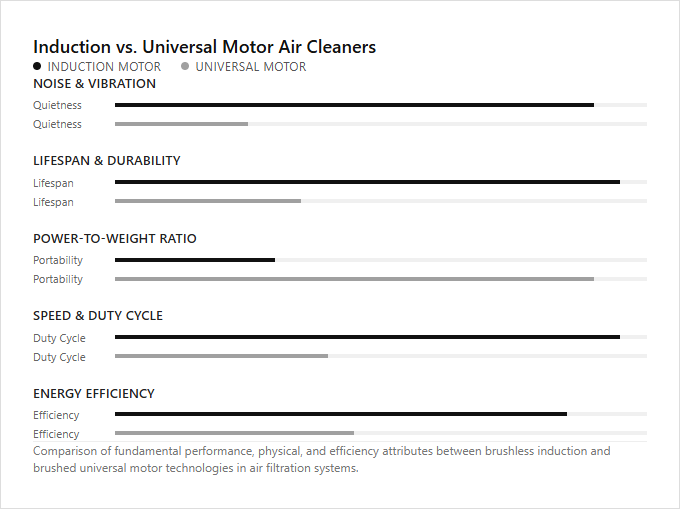
| Noise and Vibration | Induction motor air cleaners operate at a much lower decibel level due to their brushless construction, whereas universal motors produce high-frequency electromagnetic noise and physical vibration. |
| Lifespan and Durability | Induction motors offer an extended operational lifespan because they lack carbon brushes, whereas universal motors require periodic brush replacement due to friction wear. |
| Power-to-Weight Ratio | Universal motor air cleaners feature a superior power-to-weight ratio making them highly portable, while induction motors utilize heavy copper windings and steel laminations that increase bulk. |
| Speed and Duty Cycle | Induction motors run at a constant synchronous speed ideal for continuous duty cycles, whereas universal motors operate at high, variable RPMs that can degrade under prolonged loads. |
| Energy Efficiency | Induction motors exhibit superior electrical efficiency and lower thermal dissipation during long filtration cycles, while universal motors lose significant energy as heat. |
Continuous Induction vs. Intermittent Universal Motors
Induction motor air cleaners are engineered for continuous duty cycles, allowing them to run indefinitely without overheating. These brushless motors operate quietly and efficiently, making them ideal for maintaining constant, clean air filtration in busy workspaces. Their heavy-duty construction ensures long-term reliability during extended woodworking sessions where dust generation is constant.
Conversely, universal motor air cleaners rely on carbon brushes and are rated for intermittent use. While they offer high power-to-weight ratios and are more compact, they require periodic cooling periods to prevent motor burnout. Dedicated professionals requiring non-stop workshop filtration will benefit most from induction models, whereas hobbyists with limited space and occasional filtration needs are well-suited for universal motor units.
TEFC Safety vs. Open-Frame Hazards in Explosive Dust
When managing airborne particulates, the choice of motor in an air cleaner is critical for workshop safety. Induction motors utilize a Totally Enclosed Fan-Cooled (TEFC) housing, which completely seals the internal electrical components from the external environment. This design prevents fine, combustible wood dust from contacting internal electrical arcs, eliminating ignition risks. In contrast, universal motors rely on open-frame housings and carbon brushes that naturally produce sparks during operation, presenting a severe fire hazard in explosive dust atmospheres.
Induction models also operate quietly and are engineered for continuous, long-term duty cycles. Universal motor air cleaners are lighter and more portable but require frequent brush maintenance and present higher operational noise. Heavy-duty professional woodworkers requiring continuous, spark-free filtration benefit most from induction TEFC air cleaners, while hobbyists needing occasional, portable dust management may opt for budget-friendly universal motor units.
Noise and Pitch Variations in Prolonged Filtration
Induction motor air cleaners are engineered for continuous, long-term ambient filtration. Operating at a lower dBA range-typically between 50 and 60 decibels-these units emit a low-frequency hum. This deep, consistent pitch easily fades into the background, minimizing auditory fatigue during extended workshop sessions.
In contrast, universal motor air cleaners run at much higher decibel levels, often exceeding 80 dBA. These motors generate a high-pitched, whining sound due to carbon brush friction and high rotational speeds, making them significantly more disruptive during prolonged filtration runs.
Induction models are best suited for professional artisans requiring quiet, continuous all-day workshop purification, while universal units cater to hobbyists needing portable, budget-friendly filtration for short, intermittent tasks.
Maintenance-Free Induction vs. Wear-Prone Universal Motors
Induction motor air cleaners utilize a brushless design that eliminates physical contact between internal components. This engineering choice results in virtually maintenance-free operation, as there are no mechanical parts to wear down over extended periods of continuous run-time. These systems operate quietly and reliably, ensuring consistent workshop filtration without the need for routine motor servicing.
Universal motor air cleaners rely on carbon brushes and a commutator to transfer electrical current. These components are consumable, experiencing inevitable friction and wear that requires periodic inspection and replacement to prevent motor failure. Stationary induction models are ideal for commercial woodworkers requiring continuous, quiet workshop filtration, while portable universal models best suit DIY hobbyists who prioritize budget and compact, intermittent air cleaning.
CFM Stability of MERV Filters Under Static Pressure
Induction motors maintain highly stable volumetric airflow, measured in Cubic Feet per Minute (CFM), even as MERV-rated filters accumulate particulate matter and increase static pressure. Their torque characteristics allow these motors to resist RPM drops under load, ensuring consistent air exchange. In contrast, universal motors experience a sharp decline in CFM when subjected to the high static pressure of fine-mesh filtration, as their operating speed is highly sensitive to resistance.
Heavy-duty induction systems deliver reliable, quiet performance during extended run cycles, whereas universal motor air cleaners offer higher initial velocity but degrade quickly as filters clog. Commercial workshop managers requiring continuous, high-volume air filtration are best served by induction motor systems, while hobbyists seeking portable, budget-friendly units for intermittent tasks will find universal motor models sufficient.
EMI: Motor Arcing vs. Clean Induction
Universal motor air cleaners rely on carbon brushes and a rotating commutator to transfer electrical current. This mechanical contact inherently creates continuous electrical arcing, which generates significant electromagnetic interference (EMI). This high-frequency noise can disrupt wireless signals and sensitive workshop electronics, often requiring extensive shielding to prevent performance degradation in nearby equipment.
Induction motor air cleaners utilize brushless electromagnetic induction to generate rotation. Lacking physical brushes, they operate without arcing, producing a clean electromagnetic profile with virtually no interference. This ensures a stable environment for surrounding technology and highly reliable, long-term performance. Induction models are ideal for professional craftsmen using sensitive CNC machinery, whereas compact universal motor units are best suited for hobbyists seeking portable, budget-friendly air filtration.
MTBF and Lifespan: Induction vs. Universal Motors
Capacitor-run induction motors offer a significantly higher Mean Time Between Failures (MTBF) compared to universal motors, largely due to their brushless design. Without carbon brushes to wear out, induction motors experience minimal mechanical friction, allowing them to operate quietly and continuously for tens of thousands of hours with virtually no maintenance. In contrast, universal motors rely on physical brushes and commutators that degrade rapidly under constant load, resulting in a much shorter overall service life and a lower MTBF that necessitates regular brush replacement.
While induction motors run coolly over extended periods, universal motors deliver high power-to-weight ratios at the expense of longevity and acoustic comfort. Stationary workshop owners seeking quiet, long-term continuous filtration will benefit most from induction models, whereas mobile contractors requiring compact, high-output air cleaners for short-duration tasks are better suited for universal motor designs.
Leave a comment