
Woodworkers and craftspeople constantly battle invisible, fine airborne dust that bypasses standard dust collectors, settling on surfaces and threatening long-term respiratory health. Traditionally, resolving this airborne hazard involves tapping into standard equipment budgets for massive ductwork overhauls or costly source-capture system upgrades.
However, optimizing your ambient workshop air cleaner is a far more cost-effective alternative that grants operators pristine air quality without exhausting capital resources. Under the stipulation that no single filtration setup fits every environment, balancing Cubic Feet per Minute (CFM) with fine micron filtration is critical; excessive static pressure can choke machine performance. For example, a typical two-car garage workshop utilizing a 1,000 CFM ceiling-mounted air cleaner will experience drastically different air exchange rates depending on the media density.
Below, we will analyze the technical trade-offs between MERV 11 and MERV 15 filters, evaluate their direct impact on airflow velocity, and guide you to the optimal filtration balance for your workspace.
| Factor | Summary |
|---|---|
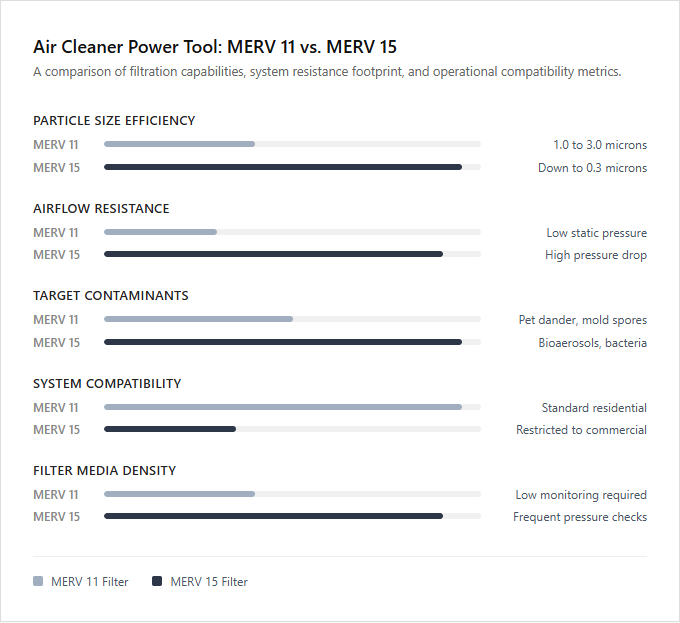
| Particle Size Efficiency | MERV 15 filters trap extremely fine particulate matter down to 0.3 microns, whereas MERV 11 filters are limited to capturing larger particles between 1.0 and 3.0 microns. |
| Airflow Resistance | A MERV 15 filter causes a higher pressure drop within the air cleaner, requiring a more powerful blower motor compared to the lower static pressure resistance of a MERV 11 filter. |
| Target Contaminants | MERV 11 filters successfully capture common allergens like pet dander and mold spores, while MERV 15 filters are rated to capture microscopic bioaerosols, bacteria, and carbon dust. |
| System Compatibility | High-efficiency MERV 15 filters are typically restricted to commercial HVAC systems due to their high airflow resistance, while MERV 11 filters are widely compatible with standard residential air handlers. |
| Filter Media Density | Because MERV 15 filters utilize a much denser synthetic media to capture smaller particles, they often require more frequent pressure differential monitoring to prevent system strain compared to MERV 11 filters. |
MERV 15 Filters Restrict Airflow More Than MERV 11
Selecting the appropriate Minimum Efficiency Reporting Value (MERV) rating for an air cleaner requires a careful balance between filtration efficiency and system performance. While a MERV 15 filter captures much smaller particulate matter than a MERV 11 filter, it introduces a significantly higher static pressure drop. This increased resistance restricts the system's volumetric airflow rate, which can strain the HVAC blower motor and reduce overall heating and cooling efficiency.
A MERV 11 filter maintains a lower static pressure, allowing for optimal airflow and consistent climate control without overworking the equipment. MERV 11 filters are ideal for standard residential homeowners seeking balanced allergen relief, whereas MERV 15 filters are best suited for commercial facility managers or individuals with severe respiratory vulnerabilities who operate high-capacity HVAC systems designed to handle elevated resistance.
MERV 15 vs. MERV 11: Fine Particle Filtration
When selecting filtration for workshop air cleaners, understanding the distinction between MERV ratings is essential for maintaining workplace safety and air quality. A MERV 15 filter provides superior containment by capturing sub-micron particles down to 0.3 microns with high fractional efficiency. This level of filtration effectively traps microscopic hazards such as fine hardwood dust, smoke, and engineered wood resins that often bypass standard filtration systems.
In contrast, a MERV 11 filter is limited to larger particulate matter, capturing bulk sawdust and coarser debris. While it offers lower airflow resistance, it lacks the capability to arrest the finest, most hazardous respiratory irritants. A MERV 11 system is ideal for casual hobbyists working primarily with solid lumber in well-ventilated spaces, whereas a MERV 15 system is suited for professional woodworkers and sensitive individuals requiring maximum protection against invisible, airborne particulates.
Low-Resistance MERV 11 Filters Maximize Workshop ACH
When selecting filtration for a workshop air cleaner, balancing particle capture with airflow is essential. A MERV 11 filter offers lower airflow resistance than a MERV 15 filter. This reduced resistance allows the air cleaner to maximize the Air Changes per Hour (ACH) within the workshop volume, rapidly cycling the air to capture suspended dust before it settles.
While the denser media of a MERV 15 filter provides superior sub-micron particle capture, it restricts airflow velocity. A MERV 11 filter is best suited for general woodworkers prioritizing rapid ambient dust clearance, while a MERV 15 filter is ideal for specialists handling highly toxic materials who require ultra-fine air purification.
Why MERV 15 Filters Need Pre-Filters to Prevent Clogging
Selecting filtration for industrial air cleaners requires balancing air purity with equipment longevity. While MERV 15 filters offer superior capture of sub-micron particles, this high-efficiency media is highly susceptible to rapid face loading and premature blinding when operated without a coarse pre-filter. Heavy particulate quickly restricts airflow, degrading tool performance and increasing replacement costs.
MERV 11 filters provide a more resilient option, managing larger dust particles without immediate clogging to maintain stable airflow. MERV 11 systems are ideal for DIY woodworkers seeking budget-friendly, low-maintenance dust control, whereas MERV 15 setups are best suited for professional lab technicians requiring sterile environments and utilizing multi-stage filtration.
MERV 15 Upgrades Require High-Static Blower Motors
When evaluating air filtration upgrades for ventilation systems, the transition from a MERV 11 to a MERV 15 filter significantly impacts system aerodynamics. A MERV 15 filter possesses a much denser media structure, which increases initial and operational static pressure. Upgrading to a MERV 15 filter shifts the system operating point along the fan curve, necessitating a blower motor designed for high static resistance to maintain proper airflow and prevent equipment strain.
Standard MERV 11 filters provide reliable particulate capture with minimal resistance, ensuring compatibility with conventional residential HVAC blowers. MERV 11 filters are best suited for typical homeowners seeking balanced everyday allergen control, while MERV 15 filters are designed for commercial operators and highly sensitive individuals requiring hospital-grade air purification within robust, high-pressure HVAC systems.
Multi-Stage Filtration Design for MERV 15 Protection
In workshop air filtration, selecting between MERV 11 and MERV 15 filters involves balancing cost with particle capture efficiency. A MERV 11 filter serves as an effective, economical barrier against standard workshop dust. Conversely, a MERV 15 filter targets sub-micron particles, offering superior air purification for fine wood dust.
Deploying a MERV 15 system in high-volume environments requires a multi-stage filtration design. Without a MERV 11 pre-filter to capture bulk debris, the expensive MERV 15 secondary filter would rapidly clog. This staged configuration protects the premium secondary element, ensuring efficient airflow and lower overall maintenance costs.
Budget-conscious hobbyists cutting standard lumber typically benefit from MERV 11 filters, whereas professional woodworkers handling exotic hardwoods or working in enclosed commercial spaces require the advanced protection of a MERV 15 system.
MERV 15 (PM2.5) vs. MERV 11 (PM10) Dust Filtration
Selecting the appropriate filtration level for workshop air cleaners is essential for maintaining safety and air quality. The primary distinction between MERV 11 and MERV 15 filters lies in their particle collection efficiency. MERV 11 filters are designed to capture larger airborne particulates, focusing primarily on PM10 dust, which includes coarse sawdust generated by basic woodworking operations.
MERV 15 filters provide a superior level of protection by targeting hazardous respirable dust within the PM2.5 aerodynamic diameter range. These microscopic particles can bypass human respiratory defenses, making high-efficiency filtration critical during intensive sanding or CNC machining. MERV 11 systems are suitable for casual DIY enthusiasts requiring standard dust management, whereas MERV 15 systems are designed for professional woodworkers and individuals with respiratory sensitivities who demand maximum protection against fine, hazardous particles.
Leave a comment