
Maintaining pristine, debris-free workspaces remains a persistent challenge for precision technicians, where microscopic particulate accumulation routinely threatens mechanical tolerances and component thermal performance. When addressing these maintenance bottlenecks, facility managers typically look to standard equipment budgets or capital improvement funds to upgrade workshop tooling. However, choosing the optimal high-velocity displacement system grants operators immediate improvements in cycle times and long-term asset longevity.
This utility upgrade comes with the technical stipulation that raw output velocity must be carefully balanced against surface sensitivity to prevent electrostatic damage or component displacement. Industry reliance on heavy-duty benchmarks, such as the Guardair 75LJ pneumatic safety nozzle, highlights the critical need for application-specific tool selection.
Below, we conduct a rigorous, comparative analysis of pneumatic blow guns and electric air dusters-evaluating their CFM metrics, operational costs, and physical mobility-to help you select the ultimate air cleaner for your facility.
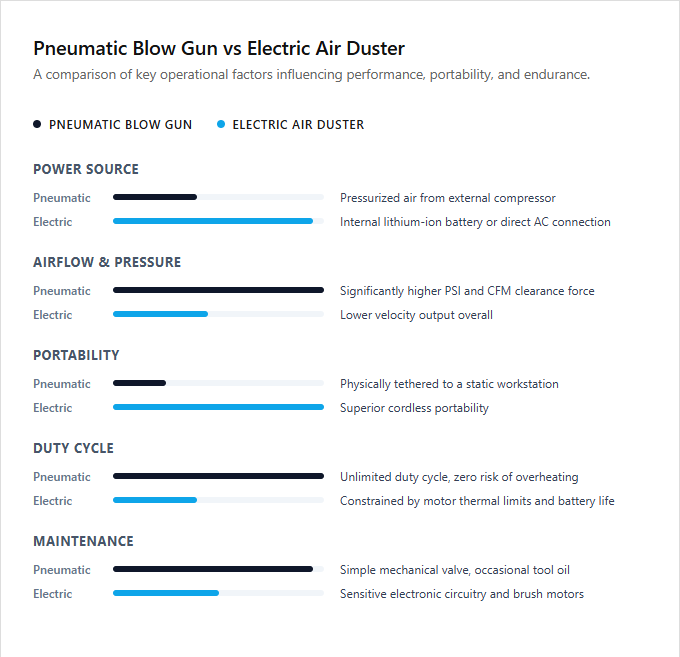
| Factor | Summary |
|---|---|
| Power Source | While the pneumatic blow gun relies on pressurized air generated by an external air compressor, the electric air duster is powered by an internal lithium-ion battery or a direct AC connection. |
| Airflow and Pressure | Pneumatic blow guns deliver significantly higher pounds per square inch (PSI) and cubic feet per minute (CFM) of clearance force compared to the lower velocity output of electric dusters. |
| Portability and Maneuverability | Electric air dusters offer superior cordless portability, whereas pneumatic blow guns are physically tethered to a static workstation by a heavy pneumatic hose. |
| Duty Cycle and Endurance | Pneumatic blow guns support an unlimited duty cycle without risk of overheating, while electric air dusters are constrained by motor thermal limits and battery discharge rates. |
| Maintenance and Durability | Pneumatic blow guns feature a simple mechanical valve design requiring only occasional pneumatic tool oil, whereas electric air dusters depend on sensitive electronic circuitry and brushless motors that are prone to wear. |
Pneumatic Blow Guns Deliver Superior Pressure and CFM
When evaluating air cleaning tools, pneumatic blow guns offer a significant performance advantage over electric air dusters. Pneumatic systems deliver vastly superior peak static pressure and a much higher volumetric flow rate measured in CFM. This high-velocity output allows pneumatic tools to easily dislodge stubborn debris and packed dust from intricate industrial machinery.
Electric air dusters provide a portable, self-contained alternative that operates without a compressed air line. Although electric models deliver consistent airflow for delicate surfaces, they lack the raw clearing power of a pneumatic setup. Industrial technicians requiring maximum force for heavy-duty workshop maintenance benefit most from pneumatic blow guns, while IT specialists and field technicians needing portable, moisture-free cleaning are ideal candidates for electric air dusters.
ESD-Safe Air Dusters Protect Sensitive Circuits
Pneumatic blow guns and electric air dusters serve as vital tools for surface cleaning, yet they differ significantly in application safety. While pneumatic guns deliver high-velocity airflow powered by air compressors, they often carry a risk of static buildup and moisture contamination. Modern electric air dusters address these vulnerabilities, particularly when cleaning delicate electronics. These specialized devices utilize ESD-safe, anti-static housings to actively mitigate electrostatic discharge risks, safeguarding sensitive microchips and circuitry from permanent damage.
Pneumatic blow guns are ideal for heavy-duty industrial workshops where high pressure is required for debris removal, whereas electric air dusters are best suited for IT professionals and electronics technicians who require precise, static-free maintenance on sensitive computer hardware.
Inline Desiccant Filters Prevent Pneumatic Moisture
When selecting between a pneumatic blow gun and an electric air duster for precision cleaning, air purity is a primary technical consideration. Pneumatic systems rely on compressed air, which inherently generates moisture during the compression cycle. To prevent the aerosolization of water droplets onto sensitive electronics or mechanical components, pneumatic setups require inline desiccant filtration. This specialized filtration is essential to guarantee a dry, contaminant-free stream of high-velocity air.
In contrast, electric air dusters utilize high-speed internal motors to generate continuous airflow, entirely eliminating condensation risks without the need for complex filtration infrastructure. Heavy-duty industrial technicians requiring maximum, sustained pressure benefit most from pneumatic blow guns paired with robust air dryers, while IT professionals and field service technicians typically prefer the portable, moisture-free convenience of electric air dusters.
High-RPM Brushless Motors Drive Electric Models
When selecting a professional surface-cleaning power tool, the choice between pneumatic blow guns and electric air dusters depends on your existing infrastructure. Modern electric air dusters utilize high-RPM brushless DC motors for self-contained velocity generation, eliminating the need for external air compressors. These electric units deliver consistent, high-velocity airflow through advanced internal fan dynamics, offering an agile and oil-free cleaning solution.
Pneumatic blow guns, by contrast, rely on established workshop compressor lines to deliver unmatched, sustained pressure for heavy-duty debris removal. Industrial workshop technicians requiring maximum, uninterrupted pressure benefit most from pneumatic blow guns, whereas field IT professionals and electronics repair technicians are better suited for the portable, self-contained electric models.
Efficient, OSHA-Compliant Venturi Pneumatic Blow Guns
In industrial environments, choosing between pneumatic blow guns and electric air dusters depends on efficiency and safety standards. Pneumatic blow guns utilize Venturi nozzles to optimize ambient air entrainment, multiplying the output airflow while maintaining strict OSHA safety compliance by preventing dead-end pressure buildup. This engineering delivers the powerful, continuous thrust required for heavy-duty debris removal in manufacturing facilities.
Electric air dusters offer a highly portable, oil-free alternative powered by electric motors. While they lack the sheer impact force of pneumatic systems, they eliminate the need for bulky air compressors and hoses. Pneumatic blow guns are ideal for industrial machinists requiring high-volume debris clearing in workshops, whereas electric air dusters are best for IT technicians and electronics repair specialists cleaning delicate components.
Electric Dusters: Battery and Thermal Limitations
Selecting the appropriate air-cleaning tool requires understanding the operational limits of pneumatic blow guns and electric air dusters. Pneumatic blow guns deliver continuous, high-velocity airflow powered by an external workshop compressor, ensuring uninterrupted performance during demanding cleanups.
Electric air dusters offer excellent mobility but face distinct limitations under heavy usage. These cordless units are constrained by battery capacity, which restricts their runtime, and they frequently experience thermal throttling during extended duty cycles to prevent the internal motor from overheating.
Pneumatic blow guns are ideal for industrial workshop technicians requiring constant, high-volume debris removal, while electric air dusters are best suited for mobile IT professionals performing light, intermittent cleaning on sensitive electronics.
Pneumatic vs. Electric Dusters: SCFM vs. Wattage
Pneumatic blow guns offer exceptional cleaning force but require a robust support system to operate effectively. These tools demand a high volume of pressurized air, measured in Standard Cubic Feet per Minute (SCFM). Operating a pneumatic gun continuously requires a substantial, stationary air compressor, as small portable tanks will quickly deplete and lose pressure during extended use.
Electric air dusters prioritize convenience with a simple plug-and-play design. Drawing power directly from an electrical outlet or rechargeable battery, their performance is determined by motor wattage, eliminating the need for bulky auxiliary equipment. Pneumatic blow guns are ideal for industrial workshop professionals requiring continuous, heavy-duty debris removal, while electric dusters are best suited for IT technicians and homeowners seeking a portable, low-maintenance cleaning solution.
Leave a comment