
Selecting the incorrect abrasive wheel tool for metal fabrication often leads to ruined workpieces, wasted shop hours, and compromised operator safety. While many facility managers initially rely on standard capital equipment budgets or traditional tool financing to build out their workshops, optimizing operational efficiency requires a more strategic analysis of your primary grinding assets.
Investing in the correct tool grants fabricators a significant competitive edge in both material removal rates and precision finishing. As an educational stipulation, however, users must understand that maximum safety and efficiency are strictly contingent upon matching the abrasive wheel's rated RPM with the specific machine's spindle speed.
For example, preparing bevels on heavy structural steel pipe demands the portability of a high-torque angle grinder, whereas sharpening high-speed steel lathe cutters requires the stable, controlled platform of a bench grinder. This article compares the mechanical specifications, wheel configurations, and safety protocols of both tools to help you choose the ideal equipment for your shop.
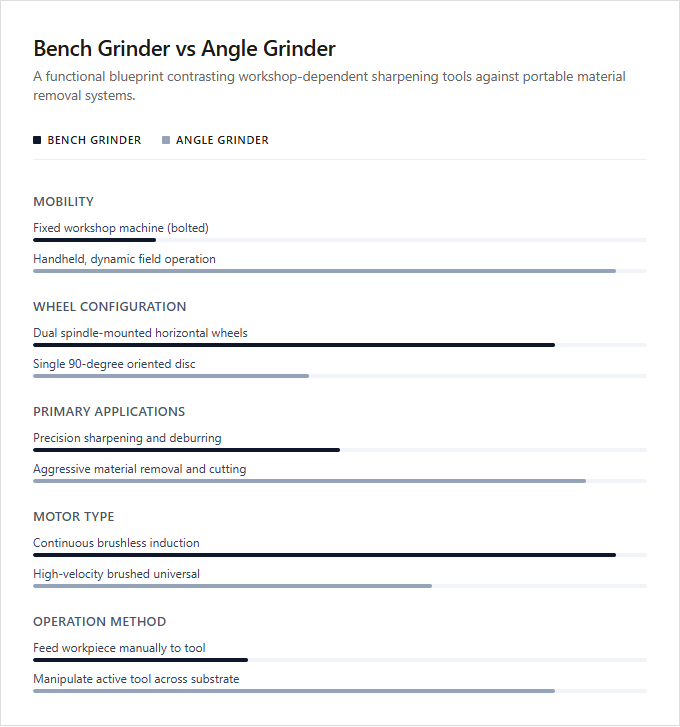
| Factor | Summary |
|---|---|
| Mobility | Bench grinders are fixed workshop machines bolted to a workstation, whereas angle grinders are handheld, highly portable power tools designed for dynamic field operations. |
| Wheel Configuration | Bench grinders feature two spindle-mounted abrasive wheels spinning on a horizontal axis, while angle grinders utilize a single disc oriented at a 90-degree angle to the driveshaft. |
| Primary Applications | Bench grinders are engineered for precision tool sharpening and deburring, whereas angle grinders excel at aggressive material removal, weld dressing, and abrasive cutting. |
| Motor Type | Bench grinders run on quiet, brushless induction motors designed for continuous duty cycles, whereas angle grinders utilize high-velocity brushed universal motors to maximize the tool's power-to-weight ratio. |
| Operation Method | With a bench grinder, the operator manually feeds the workpiece into the stationary wheel, whereas with an angle grinder, the operator manipulates the active tool across a clamped substrate. |
Stationary Bench Grinders vs. Portable Angle Grinders
Bench grinders and angle grinders serve distinct roles in metalworking. Stationary bench grinders are secured to a workshop surface, requiring operators to precisely manipulate the workpiece manually against a fixed, spinning wheel. This configuration offers unmatched stability for detailed grinding, sharpening, and shaping tasks.
In contrast, portable angle grinders offer superior mobility by bringing the tool directly to the metal fabrication workpiece. This handheld design allows operators to maneuver around large, heavy, or awkwardly shaped structures that cannot be easily moved to a workbench.
Bench grinders are ideal for machinists and tool-sharpeners who require high-precision, stationary control, while angle grinders are best suited for mobile welders and fabricators needing versatile, on-site cutting and material removal capabilities.
Angle Grinders Run Faster Than Bench Grinders
Bench grinders and angle grinders serve distinct roles in metalworking, primarily distinguished by their operating speeds. Angle grinders operate at much higher rotational speeds (RPM) and peripheral speeds than standard bench grinders. While a typical bench grinder runs at approximately 3,450 RPM, a standard angle grinder often exceeds 10,000 RPM. This high velocity allows the portable tool to rapidly discard material during heavy cutting and grinding tasks.
The stationary bench grinder offers stability, utilizing lower speeds to prevent overheating and tempering loss. Its fixed wheel configuration provides a steady platform for precision sharpening. Bench grinders are ideal for woodworkers and machinists requiring precise tool maintenance, while portable angle grinders are best suited for fabricators and construction workers needing versatile, on-site material removal.
Wheel Types for Bench and Angle Grinders
Bench grinders and angle grinders serve distinct roles in metalworking and fabrication, primarily distinguished by their design and abrasive compatibility. Bench grinders are stationary workshop machines that utilize rigid vitrified grinding wheels. These dense, vitrified wheels are ideal for heavy material removal, tool sharpening, and shaping metal objects secured by hand.
Angle grinders offer handheld portability and versatility through a different range of consumables. These tools utilize Type 27 depressed center wheels for surface grinding, thin Type 1 cutoff wheels for slicing metal, and abrasive flap discs for finishing and blending welds.
Stationary bench grinders suit machinists and woodworkers needing precise tool sharpening, while portable angle grinders are ideal for fabricators and construction workers requiring mobile cutting and finishing capabilities.
Angle Grinders vs. Bench Grinders: Key Applications
When selecting industrial grinding equipment, understanding the distinct operational capabilities of bench grinders and angle grinders is essential for optimizing workflow efficiency. Angle grinders are highly versatile, handheld tools engineered for high-performance tasks. They achieve a significantly higher material removal rate (MRR) on large weldments and heavy structural components due to their maneuverability and high power output, making them indispensable for rapid surface preparation and heavy fabrication.
In contrast, bench grinders are stationary units designed for precision and stability. These tools excel at localized deburring, shaping small workpieces, and restoring the sharp cutting edges of workshop tools. While the angle grinder is ideal for mobile fabricators and construction workers requiring aggressive metal removal, the bench grinder is best suited for machinists and maintenance technicians focused on precise tool sharpening and detailed finishing.
Bench and Angle Grinder Safety Essentials
Bench grinders and angle grinders serve distinct workshop functions, each requiring specific safety protocols to protect the operator. Bench grinder safety relies on adjustable tool rests and spark guards. Operators must maintain a gap of no more than one-eighth of an inch between the tool rest and the grinding wheel to prevent the workpiece from pulling downward, while properly adjusted spark guards shield the eyes from hot debris.
Angle grinder safety depends on wheel guard positioning and managing kickback force. Because these are handheld tools, users must position the adjustable guard to block sparks and wheel fragments, while maintaining a secure, two-handed grip to control sudden directional binding. Stationary bench grinders are ideal for machinists needing precise tool sharpening, while portable angle grinders are best suited for field welders requiring mobile cutting and grinding capabilities.
Angle Grinders vs. Bench Grinders for Heavy Steel
Bench grinders and angle grinders serve distinct functions in industrial metalworking. While bench grinders offer stationary stability, they are restricted by wheel diameter and housing clearance, limiting their application to smaller workpieces and tool sharpening. Portable angle grinders provide the necessary maneuverability to overcome these physical boundaries on larger projects.
This flexibility allows operators to perform deep beveling and weld blending on heavy structural steel directly on-site, adapting easily to complex geometries. Stationary bench grinders are best suited for workshop technicians who require precision edge maintenance and tool sharpening, while versatile angle grinders are ideal for field welders and fabricators managing heavy structural installations.
Bench vs. Angle Grinders: Abrasives and Uses
Bench grinders and angle grinders serve distinct roles in workshop fabrication, primarily differentiated by their physical operation and accessory compatibility. Stationary bench grinders accept wire wheel brushes and buffing wheels, making them highly effective for dedicated surface conditioning, rust stripping, and precise polishing. This fixed configuration allows operators to safely manipulate workpieces with both hands against a stable wheel.
In contrast, handheld angle grinders offer portable maneuverability for dynamic applications. These tools utilize fiber discs and non-woven abrasives for detailed surface finishing, weld blending, and localized material removal. Stationary bench grinders are ideal for workshop technicians who require stable, repetitive sharpening and polishing, while angle grinders are suited for mobile fabricators needing versatile, on-the-go cutting and grinding capabilities.
Leave a comment