
Achieving consistent, high-precision force application without damaging delicate components remains a persistent struggle for fabricators and precision engineers. Often, facilities look to standard hydraulic machinery or conventional benchtop equipment to bridge this gap, viewing them as the default capital investments for the shop floor. However, optimizing your mechanical advantage through manual arbor presses grants operators an unmatched level of tactile feedback and micro-adjustment capability that automated systems simply cannot replicate.
Crucially, this operational benefit carries a clear stipulation: raw force delivery is only as effective as the leverage mechanism driving it. For demanding applications such as high-tolerance bearing installations or delicate electronic assemblies, selecting the incorrect press configuration can quickly lead to component deformation or operator fatigue.
To help you make an informed procurement decision, this article provides a detailed comparison of Single Leverage and Ratchet Leverage Arbor Presses, analyzing their mechanical advantage, ergonomics, and ideal application profiles to optimize your precision pressing operations.
| Factor | Summary |
|---|---|
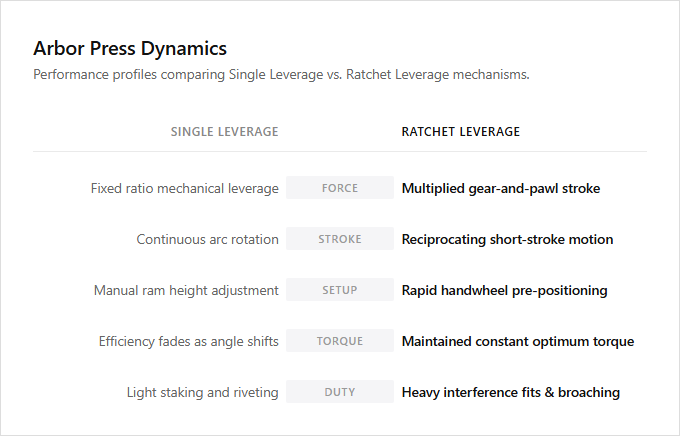
| Mechanical Advantage | Single leverage presses provide a fixed mechanical advantage determined solely by the lever length, whereas ratchet leverage presses utilize a gear-and-pawl mechanism to multiply force throughout the entire stroke. |
| Lever Operation | Single leverage handles must rotate through a continuous arc to descend the ram, while ratchet leverage presses allow reciprocating, short-stroke handle movements to maintain optimal operator ergonomics. |
| Ram Pre-positioning | Single leverage presses require manual height adjustment via the main lever, whereas ratchet models often feature a handwheel for rapid ram advancement to the workpiece before applying force. |
| Force Consistency | Single leverage presses lose force efficiency as the handle angle changes, while ratchet leverage presses allow the operator to reset the handle position to maintain maximum torque output. |
| Ideal Applications | Single leverage presses are best suited for light-duty assembly like staking or riveting, whereas ratchet leverage presses excel at heavy-duty interference fits and broaching operations. |
Direct-drive pinion gear engagement versus ratchet-and-pawl mechanisms
Single leverage arbor presses employ a direct-drive pinion gear engagement, where the hand lever directly rotates the pinion to drive the ram. This robust design provides immediate tactile feedback and precise control over pressure, as the operator directly feels the resistance of the workpiece during operation.
In contrast, ratchet leverage presses utilize a ratchet-and-pawl mechanism. This configuration allows the operator to position the hand lever at the most ergonomic angle for optimal mechanical advantage, enabling greater force application through incremental strokes without altering the ram's position.
Direct-drive models are ideal for assembly technicians requiring delicate tactile feedback for precision work, while ratchet configurations suit heavy-duty fabricators who need maximum force leverage for high-tonnage applications.
Constant mechanical advantage throughout the stroke duration
Arbor presses utilize mechanical leverage to apply precise force. The single leverage arbor press features a direct lever design, delivering a constant mechanical advantage throughout the entire stroke duration. This ensures a predictable, uniform force application from start to finish. The ratchet leverage arbor press incorporates a ratcheting mechanism that allows the operator to reposition the lever. This design maintains a constant leverage ratio during each individual stroke segment while enabling multiple short strokes to execute a longer overall ram travel.
The single leverage model is best suited for operators performing quick, repetitive, light-duty pressing, whereas the ratchet leverage design is ideal for technicians executing high-force, heavy-duty applications requiring maximum leverage in restricted spaces.
Ergonomic angular displacement optimization of the hand lever
In manual press operations, the ergonomic angular displacement of the hand lever directly impacts operator fatigue and force transmission. Single leverage arbor presses feature a fixed lever design, requiring a continuous, wide angular sweep to actuate the ram. This configuration demands consistent physical effort through a predetermined arc, making the lever's initial starting angle critical for optimal biomechanical leverage.
Ratchet leverage arbor presses optimize angular displacement by allowing the operator to adjust the hand lever's starting position. This mechanism enables short, repetitive strokes within the operator's most efficient strength zone, maximizing mechanical advantage without requiring a full rotational sweep. Single leverage presses are ideal for high-speed technicians performing light-duty, repetitive tasks, whereas ratchet leverage models are suited for heavy-duty industrial operators requiring maximum force exertion with minimized physical strain.
Tactile feedback sensitivity for precise force regulation during pressing
Single leverage arbor presses provide an uninterrupted mechanical connection between the operator and the workpiece. This direct link offers exceptional tactile feedback sensitivity, allowing operators to feel minor variations in resistance and regulate force with high precision. This direct control is vital when working with delicate materials where immediate manual adjustments prevent component damage.
Ratchet leverage presses utilize a gear mechanism to reposition the hand lever, maximizing mechanical advantage for high-force applications. While highly efficient for generating power, this multi-component assembly dampens the feedback, reducing the operator's ability to feel minute resistance changes during the press cycle.
Single leverage models are suited for precision technicians performing delicate assemblies, while ratchet leverage presses are ideal for heavy-duty industrial operators requiring maximum physical leverage.
Continuous ram stroke progression without lever resetting
Single leverage arbor presses offer direct, continuous ram stroke progression without the need for lever resetting. This design allows operators to complete a full stroke in a single fluid motion, providing consistent tactile feedback and high efficiency for rapid, short-run applications.
In contrast, ratchet leverage arbor presses utilize a ratcheting mechanism to maintain ram position while the lever is repositioned. While this allows for optimal hand positioning and increased mechanical advantage during heavy-duty operations, it introduces pauses in the stroke progression.
Choosing the correct configuration depends on your specific workflow requirements. Single leverage models are best suited for operators performing light, repetitive assembly tasks requiring speed, whereas ratchet models are ideal for technicians executing high-force press fits that demand maximum mechanical leverage.
Maximum torque multiplication via incremental lever positioning
Single leverage arbor presses employ a fixed hand lever directly coupled to the pinion, delivering rapid ram movement and direct tactile feedback. Because the lever position is static relative to the gear, achieving maximum torque multiplication is restricted to a specific physical arc during the stroke. This limits the operator's ability to maintain peak leverage over longer pressing distances.
Ratchet leverage arbor presses utilize a ratcheting mechanism to permit incremental lever positioning. This design allows operators to repeatedly reposition the handle to the most mechanically advantageous angle, sustaining maximum torque multiplication throughout the entire press stroke. Single leverage models are ideal for assembly technicians performing rapid, light-duty pressing, while ratchet leverage models best suit industrial machinists executing high-force, repetitive broaching and bending operations.
Systemic backlash variations affecting positional tolerance and alignment
Single leverage arbor presses employ a direct-drive mechanism that establishes a rigid connection between the lever and the ram. This direct engagement minimizes systemic backlash, ensuring exceptional positional tolerance and consistent axial alignment during delicate pressing operations.
In contrast, ratchet leverage arbor presses incorporate a gear-and-pawl mechanism to allow incremental handle repositioning. While this configuration increases mechanical advantage, the additional interlocking components introduce cumulative backlash, which can slightly compromise absolute positional repeatability under shifting loads.
The single leverage design is ideal for precision instrument makers requiring micro-tolerance alignment, while the ratchet leverage model is best suited for heavy-duty maintenance technicians who require maximum ergonomic force for high-load installations.
Leave a comment