
Selecting the wrong angle grinder accessory often leads to stalled projects, ruined workpieces, and wasted expenditure-a frustrating struggle familiar to many fabricators and DIY enthusiasts alike. While relying on standard, all-purpose abrasive discs is the traditional default in most workshops, this compromise rarely delivers optimal results across diverse tasks.
Choosing the precise accessory for the job grants operators unmatched cutting efficiency, cleaner finishes, and extended tool lifespan. However, achieving these benefits is contingent upon understanding specific application stipulations, such as material thickness, pressure thresholds, and RPM compatibility. For instance, attempting to grind down heavy weld seams using a thin cutting disc designed solely for sheet metal can compromise both workpiece integrity and operator safety.
This article provides a comprehensive comparison between cutting discs and grinding wheels. We will examine their distinct structural profiles, safety ratings, and ideal material applications to ensure you select the optimal accessory for your next project.
| Factor | Summary |
|---|---|
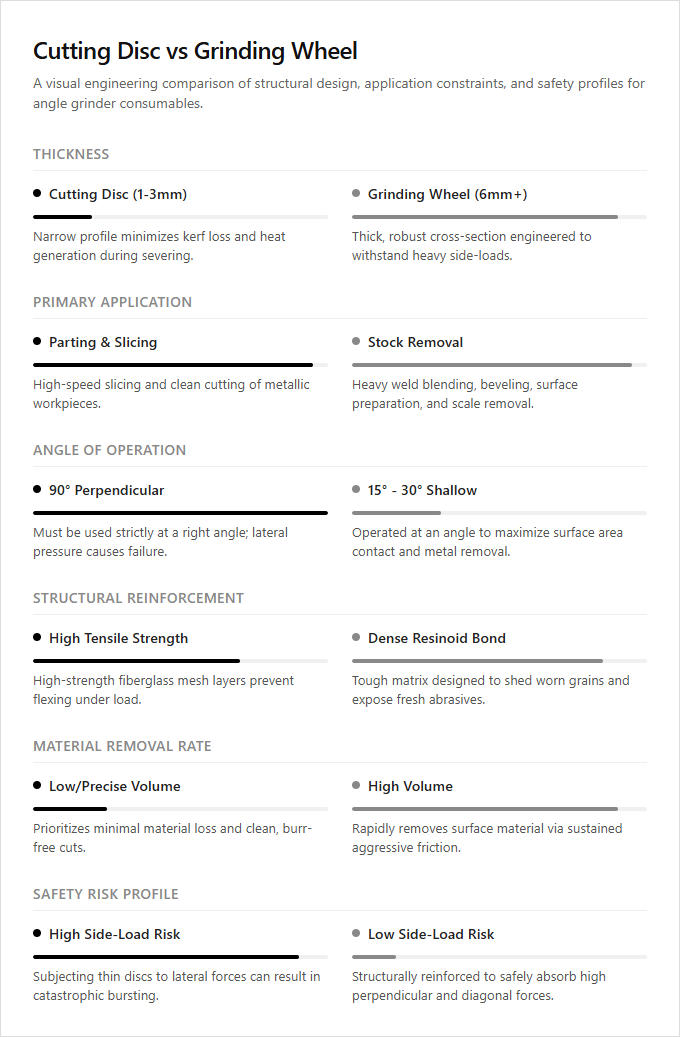
| Thickness | Cutting discs feature a narrow profile, typically 1mm to 3mm, to minimize kerf loss, whereas grinding wheels are much thicker, usually 6mm or more, to endure radial and axial stresses. |
| Primary Application | Cutting discs are engineered for rapid parting and slicing of metals, while grinding wheels are designed for heavy stock removal, beveling, and weld blending. |
| Angle of Operation | Cutting discs must be operated strictly perpendicular at a 90-degree angle to the workpiece, whereas grinding wheels are designed for surface contact at a 15-to-30-degree angle. |
| Structural Reinforcement | Both consumables utilize fiberglass mesh reinforcement, but cutting discs prioritize high tensile strength to prevent flexing, while grinding wheels utilize dense resinoid bonds for abrasive longevity. |
| Material Removal Rate | Grinding wheels offer a superior material removal rate by exposing new abrasive grains during high-pressure friction, whereas cutting discs focus on precision severing with minimal thermal discoloration. |
| Safety Risk Profile | Subjecting a cutting disc to side-loading forces can cause catastrophic wheel fragmentation, whereas grinding wheels are structurally rated to handle heavy lateral grinding loads. |
Type 41 Flat vs. Type 27 Depressed Wheels
The Type 41 flat cut-off disc is engineered specifically for precise, perpendicular slicing. Its completely flat profile maximizes the usable cutting surface and allows for deep, straight penetrations into metal pipes, angles, and sheets. Because it lacks a depressed hub, operators can utilize the entire diameter of the wheel, though they must ensure the grinder's mounting hardware does not interfere with the workpiece.
In contrast, the Type 27 depressed center geometry features a recessed hub that accommodates the locking nut. This design enables operators to grind at shallow angles-typically 15 to 30 degrees-and perform flush blending without the mounting hardware contacting the metal. While Type 27 wheels are primarily designed for heavy material removal and weld dressing, thin variations can also perform light slotting.
Precision fabricators requiring clean, deep parting cuts will benefit most from the streamlined Type 41 discs, while industrial welders and maintenance technicians should choose Type 27 wheels for versatile surface preparation and heavy-duty weld blending.
90-degree perpendicular contact angle versus 15-to-30-degree working angle range
An angle grinder requires specific accessories depending on the task, primarily distinguished by their design and operational angles. Cutting discs are engineered for slicing through materials and must be operated at a strict 90-degree perpendicular contact angle to the workpiece. This perpendicular approach ensures clean, straight cuts while preventing lateral pressure, which could cause the thin disc to shatter.
In contrast, grinding wheels are much thicker and designed for surface material removal, operating most efficiently at a 15-to-30-degree working angle range. This angled orientation allows the wheel's face to blend welds and smooth rough edges safely and effectively. Fabrication professionals requiring precise metal separation will benefit most from cutting discs, while welders and metal finishers focusing on surface preparation will find the grinding wheel indispensable.
Slicing Kerf Width vs. Grinding Load Capacity
Cutting discs are engineered with an extremely thin profile to minimize kerf width, which reduces material waste and allows for rapid, precise slicing through metal or masonry. This narrow cross-section minimizes friction and heat buildup during penetration, though it leaves the disc vulnerable to bending or shattering if subjected to side pressure.
Grinding wheels feature a much thicker design built to withstand high lateral loads during heavy face-grinding and surface preparation. This structural reinforcement ensures safety and stability when applying significant force to flat surfaces, making them highly effective for weld blending, deburring, and heavy stock removal.
Fabricators requiring precise, clean cuts benefit most from cutting discs, while industrial welders and metal workers performing heavy surface finishing are best suited for grinding wheels.
Fiberglass mesh reinforcement layers for structural integrity under centrifugal force
Angle grinders utilize both cutting discs and grinding wheels, which rely heavily on integrated fiberglass mesh reinforcement for safety. This structural reinforcement is critical for counteracting the immense centrifugal forces generated during high-RPM operations. While cutting discs are thin and typically feature one or two layers of mesh to maintain rigidity during straight, narrow cuts, grinding wheels are significantly thicker, incorporating multiple heavy-duty fiberglass layers to withstand severe lateral pressure and prevent catastrophic wheel failure.
The choice between these abrasives depends on the specific demands of the task and the user's operational needs. Thin cutting discs are ideal for fabrication specialists requiring rapid, precise metal slicing, whereas robust grinding wheels are suited for welders and surface preparation technicians who need to remove heavy material and smooth welds safely.
Material removal rate optimization versus heat-affected zone minimization
Grinding wheels utilize thick, bonded abrasives designed for high-volume material removal. This configuration optimizes stock removal rates by maintaining aggressive contact with the workpiece, making them highly efficient for heavy shaping and weld blending. The sustained friction generates substantial thermal energy, increasing the risk of creating a prominent heat-affected zone that can compromise metallurgical properties.
Cutting discs, by comparison, feature an ultra-thin profile engineered to minimize kerf and reduce frictional heat. This design restricts thermal transfer to the surrounding metal, protecting the workpiece from discoloration and structural degradation. Heavy-duty metal fabricators requiring rapid bulk stock reduction favor grinding wheels, whereas precision installers working with thin, heat-sensitive alloys rely on cutting discs to preserve material integrity.
Choosing Zirconia, Silicon Carbide, or Aluminum Oxide Abrasives
Angle grinders utilize thin cutting discs for precise slicing and thicker grinding wheels for rapid material removal. The efficiency of both configurations depends heavily on the selected abrasive grain. Aluminum Oxide serves as the durable, cost-effective standard for general-purpose steel processing. For demanding stainless steel applications, Zirconia Alumina provides a self-sharpening grain that extends accessory life under high pressure. Meanwhile, Silicon Carbide delivers the extreme hardness and sharpness required to penetrate non-ferrous metals, concrete, and masonry.
Matching the correct grain to the workpiece optimizes both material removal rates and operator safety. Industrial fabricators working with heavy structural steel benefit most from high-durability Zirconia Alumina grinding wheels, whereas masonry contractors and tile installers require sharp Silicon Carbide cutting discs for precise, clean stone fabrication.
Peripheral operating speed rating and maximum RPM spindle synchronization
Selecting between cutting discs and grinding wheels requires strict attention to peripheral operating speed ratings and spindle RPM synchronization. Both accessories possess specific maximum RPM limits that must never be exceeded by the grinder's spindle speed to prevent structural failure. Because thinner cutting discs and thicker grinding wheels generate distinct centrifugal forces at high velocities, matching the tool's output to the disc's rated peripheral speed is crucial for operational safety.
Operating within these engineered limits ensures maximum efficiency and tool longevity. Thin cutting discs are ideal for fabrication specialists needing precise, rapid metal slicing, while thick grinding wheels are suited for heavy-duty operators performing weld blending and stock removal.
Leave a comment