
Woodworkers and shop managers constantly struggle with airborne debris, compromised air quality, and clogged machinery due to underperforming dust collection. To resolve this, facilities traditionally allocate standard equipment budgets toward simply buying the highest-horsepower collector available, operating under the assumption that raw power equates to clean air.
However, optimizing your shop's health and efficiency requires a more strategic approach. Selecting the precise system-specifically distinguishing between High-Volume, Low-Pressure (HVLP) and Low-Volume, High-Pressure (LVHP) technology-grants operators unmatched static pressure control and a dramatic reduction in tool wear. Achieving this efficiency carries one critical stipulation: CFM (airflow volume) and static vacuum pressure must be perfectly balanced against your specific machinery's port sizes. For example, high-resistance tools like CNC routers or sanders demand a vastly different pneumatic profile than a standard table saw.
In this guide, we will analyze the core technical differences between HVLP and LVHP systems, evaluate the physics of CFM and static pressure, and provide a clear framework for choosing the right dust collector for your workshop.
| Factor | Summary |
|---|---|
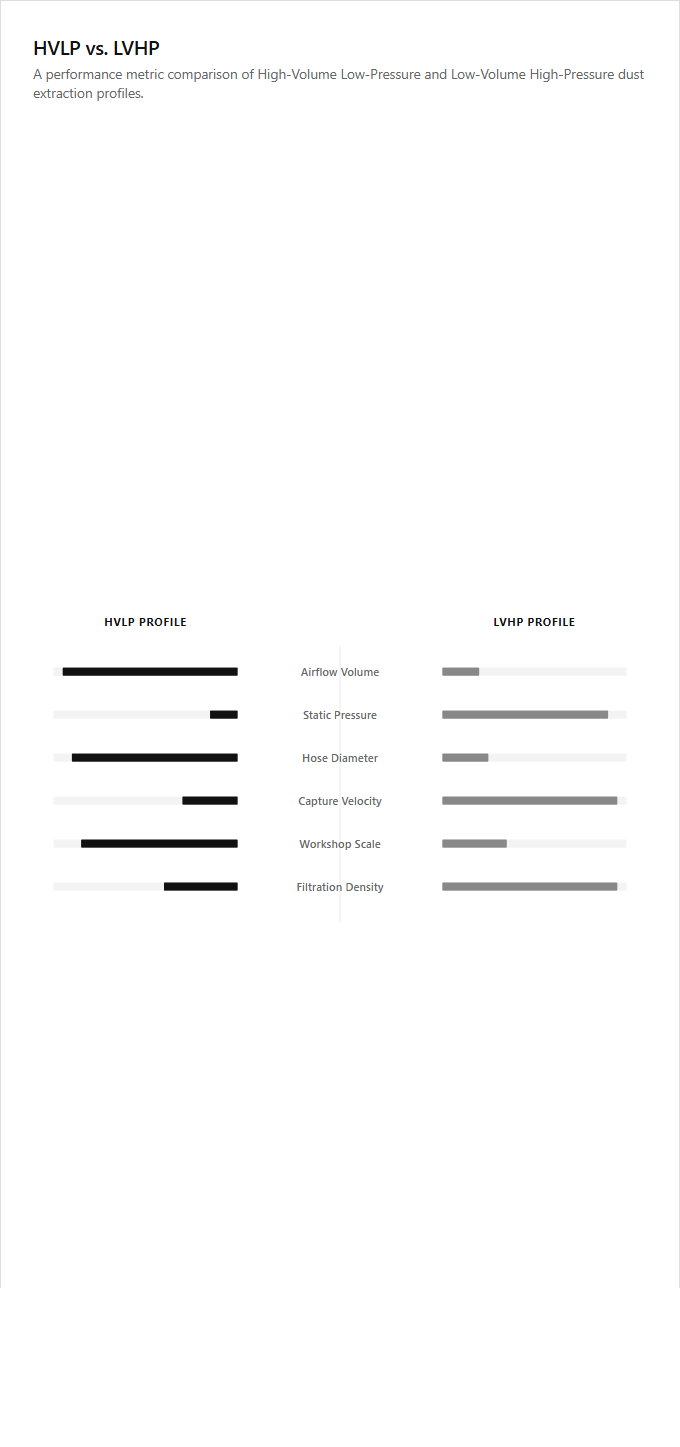
| Airflow Volume | HVLP systems move a massive quantity of air measured in cubic feet per minute (CFM), whereas LVHP systems rely on high suction with minimal air volume. |
| Static Pressure | LVHP collectors generate high static resistance to overcome narrow hoses, while HVLP units operate under low static pressure suited for wide, unobstructed ducts. |
| Hose Diameter | HVLP setups utilize large-diameter hoses to maximize volumetric flow rate, whereas LVHP systems use narrow hoses optimal for high-velocity localized extraction. |
| Collection Efficiency | HVLP is ideal for capturing ambient fine dust over a wide area, while LVHP excels at extracting heavy debris directly at the source using high capture velocity. |
| Ideal Applications | HVLP collectors are best suited for large stationary workshop machinery, whereas LVHP units function as dedicated dust extractors for hand-held power tools. |
| Filtration System | LVHP vacuums often utilize certified HEPA filtration to capture hazardous micro-particles, while HVLP collectors typically use pleated canisters or filter bags to handle bulk waste. |
Why HVLP Dust Collection Requires Large Ducts
In industrial and woodworking environments, selecting the appropriate dust collection system depends on the pressure and volume requirements of the workshop. High Volume Low Pressure (HVLP) systems are designed for machine-level dust collection, where moving a massive quantity of air is essential to capture debris. To maximize cubic feet per minute (CFM) and maintain optimal airflow, HVLP setups require large duct diameters, typically four inches or greater, to minimize static pressure resistance.
In contrast, Low Volume High Pressure (LVHP) systems utilize smaller, flexible hoses to generate high suction over a concentrated area, making them ideal for localized source capture. Aligning these technical specifications with shop requirements ensures efficient waste management and air filtration. HVLP systems are ideal for professional woodworkers operating stationary machinery, whereas LVHP systems are best suited for technicians utilizing hand-held power tools in compact workspaces.
How LVHP Vacuums Overcome Narrow Hose Resistance
Dust collection systems in workshops generally fall into two categories: High Volume Low Pressure (HVLP) and Low Volume High Pressure (LVHP). LVHP systems, such as standard shop vacuums, are specifically engineered to overcome the high airflow resistance inherent in narrow-diameter hoses. These units utilize a high static pressure water column to pull air forcefully through restricted openings, making them highly efficient at capturing heavy debris directly at the source.
Conversely, HVLP dust collectors move massive volumes of air at lower velocity through wide ductwork, which is ideal for managing fine ambient dust from large machinery. Tradespeople requiring precise, localized extraction for small power tools will find the high-suction LVHP systems most suitable, whereas production woodworkers operating heavy-duty machinery require the high-capacity airflow of HVLP systems.
Centrifugal Impellers Power Industrial HVLP Collectors
Industrial dust collection systems are categorized into High Volume Low Pressure (HVLP) and Low Volume High Pressure (LVHP) configurations. Industrial HVLP collectors rely on centrifugal impellers to move massive volumes of air at low resistance. This mechanical design is highly efficient at capturing large clouds of airborne particulates across wide duct networks before they can settle in the workspace.
In contrast, LVHP systems generate high suction through narrow hoses to pull debris from concentrated, high-resistance points. Woodworking facility operators managing large-scale machinery find HVLP systems indispensable for overall shop air quality, whereas individual artisans utilizing handheld power tools with small extraction ports are best served by the localized suction of LVHP units.
How Bypass Motors Power High-Suction LVHP Extractors
When designing a workshop dust collection system, operators must choose between High-Volume, Low-Pressure (HVLP) and Low-Volume, High-Pressure (LVHP) configurations. HVLP systems excel at moving large volumes of air through wide ductwork to manage waste from stationary machinery. In contrast, LVHP extractors are designed to capture fine dust directly at the source from hand-held power tools.
To achieve the high static pressure required for this task, LVHP units utilize bypass motors. Because bypass motors use an independent fan for cooling, they can run continuously under high restriction without overheating, maintaining the concentrated suction necessary to pull debris through narrow hoses and tight tool ports.
HVLP collectors are best suited for traditional woodworkers utilizing stationary machinery like table saws, while LVHP extractors are ideal for onsite installers and refinishers utilizing hand-held sanders and routers.
How Air-to-Cloth Ratio Dictates Filter Pressure Drop
Industrial dust collection relies on two distinct configurations: High-Volume, Low-Pressure (HVLP) systems and Low-Volume, High-Pressure (LVHP) systems. In high-volume filtration, the air-to-cloth ratio of the filter media dictates the rate of static pressure drop across the system. An inadequate filter surface area relative to the airflow volume leads to rapid particulate accumulation, which increases resistance and severely diminishes collection efficiency. LVHP systems, by contrast, utilize higher static pressure to pull smaller volumes of air through restrictive, narrow-diameter hoses.
Selecting the correct technology depends on your specific workshop machinery and operational scale. HVLP systems are ideal for stationary woodworkers operating large machinery like planers and CNC routers, while LVHP systems are best suited for technicians using portable hand-held power tools with small extraction ports.
Match System and Fan Curves to Prevent Clogging
Selecting between High Volume Low Pressure (HVLP) and Low Volume High Pressure (LVHP) dust collection systems requires precise aerodynamic planning. For optimal performance, system curve calculations must match the dust collector's fan curve. If static pressure losses within the ductwork exceed the fan's design capabilities, airflow velocity drops below the critical transport threshold, leading to debris sedimentation and eventual duct transport clogging.
HVLP systems utilize large-diameter ducts to move massive air volumes at low static pressures, whereas LVHP systems rely on high suction through narrow hoses to overcome localized resistance. HVLP systems are ideal for stationary woodworking facilities requiring continuous, multi-machine extraction, while LVHP systems suit individual contractors and shop hobbyists using small, hand-held power tools with integrated dust ports.
Two-Stage Cyclonic Separators Maintain Optimal CFM
In dust collection, selecting between High-Volume, Low-Pressure (HVLP) systems and Low-Volume, High-Pressure (LVHP) extractors depends on your workshop machinery. High-performing HVLP setups often integrate two-stage cyclonic separators. These advanced separators pre-classify heavy particulates before they reach the primary cartridge filter to maintain optimal CFM and ensure consistent airflow throughout the ductwork.
HVLP systems move massive air volumes through large ducts, making them ideal for stationary workshop machinery. LVHP systems utilize high static pressure to pull fine dust through restrictive, narrow hoses attached directly to portable hand tools. Large-scale woodworkers operating stationary machinery require the high airflow of HVLP systems, whereas mobile contractors and cabinetry specialists benefit most from the focused suction of LVHP units.
Leave a comment