
Drywall installers frequently battle hand fatigue and costly project delays caused by the repetitive, tedious motion of loading individual fasteners. While standard single-screw guns have long been the baseline for hanging board, relying solely on these traditional methods limits a crew's daily output.
Transitioning to auto-feed screwdriver technology grants contractors a massive boost in efficiency, slashing installation times and physical strain. However, maximizing this value comes with a stipulation: auto-feed systems require specific collated screw strips and proper tool calibration to prevent jamming. In high-volume commercial builds, adopting advanced systems from industry leaders like Makita and Senco has proven to significantly lower labor hours.
Below, we compare collated and single screw guns, evaluating their speed, operational costs, and ergonomics to help you determine the best tool for your next drywall project.
| Factor | Summary |
|---|---|
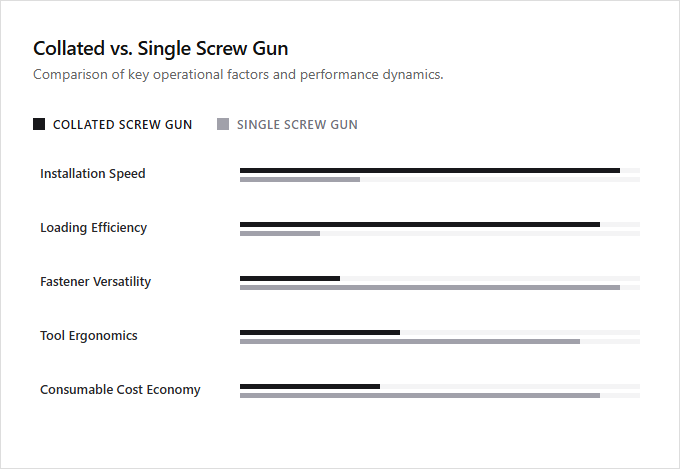
| Loading Mechanism | Collated screw guns utilize an integrated auto-feed magazine system to index plastic-strip fasteners, whereas single screw guns require manual placement of individual screws onto a magnetic bit tip. |
| Installation Speed | Collated screw guns maximize duty-cycle efficiency and throughput during high-volume drywall installation, while single screw guns operate at a slower pace due to the repetitive manual reloading cycle. |
| Fastener Versatility | Single screw guns accommodate a diverse range of screw gauges, drive types, and thread pitches, whereas collated systems are restricted to specific proprietary fastener strips compatible with the tool's feeding nosepiece. |
| Tool Ergonomics | The added mass of the auto-feed attachment on collated screw guns alters the center of gravity and increases user fatigue, unlike the lightweight, compact profile of standard single-drive nose cones. |
| Consumable Cost | Collated fasteners carry a higher unit cost due to the manufacturing complexity of the plastic collation strips, whereas loose screws used with single guns offer a highly economical bulk-rate alternative. |
Continuous Auto-Feed vs. Manual Single-Screw Fastening
Collated screw guns utilize an integrated auto-feed mechanism designed for plastic-collated strips, allowing for rapid, continuous fastening. This automated system eliminates the downtime associated with handling individual fasteners, greatly accelerating productivity during high-volume installations like drywalling or subfloor attachment.
Single screw guns rely on manual, one-by-one loading of each fastener. Although this process is slower, it provides superior depth-control precision and allows operators to easily switch between different screw sizes and types without swapping feeding attachments.
High-volume drywall installers and decking contractors benefit most from the speed of collated screw guns, while general carpenters and remodelers prefer single-screw models for their versatility and precision on detailed projects.
Tool-Free Depth Adjustment for Consistent Countersinking
In professional fastening applications, choosing between a collated screw gun and a single screw gun significantly impacts both efficiency and precision. The primary distinction lies in their depth-control mechanisms. Collated screw guns feature auto-feed nosepieces with tool-free depth-of-drive adjustment, ensuring consistent, repeatable countersinking across various materials. Conversely, single screw guns rely on manual, pressure-sensitive clutches, where the depth depends heavily on user technique and applied force, which can lead to uneven fastening.
While single screw guns offer excellent versatility for custom, low-volume tasks, collated systems excel in high-repetition environments. Drywall contractors and high-volume decking installers benefit most from the rapid, consistent output of collated screw guns, whereas general carpenters and DIYers requiring precise, individual screw placement find the single screw gun more practical and versatile.
High-Torque Brushless Motors for Rapid-Fire Collation
In professional fastening applications, the choice between a collated screw gun and a single screw gun depends heavily on motor efficiency and workflow speed. Collated screw guns utilize advanced high-torque brushless motors optimized for sustained RPMs during rapid-fire collation advancement. This engineering ensures the tool maintains peak rotational speed without stalling as the mechanical auto-feed link cycles through strip-fed fasteners.
Single screw guns require manual loading for each fastener, prioritizing extreme depth precision and versatility over automated speed. High-volume drywall contractors and subfloor installers gain maximum efficiency from the rapid, continuous output of collated systems, whereas cabinet makers and detail-oriented finish carpenters require the deliberate control and placement precision of single screw guns.
Reducing RSI with Single-Handed Lock-On Switches
Collated screw guns significantly lower ergonomic risks during high-volume fastening. Utilizing an auto-feed belt enables true single-handed operation, keeping the user's off-hand free to stabilize materials safely. Crucially, the integration of a lock-on switch removes the necessity for continuous trigger depression, mitigating repetitive strain injury (RSI) and alleviating musculoskeletal stress in the hand and forearm during extended use.
Conversely, single screw guns require manual, individual fastener loading, which demands repetitive bilateral hand movement. Although many models feature a lock-on switch to reduce grip fatigue, the constant interruption for manual placement increases repetitive wrist motion. Collated models are best suited for high-volume drywall contractors seeking rapid installation and strain reduction, while single screw guns are ideal for cabinetmakers and maintenance technicians performing diverse, low-volume fastening tasks.
Pre-Alignment Minimizes Fastener Cam-Out and Slippage
Collated screw guns feature an integrated auto-feed mechanism that ensures precise, pre-aligned drive bit engagement. By mechanically securing the fastener's position, this system minimizes hand-held alignment errors, drive-end slippage, and fastener cam-out. This constant alignment preserves the integrity of both the screw head and the drive bit during high-torque applications.
Single screw guns rely on manual alignment, which increases the risk of off-axis driving and head stripping. While single-feed tools offer adaptability for various fastener sizes, collated systems optimize speed and consistency in repetitive environments. Collated screw guns are ideal for high-volume drywall installers requiring rapid, continuous production, whereas single screw guns are best suited for general remodelers needing versatility for diverse, low-volume tasks.
Auto-Feed Systems Maximize Installation Speed and Throughput
In high-volume fastening applications, the choice between a collated screw gun and a traditional single screw gun directly impacts project timelines. Auto-feed collated systems offer a significant escalation in installation duty cycle by eliminating the need to manually load individual fasteners. This continuous feeding mechanism drastically increases linear feet per hour throughput, maximizing efficiency during large-scale drywall or decking installations.
Single screw guns require manual loading for every drive, which reduces overall speed but provides superior precision and depth control in tight spaces. High-production drywall contractors benefit most from the rapid output of collated systems, while general renovators and finish carpenters are better suited to the versatility of single screw guns.
Quick-Release Auto-Feed to Single-Screw Couplers
Modern screw guns offer a choice between dedicated single-screw models and collated auto-feed systems. The most versatile option involves screw guns equipped with quick-release collated attachment couplers. This design innovation allows operators to instantly transition between high-speed auto-feed mechanisms and traditional single-screw nose cones. By swapping the attachment without requiring extra tools, professionals can adapt to changing project demands on the fly.
Collated systems excel in high-volume, repetitive tasks like drywall installation where speed is paramount. Conversely, single-screw nose cones provide the precision and depth control necessary for delicate fastening and tight spaces. High-production drywall contractors benefit most from the speed of collated systems, while general remodelers and cabinet installers require the precise control of single-screw configurations.
Leave a comment