
Achieving precise tire pressure is a persistent challenge for fleet managers and automotive professionals, where even a minor 2 PSI variance can compromise vehicle safety, fuel efficiency, and tire longevity. Traditionally, organizations bridge this operational hurdle by leveraging standard tool procurement budgets and equipment funding sources to acquire basic roadside utility kits. However, investing in the correct gauge technology grants operators the exact precision needed to eliminate costly guesswork during critical roadside deployments.
As an important stipulation, readers must understand that long-term accuracy is contingent upon ongoing calibration practices, regardless of the display interface. For instance, maintaining a strict 35 PSI threshold across a fleet of commercial vans requires an understanding of how digital transducers perform over time compared to traditional analog Bourdon tubes.
This article provides a comparative analysis of digital and analog gauges, detailing their mechanical tolerances, calibration requirements, and operational advantages to help you optimize your inflator tool kit.
| Factor | Summary |
|---|---|
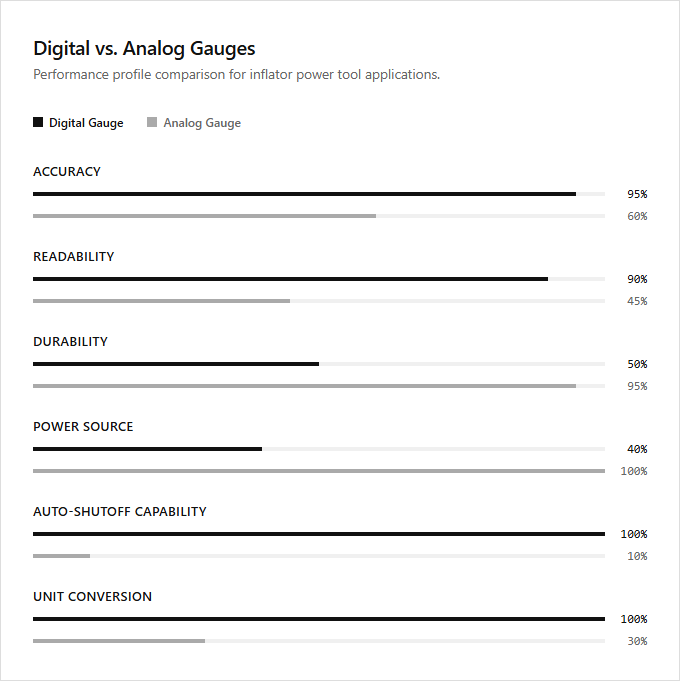
| Accuracy | Digital gauges offer superior precision by eliminating parallax error, whereas analog gauges rely on manual interpolation of a physical needle. |
| Readability | Digital gauges utilize backlit liquid-crystal displays for clear visibility in dark conditions, while analog systems require sufficient ambient light to read the printed faceplate. |
| Durability | Analog gauges feature a robust Bourdon tube mechanism that withstands physical impact, whereas digital sensors contain delicate microcontrollers susceptible to shock damage. |
| Power Source | Digital displays require auxiliary battery power to operate the electronic transducers, whereas purely mechanical analog gauges function indefinitely without any electrical current. |
| Auto-Shutoff Capability | Digital inflators can easily integrate electronic solenoid valves for automatic shutoff at a target pressure, a function that mechanical analog designs cannot support. |
| Unit Conversion | Digital software allows instant toggling between PSI, BAR, and kilopascals, whereas analog gauges are limited to the fixed dual-scale measurements printed on the dial face. |
Digital Gauges Eliminate Parallax Error in PSI Readings
When selecting a portable inflator power tool, the choice between a digital and an analog gauge significantly impacts measurement accuracy. Analog gauges rely on a physical needle sweeping across a graduated dial, a design highly susceptible to parallax error. This optical discrepancy occurs when the operator views the face from an angle rather than directly head-on, leading to incorrect PSI readings. Digital gauges eliminate this alignment issue entirely by displaying precise, real-time numerical values on an electronic screen, ensuring consistent data regardless of the user's viewing position.
While analog systems offer classic, battery-free reliability, digital interfaces often include advanced features like automatic shut-off. Precision-focused technicians requiring exact pressure specifications benefit most from digital gauges, while field operators seeking rugged, battery-independent utility typically prefer analog models.
Piezoresistive Sensors Outperform Bourdon Tubes in Calibration Stability
Digital inflators utilize solid-state piezoresistive pressure transducers, which offer superior calibration stability compared to the mechanical Bourdon tubes found in analog gauges. Piezoresistive sensors convert physical pressure into electrical signals with minimal mechanical wear, ensuring long-term accuracy even under heavy vibration. Traditional analog Bourdon tubes rely on physical deformation, making them susceptible to calibration drift and mechanical fatigue over time.
This structural difference directly impacts operational reliability in demanding environments, as digital gauges deliver precise, repeatable readings without the parallax error inherent in physical dials. Technicians requiring absolute precision for high-performance fleet maintenance benefit most from digital inflators, while general operators seeking simple, battery-free operation for occasional roadside tasks remain well-suited to analog models.
Vibration-Induced Wear in Analog Inflator Gears
When selecting a portable inflator, the choice between digital and analog gauges deeply impacts long-term measurement accuracy. Analog gauges rely on intricate physical gear mechanisms that are highly susceptible to mechanical wear and hysteresis. The intense vibrations generated by portable inflator motors degrade these delicate internal components over time, leading to shifted calibration and inconsistent pressure readings.
In contrast, digital gauges utilize solid-state electronic sensors lacking moving parts, making them highly resilient to operational vibrations. This digital integration ensures sustained accuracy and easier readability under demanding field conditions. Digital models are ideal for high-precision operators requiring exact PSI levels, while analog options suit casual users who prioritize simplicity and battery-free reliability for basic, occasional inflation tasks.
Precise Digital Measurement Down to 0.1 PSI
When selecting a portable inflator, the choice between digital and analog gauges directly impacts operational accuracy and efficiency. Digital inflators utilize advanced microprocessors to deliver precise measurement resolution down to decimal increments of 0.1 PSI. This electronic sensing eliminates the reading errors common with physical needles, ensuring highly consistent pressure management for sensitive applications.
In contrast, analog gauges rely on mechanical Bourdon tubes, which are highly durable and require no battery power but lack granular resolution. Digital gauges are ideal for automotive technicians and precision sports enthusiasts who require exact pressure targets, whereas analog models best suit general contractors needing rugged, maintenance-free tools for basic inflation tasks.
Maintaining Digital Gauge Accuracy in Extreme Temperatures
Selecting the right pressure gauge for an inflator power tool depends heavily on the operating environment and required precision. Digital gauges offer high-contrast readouts and superior precision under fluctuating conditions. Advanced digital models incorporate temperature compensation algorithms, which automatically adjust sensor readings to maintain calibration accuracy across thermal extremes. This technology prevents the accuracy drift common in mechanical systems when exposed to intense heat or cold.
In contrast, analog gauges utilize traditional Bourdon tubes or spring mechanisms. While highly reliable and battery-free, they are more susceptible to physical calibration shifts and lack thermal compensation. Technicians requiring absolute precision in extreme field conditions benefit most from digital gauges, whereas general consumers seeking a durable, maintenance-free tool for occasional use are ideal candidates for analog models.
Digital Sensors Offer Superior Transport Shock Resistance
When selecting an inflator power tool, evaluating gauge durability during transport is essential. Digital inflators utilize solid-state electronic sensors that offer superior resistance to mechanical shock and vibration, maintaining their calibration even after rough transit. Conversely, analog gauges rely on intricate mechanical linkages and springs that are highly susceptible to damage and misalignment from routine drops or vehicular vibrations.
While digital interfaces provide precise, backlit readings, analog dials offer pressure feedback without requiring auxiliary battery power. Mobile technicians and field professionals who frequently transport tools over rough terrain are best suited for rugged digital gauges, whereas stationary workshop users seeking simple, battery-free operation will find reliable utility in analog models.
Digital Calibration: ADC Precision Over Mechanical Tension
Selecting the right gauge for an inflator power tool depends on the required measurement mechanism. Digital gauges leverage electronic sensors where calibration relies entirely on the precision of an analog-to-digital converter. This electronic process eliminates the mechanical variances associated with analog gauges, which depend on physical spring tension and are subject to needle friction. Over time, physical components can wear down, whereas electronic sensors maintain consistent accuracy.
Analog gauges remain valued for their battery-free reliability and instant visual feedback in rugged environments, whereas digital options offer precise, micro-adjusted readings for high-specification tasks. High-volume automotive technicians requiring exact PSI targets benefit most from digital precision, while roadside emergency users seeking dependable, low-maintenance tools prefer the simplicity of analog.
Leave a comment