
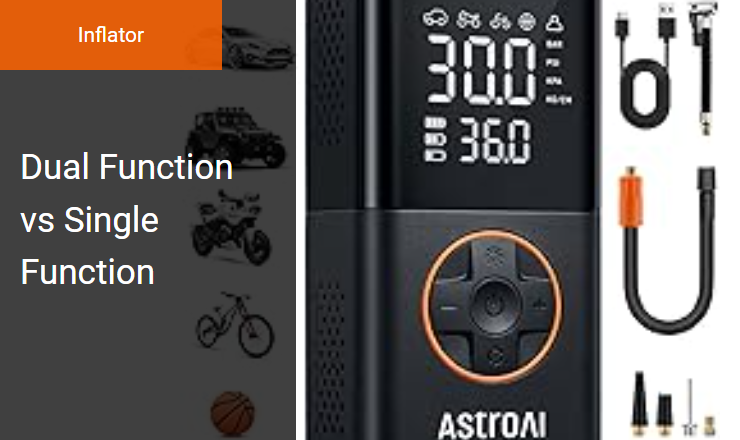
Selecting the right portable air inflator for high-pressure pneumatic applications often presents a frustrating challenge for fleet managers and industrial technicians, who frequently face costly field downtime due to underpowered or incompatible equipment. Traditionally, organizations rely on standard capital equipment budgets to fund these purchases, expecting a single, standardized tool to handle every inflation need.
However, investing in a specialized dual-function unit grants operators unmatched field versatility, maximizing the utility of your equipment allocations. To manage expectations, we must stipulate that high-pressure applications demand strict adherence to tool duty cycles and precise PSI limits. Industry-leading tools, such as the Milwaukee M18 Inflator, demonstrate how matching the tool's specific mechanical limits to the workload prevents premature motor failure.
This article evaluates the critical distinctions between dual-function and single-function portable air inflators, analyzing their pressure capabilities, duty cycles, and overall cost-efficiency to help you optimize your tooling procurement strategy.
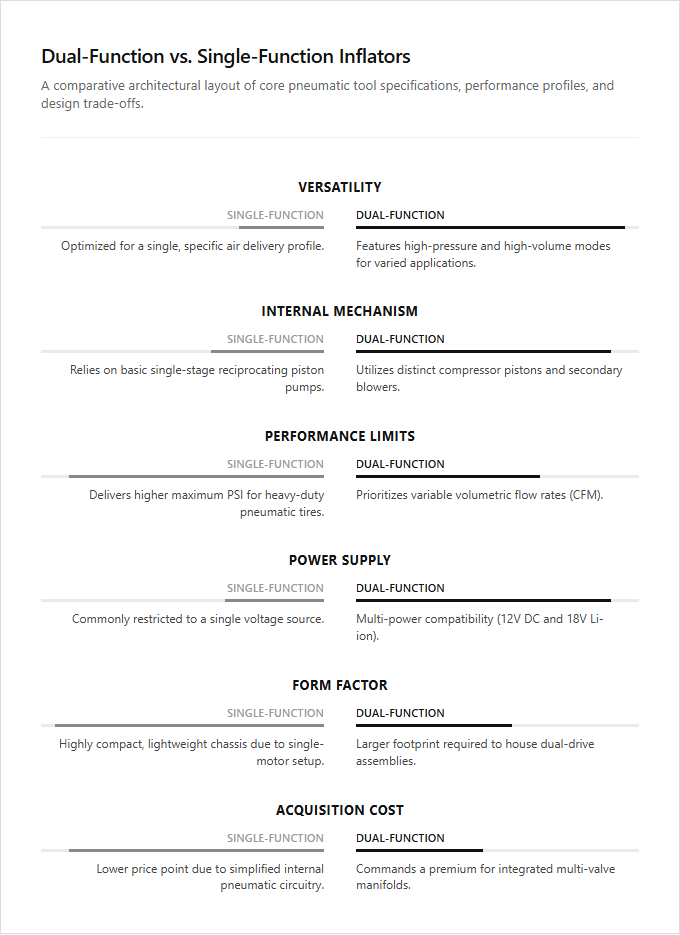
| Factor | Summary |
|---|---|
| Versatility | Dual-function inflators feature both high-pressure and high-volume modes to handle different inflatables, whereas single-function units are optimized for a specific air delivery profile. |
| Internal Mechanism | Dual-function tools utilize distinct compressor pistons for high pressure and secondary blowers for high volume, unlike the single-stage reciprocating piston pumps found in most single-function inflators. |
| Performance Limits | Single-function inflators often deliver higher maximum PSI for heavy-duty pneumatic tires, while dual-function models prioritize variable volumetric flow rates measured in cubic feet per minute. |
| Power Supply | Many dual-function models feature multi-power compatibility, running on both 12V DC auxiliary power and 18V lithium-ion battery packs, while single-function models are often restricted to a single voltage source. |
| Form Factor | Single-function inflators boast a highly compact and lightweight chassis due to their single-motor configuration, whereas dual-function units have a larger footprint to house dual-drive assemblies. |
| Acquisition Cost | Single-function tools offer a lower price point due to simplified circuitry and fewer pneumatic valves, whereas dual-function units command a premium for their integrated multi-valve manifolds. |
Single-Function Inflators Excel at High Pressure
When selecting an inflator power tool, the choice between dual-function and single-function models depends on your performance requirements. Dual-function units offer versatility by handling both high-volume and high-pressure tasks, but they often compromise on peak output. In contrast, single-function inflators are engineered exclusively for high-pressure pneumatic applications, delivering superior maximum PSI ratings. This dedicated design ensures rapid, efficient air delivery under significant resistance.
The specialized internal mechanics of single-function tools prioritize pressure over volume, making them highly effective for demanding tasks like seating heavy-duty tires. Single-function units are ideal for automotive technicians and trade professionals requiring maximum pressure, whereas dual-function models suit homeowners and outdoor enthusiasts who value adaptable, all-in-one utility.
High-Pressure Units Offer Higher Continuous Duty Cycles
When selecting an inflator power tool, the choice between dual-function and single-function units depends on the operational demands of the application. Dedicated single-function, high-pressure inflators are engineered specifically for demanding tasks, offering a costly but necessary advantage with a significantly higher duty cycle percentage under continuous load. This specialized design ensures superior thermal management, allowing the tool to run longer without overheating during heavy-duty applications.
Dual-function inflators offer the convenience of both high-pressure and high-volume outputs in a single chassis, though they generally feature lower duty cycles. Industrial operators requiring sustained pressure for fleet vehicles benefit most from dedicated single-function tools, whereas recreational users and DIY homeowners gain the most value from the versatility of dual-function models.
Manifold Switching for CFM and Pressure Outputs
When choosing an inflator, the decision between single-function and dual-function designs impacts utility and mechanical complexity. Single-function units are optimized for a dedicated output, such as high-pressure tire inflation. Dual-function models provide both high-pressure and high-volume (CFM) outputs by utilizing internal manifold switching to transition between the high-CFM and high-pressure air paths.
This mechanical adaptability delivers excellent versatility, whereas single-function alternatives offer simpler, highly focused performance. Single-function inflators are best suited for roadside emergencies or cyclists requiring rapid, dedicated tire inflation, while dual-function models are ideal for homeowners and campers who need to service both vehicle tires and large recreational inflatables with one tool.
Single-function portable inflators maximize efficiency using high-torque brushless DC motors.
When selecting a portable inflator, understanding the mechanical distinction between dual-function and single-function models is essential for optimizing performance. Single-function portable inflators are engineered specifically for high-pressure applications, maximizing operational efficiency through the integration of high-torque brushless DC motors. By eliminating the secondary low-pressure air pathways found in dual-function units, these dedicated tools minimize energy loss and heat generation, delivering rapid tire inflation and prolonged battery runtimes.
In contrast, dual-function inflators offer versatility by incorporating separate systems for both high-pressure tires and high-volume leisure inflatables. While these hybrid models provide broader utility, they often sacrifice the specialized speed and compact form factor of single-purpose designs. Professionals and roadside commuters requiring rapid, heavy-duty tire maintenance benefit most from single-function inflators, whereas recreational campers and families needing to inflate diverse gear are better served by dual-function units.
Thermal Overload Protection for High-Pressure Designs
Selecting an inflator power tool requires understanding the operational differences between single-function and dual-function units. Single-function inflators are engineered specifically for either high-pressure tasks, like inflating vehicle tires, or high-volume needs, like filling large inflatables. Dedicated high-pressure designs integrate robust thermal overload protection mechanisms for heat dissipation during demanding cycles, ensuring long-term motor durability under heavy loads.
Dual-function models offer versatility by combining both high-pressure and high-volume modes into a single unit, utilizing distinct internal pathways to switch between tasks. Contractors and automotive technicians requiring continuous, heavy-duty tire inflation benefit most from the robust endurance of single-function designs, while homeowners and outdoor enthusiasts seeking all-in-one adaptability find dual-function models ideal for various recreational tasks.
Dual-Function Inflators Sacrifice Piston Efficiency for Volume
Single-function inflators utilize dedicated reciprocating piston displacement to maximize high-pressure output. In contrast, dual-function units integrate a secondary high-volume blower within the same housing. This design integration requires engineering compromises, as accommodating the blower mechanism restricts the physical space and optimization available for the high-pressure piston, reducing its overall displacement efficiency.
Single-function models deliver faster, more consistent performance for demanding high-pressure tasks. Dual-function alternatives offer versatility for various inflation needs, ranging from vehicle tires to large camping inflatables. Dedicated automotive professionals requiring rapid, high-pressure execution benefit most from single-function tools, whereas general homeowners and outdoor enthusiasts seeking multi-application versatility are better suited for dual-function models.
Optimized Battery Management for Continuous High-Current Draw
Single-function inflators feature battery management systems engineered specifically for continuous, high-current draw. Because their internal circuitry is dedicated to a single motor configuration, energy consumption is highly optimized. This prevents thermal overload and maintains consistent pressure delivery during demanding tasks, such as inflating large vehicle tires. Dual-function units, while highly versatile, must balance power distribution between high-volume and high-pressure modes, often resulting in less specialized battery duty cycles.
The choice between these systems depends heavily on the user's operational demands. Professional contractors and fleet mechanics benefit most from the sustained, heavy-duty performance of single-function inflators, whereas general homeowners and outdoor enthusiasts will find the versatility of dual-function models ideal for occasional, multi-purpose tasks.
Leave a comment