
Outfitting a professional or home workshop with pneumatic power often presents a frustrating challenge: selecting a system that delivers consistent pressure without demanding constant repair. Before committing capital, operators typically evaluate standard funding sources-such as workshop equipment reserves, tool depreciation budgets, or capital improvement grants-to finance these essential machinery upgrades.
Choosing the correct compressor architecture grants workshops unparalleled operational efficiency, with the stipulation that operators must carefully weigh maintenance tolerances against heavy-duty output requirements. For example, powering high-volume tire inflators or continuous-use pneumatic grinders requires distinct mechanical advantages. This guide examines the critical engineering differences between oil-free and oil-lubricated air compressors, outlining their lifespan, noise levels, and maintenance profiles to help you select the ideal pneumatic driver for your specific workshop projects.
| Factor | Summary |
|---|---|
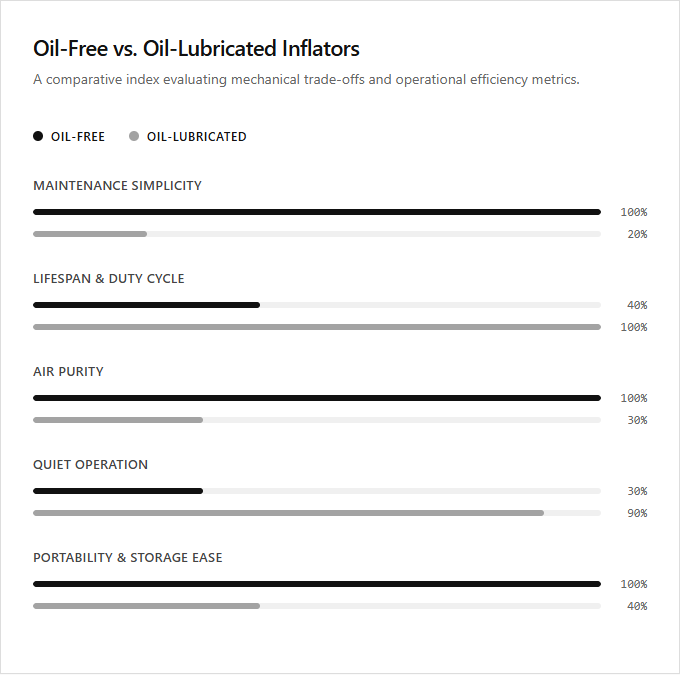
| Maintenance | Oil-free inflators require zero cylinder lubrication upkeep, whereas oil-lubricated models demand routine crankcase oil monitoring to prevent mechanical seizure. |
| Lifespan and Duty Cycle | Oil-lubricated compressors achieve a superior duty cycle and longevity through efficient thermal dissipation and reduced mechanical friction. |
| Air Contamination | Oil-free units guarantee output air free of oil aerosols, preventing particulate contamination in sensitive pneumatic applications. |
| Operational Noise | Oil-lubricated tools operate at lower decibel levels because the liquid lubricant provides inherent acoustic dampening of internal moving parts. |
| Portability and Storage | Oil-free inflators allow for worry-free transport in any physical orientation without the risk of fluid leakage associated with oil-bath reservoirs. |
PTFE self-lubricating cylinder coatings in oil-free pumps
When selecting an inflator power tool, the choice between oil-free and oil-lubricated designs centers on maintenance and durability. Modern oil-free pumps utilize advanced PTFE (polytetrafluoroethylene) self-lubricating cylinder coatings. This specialized fluoropolymer creates an extremely low-friction barrier between the piston ring and the cylinder wall, eliminating the need for traditional oil lubrication. This technology ensures clean, oil-free air delivery and allows the tool to operate reliably in various orientations without the risk of spills.
Oil-lubricated inflators rely on a continuous oil bath to reduce wear and dissipate heat during prolonged use, extending the tool's overall lifespan under heavy loads. Maintenance-free, PTFE-coated oil-free models are best suited for DIY enthusiasts and mobile technicians seeking portability, whereas durable oil-lubricated models are ideal for workshop professionals requiring continuous, high-volume operation.
Continuous duty cycle ratings for demanding workshop air tools
When selecting inflator power tools and compressors for demanding workshop air tools, evaluating continuous duty cycle ratings is critical. Oil-lubricated models excel in heavy-duty applications because the oil cools internal components, reduces friction, and manages heat buildup. This design allows the machinery to run continuously under demanding loads without the risk of overheating or premature wear.
Oil-free inflators offer the benefits of low maintenance and clean air delivery, but they typically possess lower duty cycle ratings due to higher operating temperatures. Oil-lubricated models are best suited for professional automotive technicians requiring sustained tool operation, whereas oil-free alternatives are ideal for mobile operators and hobbyists prioritizing light-duty tasks and zero-maintenance portability.
Prevention of oil aerosol contamination in painting and finishing
When selecting an air source for painting and finishing applications, managing oil aerosol contamination is a critical technical consideration. Oil-lubricated inflators and compressors rely on oil for internal cooling, which can introduce microscopic oil droplets into the compressed air stream. In precision finishing tasks, even trace amounts of oil compromise paint adhesion and cause surface defects like "fish-eyes," necessitating complex and expensive filtration systems to ensure a clean output.
Oil-free alternatives eliminate this risk entirely by utilizing self-lubricating synthetic components. This design guarantees a contamination-free airflow, preserving the integrity of delicate coatings and ensuring a flawless finish. Oil-free models are ideal for automotive painters and detailers who require pristine, defect-free surfaces, while oil-lubricated units are best suited for heavy-duty industrial operators prioritizing mechanical longevity over air purity.
Lower decibel ratings in oil-lubricated induction motors
When selecting an inflator power tool, the distinction between oil-free and oil-lubricated models heavily impacts the workshop environment. Oil-lubricated induction motors are engineered specifically for quieter, smoother operation. The internal lubricating oil dampens mechanical friction and absorbs sound waves, resulting in significantly lower decibel ratings compared to oil-free alternatives. This noise reduction creates a safer, more comfortable workspace during extended periods of tool operation.
Oil-free inflators utilize self-lubricating materials, which eliminates oil maintenance but results in higher operating noise levels. Oil-free models are ideal for DIY enthusiasts or mobile service operators needing a portable, low-maintenance tool for quick tasks, while oil-lubricated models are best suited for commercial mechanics and workshop professionals who require continuous, heavy-duty performance in a quieter environment.
Higher CFM output at maximum PSI for heavy pneumatic loads
When selecting an air inflator for heavy pneumatic loads, the choice between oil-free and oil-lubricated models directly impacts sustained performance. Oil-lubricated compressors typically deliver higher CFM output at maximum PSI because the lubricating oil reduces friction and dissipates heat. This superior thermal regulation allows the pump to run cooler and longer under intense mechanical stress without risking premature component wear.
Oil-free designs utilize pre-lubricated synthetic components, which minimize maintenance but often struggle to match the continuous high-CFM delivery required for demanding applications. Oil-free tools are ideal for DIY enthusiasts seeking clean, low-maintenance operation, whereas oil-lubricated systems are best suited for professional contractors requiring reliable, continuous high-volume power on busy jobsites.
Superior thermal dissipation in oil-bath cast iron crankcases
When selecting an inflator power tool, understanding the thermal dynamics of oil-free versus oil-lubricated systems is essential for long-term reliability. Oil-lubricated models utilize an oil-bath cast iron crankcase, which delivers superior thermal dissipation. The circulating oil continuously transfers heat away from high-friction zones, while the cast iron housing absorbs and radiates thermal energy more effectively than the lightweight materials used in oil-free alternatives. This robust cooling mechanism prevents overheating and significantly extends the pump's operational lifespan.
Oil-free inflators rely on self-lubricating composite seals, which generate more localized heat and require frequent cooling intervals. Maintenance-free oil-free models are ideal for residential users seeking occasional, light-duty tire inflation, whereas heavy-duty oil-lubricated units are best suited for automotive professionals and industrial operators requiring continuous, high-volume performance.
Overall operational lifespan measured in total running hours
When selecting an inflator power tool, operational lifespan is a critical metric, typically measured in total running hours. Oil-free inflators are engineered with pre-lubricated components, such as Teflon-coated pistons, which eliminate the need for manual lubrication. While highly convenient and maintenance-free, these units generally offer a shorter operational lifespan, often ranging between 200 to 500 total running hours before the friction-reducing coatings wear down.
In contrast, oil-lubricated inflators utilize a continuous oil bath to minimize friction and dissipate heat during operation. This mechanical design significantly extends the tool's durability, often yielding an operational lifespan exceeding 1,000 to 5,000 running hours with proper maintenance. Oil-free models are ideal for casual homeowners seeking hassle-free, occasional inflation, whereas oil-lubricated units are best suited for commercial professionals requiring daily, heavy-duty performance.
Leave a comment