
Machinists and shop managers constantly battle the frustrating trade-off between maximizing Material Removal Rate (MRR) and achieving flawless surface finishes, often sacrificing valuable cycle time to manual trial-and-error. Historically, resolving this bottleneck required drawing from standard tooling and capital equipment budgets to invest in premium CNC machinery or complex CAM upgrades.
However, mastering the strategic application of roughing versus finishing end mills grants operators unprecedented control over production efficiency without increasing machine-overhead costs. Under the stipulation that machine rigidity and spindle horsepower are properly calibrated, this dual-tool strategy optimizes your workflow. For example, when milling complex 6061-T6 aluminum aerospace brackets, pairing a heavy-duty roughing end mill with a dedicated finishing tool dramatically slashes cycle times while maintaining precise tolerances.
In this article, we will analyze the unique geometries of roughing and finishing cutters, compare their mechanical advantages, and outline a strategic framework to optimize your milling machine operations.
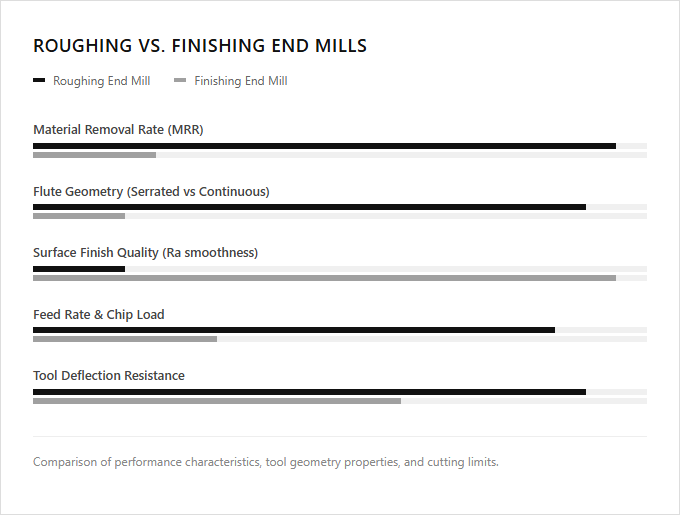
| Factor | Summary |
|---|---|
| Material Removal Rate (MRR) | Roughing end mills maximize the volumetric material removal rate during initial machining phases, whereas finishing end mills are restricted to a shallow depth of cut to achieve exact final dimensions. |
| Flute Geometry | Roughing end mills feature serrated chipbreaker profiles along their cutting edges to reduce cutting forces, while finishing end mills utilize continuous, high-helix flutes for clean shearing. |
| Surface Finish Quality | Finishing end mills are engineered to yield a very low surface roughness (Ra value), whereas roughing end mills leave a coarse, scalloped texture on the workpiece surface. |
| Feed Rate and Chip Load | Roughing operations demand a high feed per tooth to aggressively evacuate stock, while finishing operations require a reduced feed rate to preserve tool life and dimensional accuracy. |
| Tool Deflection | Finishing end mills must minimize tool deflection to maintain tight geometric tolerances, whereas roughing end mills prioritize core rigidity to withstand high radial forces. |
Serrated Roughing End Mills Maximize MRR
In CNC milling, selecting the appropriate tooling is critical for optimizing production efficiency. Roughing end mills are specifically engineered for heavy stock removal, utilizing unique serrated cutting edges. These serrations break the metal chips into smaller, manageable segments, which significantly reduces cutting forces and heat generation while maximizing the Material Removal Rate (MRR). In contrast, finishing end mills feature continuous, smooth cutting edges designed to achieve tight dimensional tolerances and a superior surface finish during the final passes.
Roughing end mills are ideal for high-volume machinists requiring rapid bulk material extraction, whereas finishing end mills are best suited for precision toolmakers focusing on the final aesthetic and dimensional accuracy of a component.
Smooth Cutting Edges Enhance End Mill Precision
In industrial milling operations, selecting the appropriate cutting tool is vital for optimizing machining efficiency and part quality. Roughing end mills feature serrated cutting edges designed for rapid material removal, effectively breaking chips into smaller pieces to reduce cutting forces and heat during heavy initial passes.
Finishing end mills are engineered specifically for final passes. Continuous smooth cutting edges on finishing end mills minimize surface roughness (Ra) to achieve high dimensional tolerance. This uninterrupted edge geometry ensures superior surface finishes and precise adherence to final part specifications.
Roughing cutters are best suited for high-production machinists focused on rapid bulk material removal, while finishing cutters are essential for precision mold makers and aerospace technicians requiring flawless surface quality and exact dimensional accuracy.
Why Roughing End Mills Have Larger Cores
Selecting the appropriate cutter is critical for optimizing efficiency and accuracy in milling operations. Roughing end mills are engineered specifically for rapid material removal, featuring a larger core diameter to withstand high radial cutting forces and prevent tool deflection during heavy-duty operations. This robust design ensures structural integrity under extreme stress, making them ideal for the initial machining stages.
In contrast, finishing end mills are designed to achieve superior surface quality and precise final dimensions. These tools feature closely spaced flutes and standard cores, which minimize vibration to produce a highly polished finish on the workpiece. High-volume production machinists benefit most from roughing end mills to quickly shape raw stock, whereas detail-oriented precision machinists utilize finishing end mills to meet exact tolerance specifications.
High Flute Counts: Maximizing Finishing Feed Rates
In precision machining, selecting the appropriate cutting tool is critical for optimizing production efficiency and surface quality. Roughing end mills feature scalloped cutting edges designed to rapidly evacuate large volumes of material, though they leave a coarse surface finish. Conversely, finishing end mills are engineered to produce highly polished surfaces and precise dimensional tolerances. To achieve this, finishing end mills utilize a higher flute count to reduce the chip load per tooth while maintaining high feed rates.
This design variation minimizes vibration and deflective forces during final passes, preserving the integrity of the workpiece. Roughing end mills are ideal for heavy-duty machinists focused on rapid stock removal, whereas finishing end mills are best suited for detail-oriented technicians requiring flawless surface finishes on completed components.
Optimizing Roughing with High ADOC and RDOC
In milling operations, selecting the appropriate tool is critical for process efficiency. Roughing end mills are engineered specifically for rapid bulk material removal, optimizing productivity by utilizing a high axial depth of cut (ADOC) and a high radial depth of cut (RDOC). Their scalloped cutting edges break chips into smaller segments, which reduces cutting forces and manages heat dissipation during heavy-duty material extraction.
In contrast, finishing end mills feature continuous, smooth cutting edges designed to achieve precise final dimensions and superior surface quality. These tools operate at shallower depths of cut to eliminate tool deflection and remove the surface imperfections left behind by the roughing stage.
High-volume production machinists prioritizing rapid cycle times during initial fabrication benefit most from roughing end mills, while precision toolmakers requiring tight tolerances and flawless surface finishes rely on finishing end mills for final passes.
Eliminating Scallop Height in Finishing Operations
Roughing end mills are engineered for rapid volume material removal, utilizing coarse, serrated teeth to break chips and reduce cutting forces during the initial machining stages. Finishing end mills are designed to achieve precise final dimensions and superior surface quality. To eliminate scallop height on the workpiece, finishing operations employ small stepover and shallow cuts, resulting in a highly smooth, continuous surface profile.
The geometry of finishing tools typically features a higher flute count, which optimizes chip clearance at lower feed rates and prevents surface blemishes. Roughing tools are ideal for high-volume manufacturing technicians prioritizing rapid cycle times, while finishing tools are essential for precision aerospace machinists demanding flawless cosmetic finishes and tight tolerances.
High Helix Angles Prevent Finishing Tool Chatter
In precision milling, selecting the correct tool geometry is critical for balancing material removal rates with surface quality. Roughing end mills utilize scalloped cutting edges to rapidly evacuate large volumes of raw material, prioritizing speed over surface aesthetics. Conversely, finishing end mills are designed to achieve precise dimensional tolerances and superior surface refinement.
The performance of finishing tools relies heavily on high helix angles, which stabilize the cutting process. This design ensures a gradual engagement of the flute with the workpiece, significantly reducing cutting force fluctuations. By smoothing these transitions, the tool prevents harmonic chatter and vibration, securing a flawless finish and protecting spindle integrity.
Operators focusing on high-volume, initial metal removal will benefit most from roughing end mills, whereas technicians demanding ultra-precise tolerances and pristine surface cosmetics are ideal candidates for finishing end mills.
Leave a comment