

For many woodworkers and contractors, achieving dead-straight, splinter-free cuts on expensive sheet goods remains a persistent frustration. Standard hand-held circular saws, while highly versatile, frequently drift off-line, leaving behind jagged edges that can compromise an entire project.
Traditionally, craftsmen have relied on heavy stationary table saws or cumbersome, shop-made straight-edge jigs to mitigate these inaccuracies. While these standard approaches provide a temporary workaround, they often fall short in terms of portability and setup speed.
Track saw technology solves this dilemma, granting workshop-grade precision directly on the job site. For example, when building custom cabinetry or sizing delicate pre-finished MDF panels, a plunge-cut track saw delivers flawless, glue-ready edges on the very first pass. However, it is important to stipulate that achieving these results requires proper guide-rail calibration and appropriate blade selection to prevent motor strain.
This article will compare plunge saws and traditional circular saws, examining their mechanical differences, safety features, and accuracy metrics to help you choose the right tool for your workflow.
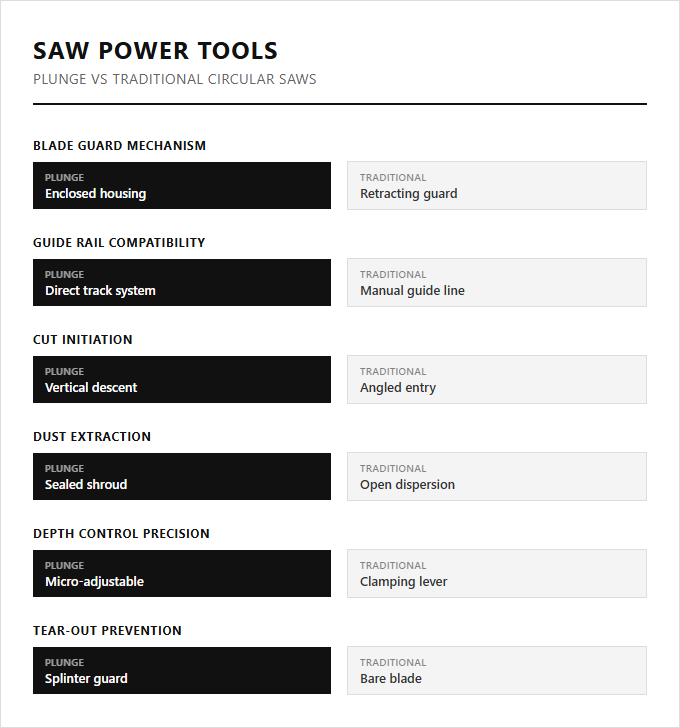
| Factor | Summary |
|---|---|
| Blade Guard Mechanism | Traditional circular saws utilize a pivoting lower blade guard that retracts during cutting, whereas plunge saws feature a fully enclosed blade housing with a spring-loaded plunge mechanism for enhanced user safety. |
| Guide Rail Compatibility | Plunge saws are engineered to interface directly with precision track systems for perfectly straight rip cuts, while traditional circular saws generally rely on manual rip fences or chalk lines. |
| Cut Initiation | Plunge saws excel at mid-panel pocket cuts because the blade can descend vertically into the workpiece, whereas traditional circular saws require a riskier angled entry technique. |
| Dust Extraction | The enclosed shroud design of a plunge saw maximizes static pressure for highly efficient dust collection through a dedicated vacuum port, whereas traditional circular saws have open guards that disperse particulate matter. |
| Depth Control Precision | Plunge saws feature a micro-adjustable depth-stop mechanism with integrated compensation for track thickness, while traditional circular saws use a simpler, pivot-point clamping lever. |
| Tear-Out Prevention | Plunge saws leverage a vulcanized rubber splinter guard on the guide rail to ensure clean, chip-free edges on delicate veneers, a capability that standard circular saws struggle to replicate. |
Guide rail system integration
Plunge saws, often referred to as track saws, are engineered specifically for seamless integration with guide rails. The base plate of a plunge saw features a dedicated groove that locks directly onto the rail rib, entirely eliminating lateral play. This cohesive design allows the user to perform exceptionally precise, splinter-free straight cuts, as the rubber strip on the guide rail indicates the exact line of cut.
In contrast, traditional circular saws are designed primarily for freehand operation or use with simple rip fences. While certain modern circular saws can adapt to guide rails using universal adapters, they lack the inherent stability, depth control, and plunge-action alignment of a dedicated track system.
Cabinetmakers and finish carpenters requiring flawless, workshop-grade accuracy on-site will benefit most from the plunge saw system, whereas framing contractors and demolition workers prioritizing speed and portability will find the traditional circular saw more suitable.
Spring-loaded plunge mechanism
The defining distinction between a plunge saw and a traditional circular saw lies in the spring-loaded plunge mechanism. On a plunge saw, the motor and blade sit housing-encased above the baseplate; pressing down compresses the internal springs to lower the blade directly into the material. This controlled vertical descent allows users to initiate cuts safely at any point on a workpiece with extreme accuracy.
Traditional circular saws feature a fixed motor position with a pivoting lower guard that retracts only as the tool pushes forward. Without a spring-guided vertical plunge, initiating a cut in the middle of a panel requires a manual, pivot-style tip-in, which increases the risk of kickback and reduces precision.
Plunge saws are best suited for furniture makers who demand precise, splinter-free internal cutouts, while traditional circular saws remain the preferred choice for framing carpenters requiring rapid, high-volume straight cuts.
Integrated splinter guard
Plunge saws and traditional circular saws differ significantly in their cutting mechanics and finish quality. A primary advantage of the plunge saw system is its integrated splinter guard. This rubber strip on the guide rail presses firmly against the workpiece directly along the cut line, effectively trapping wood fibers and preventing them from lifting or tearing. Traditional circular saws lack this built-in support, which often results in rougher, splintered edges on the top surface of the material.
The plunge saw's guard ensures clean, paint-ready edges on delicate materials like veneered plywood and laminates without requiring secondary sanding. Precision cabinetmakers and finish carpenters benefit most from the splinter-free accuracy of plunge saws, whereas framing carpenters and general contractors favor traditional circular saws for rapid, heavy-duty demolition and framing cuts where edge finish is less critical.
Co-moving riving knife
Traditional circular saws and plunge saws differ significantly in safety and precision, particularly regarding the integration of the riving knife. In traditional circular saws, the riving knife is typically fixed, which can obstruct plunge cuts or require manual removal, increasing the risk of dangerous kickback. Plunge saws solve this issue with a spring-loaded, co-moving riving knife that retracts into the housing and emerges directly behind the blade as it descends into the wood.
This co-moving mechanism ensures continuous alignment and prevents the kerf from closing and pinching the blade during mid-board entries. Traditional circular saws excel at rapid, heavy-duty construction cuts, whereas plunge saws deliver splinter-free, cabinet-grade accuracy. High-production framers and deck builders rely on the swift utility of traditional circular saws, while precision finish carpenters and cabinetmakers require the controlled plunging capabilities of track-guided plunge saws.
Enclosed blade shroud
Plunge saws feature a fully enclosed blade shroud that remains fixed during operation, exposing the blade only when it is plunged directly into the workpiece. This design creates a highly efficient, sealed chamber that optimizes dust extraction and enhances operator safety by keeping the spinning blade completely isolated. In contrast, traditional circular saws utilize a spring-loaded, pivoting lower guard that retracts as the tool advances, which inherently allows more airborne debris to escape into the workspace.
While the enclosed shroud of the plunge saw ensures clean, splinter-free results on delicate materials, the open guard of the traditional circular saw allows for faster setup and easier line-of-sight tracking. Plunge saws are best suited for precision cabinet makers and indoor finish carpenters who require dust-free accuracy, whereas traditional circular saws are ideal for framing carpenters and general contractors who prioritize speed, durability, and rapid repetitive cuts on site.
Zero-clearance cutline alignment
Plunge saws, when paired with guide rails, offer exceptional precision through zero-clearance cutline alignment. The rubber lip of the guide rail aligns exactly with the blade's entry point, which eliminates alignment guesswork and prevents wood splintering along the cutline. Because the blade plunges directly into the material along this defined path, operators achieve flawless, tear-out-free cuts on delicate veneered sheet goods.
Traditional circular saws rely primarily on visual sightlines and baseplate notches for alignment. Without a dedicated zero-clearance track system, maintaining a perfect edge requires additional setup, making splinter-free cuts more difficult to replicate consistently. Plunge saws are ideal for cabinetmakers and finish carpenters requiring cabinetry-grade accuracy, whereas traditional circular saws suit framing carpenters and general builders prioritizing speed, portability, and rough cutting.
Pivot point bevel compensation
When comparing plunge saws and traditional circular saws, pivot point bevel compensation is a critical differentiator. Plunge saws, often paired with guide rails, feature a sophisticated hinge system that adjusts the blade's entry point during angled cuts. This compensation ensures the blade intersects the workpiece at the exact same line along the track's splinter guard, regardless of the bevel angle. Conversely, traditional circular saws pivot from a static baseplate mechanism, which shifts the blade's cutting line as the angle changes, requiring manual alignment and recalibration.
This variance in engineering directly impacts workflow efficiency and accuracy. Traditional circular saws remain ideal for framing carpenters who prioritize speed and raw cutting power on the jobsite, while plunge saws are suited for furniture makers and finish installers who require micro-precise, splinter-free bevel joins.
Leave a comment