
Achieving perfectly flat faces on twisted or bowed lumber is a persistent struggle for woodworkers, often resulting in alignment errors that ruin expensive hardwood stock. When upgrading your workshop, it is common to first evaluate standard machinery funding sources and capital equipment budgets, which typically direct buyers toward standard, off-the-shelf machinery configurations.
However, selecting the correct bed configuration is a critical decision, as the right choice grants you unmatched milling accuracy and eliminates material waste. This advantage is subject to a key stipulation: your jointer's bed length must scale with the length of your workpiece to maintain stability. For example, professional custom furniture makers rely on long bed jointers to flatten eight-foot tabletop slabs, while boutique instrument makers achieve precision on shorter stock using compact beds.
This article provides a comprehensive comparison of long bed versus short bed jointers. We will analyze how bed length affects face-jointing precision, examine the spatial demands of each machine type, and guide you in selecting the ideal tool for your workshop's specific workflow.
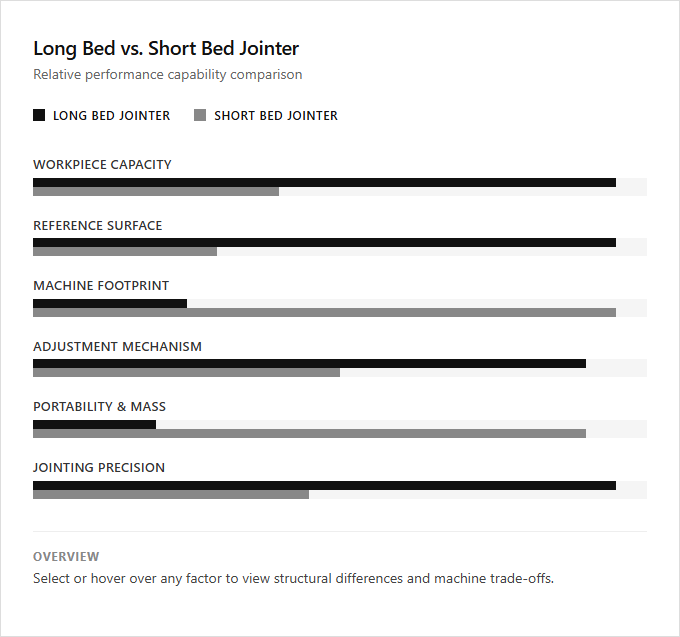
| Factor | Summary |
|---|---|
| Workpiece Capacity | Long bed jointers excel at flattening extremely long stock, whereas short bed jointers are limited to shorter boards to prevent sagging and maintain coplanar accuracy. |
| Reference Surface | The extended beds of a long jointer provide a vastly superior reference surface for straightening bowed lumber compared to the limited registration area of a short bed. |
| Machine Footprint | Short bed jointers offer a compact footprint ideal for small workshops, whereas long bed models require significant dedicated floor space for operation. |
| Adjustment Mechanism | Long bed jointers frequently utilize parallelogram beds for precise depth-of-cut adjustments, while short bed models often rely on simpler dovetail ways. |
| Portability and Mass | Short bed jointers are often designed as benchtop units for easy transport, whereas long bed jointers feature heavy cast-iron construction to minimize vibration during operation. |
| Jointing Precision | Long bed jointers require fewer passes to achieve datum flatness on long boards, while short bed jointers require auxiliary rollers to prevent snipe at the trailing end. |
Table Length's Impact on Warped Lumber Registration
The primary differentiator between long bed and short bed jointers lies in the physical span of their infeed and outfeed tables. This combined length directly determines the maximum registerable reference surface available to support warped, bowed, or twisted lumber during face-jointing. A longer bed provides the necessary continuous support to prevent the wood from rocking, allowing the machine to establish a perfectly flat reference face across the entire length of the board.
Short bed jointers offer valuable space efficiency but struggle to accurately flatten boards that exceed twice the length of the infeed table. Long bed models excel at processing heavy, oversized stock by maintaining stable workpiece contact throughout the entire feed cycle. Professional furniture makers and production shops requiring high-precision milling on long timber favor long bed jointers, while hobbyists and instrument makers working with smaller workpieces benefit most from the compact utility of short bed designs.
Aligning Long Bed Jointers: The Coplanar Challenge
When choosing between a long bed and a short bed jointer, bed length dictates both stock capacity and calibration complexity. Long bed jointers excel at straightening longer boards but require meticulous setup. Achieving coplanar alignment-where the infeed and outfeed tables are perfectly parallel-is significantly more critical and difficult to calibrate on extended beds. Microscopic deviations at the far ends of a long bed amplify across the surface, resulting in bowed or snipped cuts. Short bed jointers, with their reduced surface area, remain inherently easier to align and maintain over time.
While short beds offer simpler maintenance and a smaller workshop footprint, they limit the maximum length of lumber you can joint accurately. Short bed jointers are ideal for weekend hobbyists working with limited shop space and smaller project components, whereas long bed models suit high-production professionals who routinely flatten heavy, full-length hardwood boards.
Max Workpiece Length: Twice the Bed Length
When selecting between a long bed and a short bed jointer, the bed length directly determines the maximum stock length you can safely and accurately flatten. The industry rule of thumb dictates that the maximum workpiece length is twice the total bed length. Exceeding this limit compromises workpiece support, making it difficult to maintain proper registration against the tables and resulting in imperfect joints.
Long bed jointers provide the necessary registration surface to straighten long, heavy boards without sagging. Short bed models offer a compact footprint ideal for restricted workspaces, though they limit your capacity for milling architectural lumber. Short bed models suit hobbyists and instrument makers working with compact stock, while long bed models are essential for professional cabinetmakers and furniture builders who regularly mill large-scale lumber.
Longer Beds Minimize Deflection and Errors
When selecting a jointer, bed length represents a critical factor in achieving flat, straight reference faces on timber. The primary advantage of a long bed jointer lies in its ability to support longer workpieces throughout the entire cutting pass. Longer infeed and outfeed tables effectively minimize gravitational deflection and leverage errors, which occur when the overhanging weight of the board causes it to dip or lift as it passes the cutterhead.
In contrast, short bed jointers offer a compact footprint, making them ideal for smaller workshops, though they struggle with stock exceeding twice their bed length. While short bed models excel for hobbyists working on smaller furniture projects, long bed jointers are indispensable for professionals requiring precision straightness on lengthy, heavy architectural timbers.
Parallelogram Beds Outperform Dovetailed Ways in Long-Bed Coplanarity
When selecting a jointer, bed length determines the maximum board length you can accurately flatten. Long bed jointers excel at straightening longer stock, but the extended tables require precise calibration. On these longer beds, parallelogram adjustment mechanisms maintain coplanarity far better than traditional dovetailed ways, as they guide the tables in a pivoting arc that keeps them perfectly parallel to the cutterhead over years of use.
Short bed jointers offer a more compact footprint, though their simpler dovetailed ways are less critical due to the reduced leverage of shorter beds. Professional furniture makers requiring absolute precision on long boards are best suited for a parallelogram long bed jointer, whereas hobbyists working with limited space and shorter furniture components will find a short bed jointer ideal.
How Short Beds Cause Sniping and Concave Boards
When selecting a jointer, the bed length dictates the machine's capacity to flatten stock accurately. Short bed jointers present a distinct physical limitation when processing longer lumber. As a board extends past the short infeed or outfeed tables, the lack of support introduces a fulcrum effect. This imbalance causes the workpiece to tilt during the pass, resulting in snipe at the ends and an undesired concave geometry along the board's length.
Long bed jointers mitigate this issue by providing continuous support throughout the cutting cycle, ensuring flat faces and straight edges on substantial stock. Choosing the right configuration depends entirely on your workspace constraints and typical project scale. Short bed jointers are ideal for hobbyists working with short stock in limited workshop spaces, whereas long bed models are essential for professional furniture makers requiring high-precision straightness on large-scale builds.
Rigid Cast Iron Beds Prevent Long Jointer Sag
When selecting a jointer, the choice between a long bed and a short bed model significantly impacts workpiece capacity and machine stability. Long bed jointers excel at straightening longer stock, but their extended tables require exceptional structural integrity. Cast iron bed rigidity and torsion resistance are essential to prevent sag on extended-length jointers over time, ensuring the infeed and outfeed tables remain perfectly coplanar.
Short bed jointers offer a more compact footprint and are easier to calibrate, though they limit the safe processing of long boards. The structural demands on short beds are less intense, making them highly resilient even with lighter castings. Short bed models are ideal for hobbyists working with limited space on furniture projects, while long bed units are best suited for professional woodworkers preparing large-scale architectural millwork.
Leave a comment