
Few things derail a precision machining project faster than a slipping chuck or a mismatched arbor that refuses to seat properly in your drill press spindle. Workshop professionals and serious hobbyists alike frequently struggle with the frustration of excessive runout, vibration, and tool slippage caused by selecting incompatible taper interfaces.
While standard workshop configurations often rely on pre-assembled chuck-and-arbor packages provided directly by original equipment manufacturers, upgrading your tooling or replacing a worn component requires navigating the precise engineering standards of spindle connections.
Securing the correct mating system is critical, as a perfectly matched arbor grants unmatched rotational stability and maximum torque transfer during high-load drilling operations.
However, an important stipulation must be understood: Morse Tapers and Jacobs Tapers serve entirely different functions within the spindle assembly, and attempting to force mismatched angles will result in permanent equipment damage.
For instance, adapting a heavy-duty production chuck using an industry-standard MT2 (Morse Taper 2) to JT3 (Jacobs Taper 3) arbor is a proven solution for achieving concentricity and grip.
In this article, we will examine the structural differences between Morse and Jacobs tapers, outline how to accurately measure your spindle, and provide a step-by-step selection framework to ensure your drill press operates with flawless mechanical alignment.
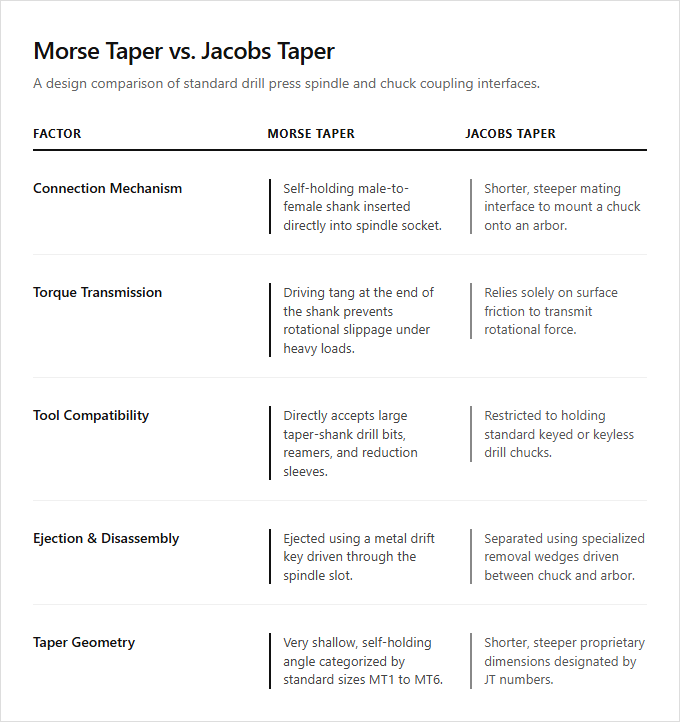
| Factor | Summary |
|---|---|
| Connection Mechanism | The Morse Taper utilizes a self-holding male-to-female shank system inserted directly into the spindle socket, whereas the Jacobs Taper uses a shorter, steeper mating interface specifically to mount a chuck onto a stepped arbor. |
| Torque Transmission | Morse Taper systems employ a driving tang at the end of the shank to prevent rotational slippage under heavy loads, while Jacobs Tapers rely solely on surface friction to transmit torque. |
| Tool Compatibility | A Morse Taper spindle can directly accept large taper-shank drill bits and reamers, whereas a Jacobs Taper is restricted to holding standard keyed or keyless chucks. |
| Ejection and Disassembly | Operators eject a Morse Taper using a metal drift key driven through the spindle slot, while a Jacobs Taper is separated using specialized removal wedges driven between the chuck and the arbor. |
| Taper Geometry | Morse Tapers feature a very shallow, self-holding taper angle categorized by sizes MT1 through MT6, while Jacobs Tapers use shorter, steeper proprietary dimensions designated by JT numbers. |
Morse Taper Shank Self-Holding Spindle Fit
In drill presses, the Morse Taper (MT) system provides a highly efficient method for transferring high torque. This design utilizes a precise, shallow-angled male shank that seats directly into the matching female spindle socket. The connection relies on a self-holding friction fit, where the mating metal surfaces wedge together tightly under axial pressure. As drilling force increases, this wedge effect intensifies, preventing rotational slippage without the need for keys or threaded fasteners.
Conversely, the Jacobs Taper (JT) features a shorter, steeper taper designed primarily to mount a drill chuck semi-permanently to an arbor. Heavy industrial machinists requiring frequent, high-torque swaps of large-diameter drill bits benefit most from the robust Morse Taper system, whereas hobbyists and general maintenance technicians find the versatility of a standard Jacobs Taper chuck setup more suitable for their daily needs.
Jacobs Taper short-taper mount for securing the drill chuck body
In drill press applications, the Morse Taper and Jacobs Taper systems serve distinct, complementary roles in tool retention. While the Morse Taper is a long, self-holding external taper used to mount arbors directly into the machine spindle, the Jacobs Taper is a specialized short-taper mount. This short taper is specifically engineered to press-fit into the back of the drill chuck body, establishing a highly concentric, friction-locked connection that effectively resists rotational slippage under load.
The compact design of the Jacobs Taper ensures a rigid, semi-permanent coupling for the chuck itself, whereas the Morse Taper facilitates rapid tooling changes at the spindle level. High-production machinists who frequently swap between large twist drills and chucks rely on the quick-change versatility of the Morse Taper, whereas precision fabricators and woodworkers requiring a dedicated, wobble-free chuck setup benefit most from the permanent stability of the Jacobs Taper.
Tang drive engagement for torque transfer and drift key ejection
The Morse Taper (MT) and Jacobs Taper (JT) systems offer distinct methods for mounting tooling in a drill press. The Morse Taper utilizes a male shank with a flattened end, known as the tang, which mates with a slot inside the spindle. This tang drive engagement ensures positive torque transfer, preventing slippage under heavy loads. Additionally, the spindle housing features an access slot, allowing operators to insert a wedge-shaped drift key to quickly eject the taper for tool changes.
The Jacobs Taper relies entirely on a high-precision friction fit without a tang or ejection slot, making it a semi-permanent mounting solution for drill chucks. Heavy-duty metalworkers and machinists requiring frequent tool changes benefit most from the Morse Taper, while general woodworkers and hobbyists seeking a set-and-forget chuck installation are best suited for the Jacobs Taper.
Threaded Drawbars Prevent Morse Taper Axial Slippage
In drill press spindles, Jacobs Tapers and Morse Tapers handle mechanical loads differently. Jacobs Tapers rely on a press-fit friction connection, making them highly reliable for standard vertical drilling but vulnerable to side-load separation. Morse Tapers offer a self-holding, interchangeable design suitable for heavier and more diverse applications.
Standard Morse Tapers can slip axially under lateral loading. To prevent this slippage during operations like light milling, some Morse Taper ends feature a threaded hole for a drawbar. This rod runs through the spindle to mechanically lock the taper, ensuring stability against side forces. Jacobs Taper configurations suit hobbyists performing routine vertical drilling, while threaded Morse Taper systems are essential for professional machinists requiring lateral load security for light milling tasks.
Total Indicated Runout minimization to ensure spindle-to-chuck concentricity
Minimizing Total Indicated Runout (TIR) is critical for achieving precise spindle-to-chuck concentricity in drill presses. Jacobs Tapers (JT) rely on a shallow, friction-fit external mount directly onto the spindle, offering a compact connection suitable for standard drilling. In contrast, the Morse Taper (MT) system utilizes a self-holding, long internal mating design. This deeper mechanical engagement provides superior axial rigidity and inherently lower TIR, which is essential for maintaining alignment during heavy-duty torque transmission and high-precision machining.
Choosing the correct interface depends on the specific demands of the operator's workflow. Jacobs Tapers are ideal for DIY hobbyists and light-duty woodworkers prioritizing simplicity and cost-effectiveness, whereas Morse Tapers are best suited for industrial machinists and metal fabricators requiring high-accuracy, interchangeable tooling, and maximum concentricity under heavy loads.
Taper-per-foot angle differences between Morse and Jacobs standardized dimensions
Morse Tapers and Jacobs Tapers are standard machine tapers used in drill presses, differing significantly in their taper-per-foot (TPF) gradients. Morse Tapers feature a shallow, highly consistent slope averaging approximately 0.602 inches per foot. This gradual angle provides exceptional surface contact and wedging force, allowing the spindle to drive heavy torque directly through the shank.
Jacobs Tapers utilize shorter, steeper angles designed specifically for mounting drill chucks. Standard JT dimensions vary widely; a JT3 has a taper of 0.630 inches per foot, while a JT33 features a steeper 0.761 inches per foot. This steeper angle facilitates secure, precise, semi-permanent chuck mounting.
Industrial machinists requiring frequent, quick tool changes rely on the self-holding Morse Taper system, whereas general woodworkers and fabrication shops needing a fixed, dedicated chuck assembly are better served by the stable Jacobs Taper connection.
Morse to Jacobs Taper Compatibility on Dual Arbors
In drill press configurations, dual-ended arbors serve as the critical link between the machine spindle and the drill chuck. Step-down compatibility relies on matching the larger Morse Taper (MT) on the spindle end with the appropriate Jacobs Taper (JT) designation on the chuck end. Properly pairing these tapers prevents rotational slippage and ensures optimal torque transfer, allowing a heavy-duty spindle to drive smaller, high-precision chucks efficiently.
Common step-down combinations, such as an MT2-to-JT33 or MT3-to-JT6 arbor, balance the spindle's driving power with the chuck's gripping capacity. Morse Tapers suit industrial operators requiring high-torque drilling and rapid tool changes, whereas Jacobs Tapers are ideal for precision-oriented machinists who require a highly concentric, permanently mounted chuck.
Leave a comment