
For professional fabricators and woodworkers, few workshop limitations are as frustrating as hitting the physical boundary of your machinery. When attempting to drill holes in the center of wide stock, standard drill presses frequently run out of throat capacity, stalling production and compromising accuracy.
To overcome these capacity bottlenecks, shops typically look to reallocate capital from standard equipment budgets or seek traditional tooling procurement funding to buy larger machinery. However, choosing the right configuration is a more cost-effective solution. Selecting a radial drill press grants operators the unique ability to extend the spindle far beyond the column limit, maximizing reach without requiring industrial-scale capital expenditure.
Stipulation: While a radial arm offers unmatched flexibility, operators must expect a slight trade-off in absolute rigidity compared to rigid standard columns-a critical factor when boring dense hardwoods or undertaking heavy metal fabrication.
In this article, we will compare radial and standard drill presses, analyze how throat capacity impacts your workflow, and provide a clear framework for selecting the optimal tool for your shop's needs.
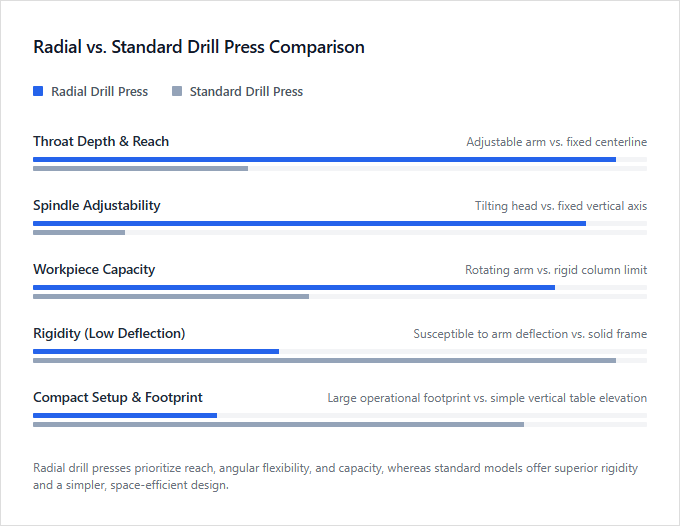
| Factor | Summary |
|---|---|
| Throat Depth and Reach | The radial drill press features an adjustable horizontal arm that significantly extends its throat depth compared to the fixed spindle centerline of a standard drill press. |
| Spindle Head Adjustability | Unlike a standard drill press with a fixed vertical axis, a radial drill press has a tilting spindle head that allows for precise angular drilling and bevel cuts. |
| Workpiece Capacity | Standard drill presses are limited by their rigid column-to-spindle swing distance, whereas radial models accommodate oversized materials by rotating the arm around the column. |
| Rigidity and Deflection | Standard drill presses offer superior structural rigidity for heavy metalworking, while the extended arm of a radial drill press is more susceptible to column deflection under high thrust loads. |
| Table Adjustment and Setup | Radial drill presses require a significantly larger operational footprint, whereas standard drill presses utilize a simpler rack-and-pinion system for vertical table elevation. |
How Radial Drill Presses Maximize Throat Depth
When selecting a drill press, understanding the structural differences between standard and radial models is essential for workshop efficiency. Standard drill presses feature a fixed spindle-to-column distance, which strictly limits the physical size of the workpiece that can be positioned directly under the chuck. In contrast, radial drill presses incorporate an adjustable radial arm that can slide, swing, and tilt, allowing operators to position the drill head far beyond the constraints of a traditional frame.
This movable arm design drastically increases the maximum throat depth, enabling the fabrication of wide panels and complex angled boring that would be impossible on standard machines. Standard models offer unmatched rigidity and footprint efficiency for repetitive, vertical drilling tasks. Dedicated woodworkers and metalworkers requiring high-precision, repetitive straight boring find standard models ideal, while craftsmen managing oversized sheets or intricate, multi-angle joinery benefit most from the versatility of a radial drill press.
Sliding Headstock Carriage for Variable Throat Capacity
When selecting between a radial drill press and a standard drill press, workshop efficiency often hinges on workpiece maneuverability. The defining feature of a radial drill press is its sliding headstock carriage mounted along a horizontal radial arm. This specialized design enables variable throat capacity, allowing the operator to position the spindle precisely over different areas of the material without shifting heavy or awkward workpieces.
A standard drill press features a fixed headstock, requiring operators to physically move the workpiece to align successive holes, which restricts throat depth to the static distance between the column and the spindle. While standard models offer excellent rigidity for vertical, repetitive tasks, radial models provide superior versatility for complex, angled, and oversized projects. Standard drill presses are ideal for general hobbyists requiring straightforward, vertical drilling, whereas radial drill presses best serve professional fabricators and industrial woodworkers who regularly handle large, irregular fabrications.
Arm Extension Determines Radial Swing Capacity
When selecting a drill press, understanding the mechanical distinctions between standard and radial models is essential for workshop efficiency. Standard drill presses feature a fixed spindle alignment where the swing capacity is limited by a static pillar-to-spindle measurement. Conversely, the swing capacity on radial models is determined by the maximum radial arm extension rather than a static pillar-to-spindle measurement. This telescoping arm design allows operators to adjust the throat depth, enabling the spindle to reach the center of much larger workpieces.
In addition to increased reach, radial drill presses offer a tilting head assembly, allowing for angled drilling without adjusting the work table. Standard models maintain a rigid, strictly vertical spindle, prioritizing maximum stability and perpendicular precision for repetitive tasks. Standard models are ideal for traditional woodworkers and machinists focused on high-precision straight drilling, while radial models are best suited for versatile fabricators and carpenters who regularly work with oversized, irregular materials.
Multi-Angle Drilling with Tilting Spindle Radial Drills
Standard drill presses offer robust stability and precision for vertical drilling, but they are limited by a fixed throat depth and spindle angle. In contrast, radial drill presses provide significantly enhanced versatility due to an adjustable arm and a tilting spindle head. This tilting mechanism allows for multi-angle angular drilling across the entire expanded throat area, enabling operators to execute complex bores on oversized workpieces without constantly repositioning the material.
Selecting the appropriate machine depends on your specific workshop applications and workpiece dimensions. Standard drill presses are ideal for general woodworkers and metalworkers requiring consistent, perpendicular holes in standard-sized stock, while radial models are best suited for commercial fabricators and furniture makers handling large, irregular pieces that demand intricate, angled drilling operations.
Heavy-Duty Columns Prevent Radial Drill Spindle Deflection
When comparing radial and standard drill presses, the primary differentiator is throat capacity. Radial drill presses feature an adjustable arm that extends the spindle-to-column distance to accommodate large or awkwardly shaped workpieces. This high throat capacity necessitates a heavy-duty vertical column to prevent spindle deflection during high-torque operations, ensuring structural rigidity under intense leverage.
In contrast, standard drill presses feature a fixed spindle aligned close to the column, which inherently minimizes deflection during repetitive tasks. Standard models are ideal for hobbyists and light fabricators seeking consistent perpendicular accuracy on smaller workpieces, whereas radial drill presses are best suited for industrial machinists requiring versatile angles and deep reach for oversized materials.
Precision Arm Elevation on Radial Presses
When choosing between a radial drill press and a standard drill press, the mechanism for adjusting spindle height is a critical differentiator. On a standard drill press, raising or lowering the worktable can alter the workpiece alignment relative to the spindle. In contrast, a radial drill press features a vertical arm elevation mechanism that allows operators to adjust the height of the entire radial arm. This movement preserves the exact workpiece alignment and maintains the machine's maximum throat clearance, allowing for seamless vertical adjustments on complex setups without repositioning the material.
Standard drill presses are ideal for hobbyists and light-duty woodworkers requiring straightforward, vertical accuracy on uniform parts, while radial drill presses are best suited for industrial fabricators and machinists handling oversized, irregular workpieces.
Radial Models Engineered for Heavy-Duty Boring
Standard drill presses deliver reliable, vertical precision for everyday workshop applications. In contrast, radial drill presses offer unmatched versatility through their adjustable tilting heads. The deep throat capacity of radial models is complemented by a longer quill stroke and a Morse taper spindle, enabling high-torque, heavy-duty boring operations across wide or irregular workpieces that standard models cannot accommodate.
Choosing between these two machines depends heavily on the scale and complexity of your projects. Standard drill presses are ideal for hobbyists and general woodworkers who require consistent, straightforward vertical holes, while radial drill presses are best suited for industrial fabricators and professional machinists handling large-scale, angled, or intricate workpieces.
Leave a comment