
Maintaining consistent pneumatic power during demanding industrial tasks is a persistent struggle for fleet managers and operators, who frequently battle pressure drops and tool stalling. While organizations typically rely on standard operational funding or baseline equipment budgets to procure entry-level shop tools, high-PSI applications require a more strategic capital investment. Selecting the correct compressor configuration is vital, as it grants the sustained duty cycle and high-volume output necessary to eliminate costly operational bottlenecks.
As an educational stipulation, it is important to note that PSI rating alone does not guarantee performance; it must be balanced with sufficient CFM (Cubic Feet per Minute) delivery. For example, running heavy-duty 1-inch pneumatic impact wrenches or continuous sandblasting setups will quickly exhaust an under-matched system. To assist in your procurement decision, this article provides a comparative analysis of single-stage and two-stage compressors, detailing their mechanical differences, thermal efficiencies, and ideal operational environments.
| Factor | Summary |
|---|---|
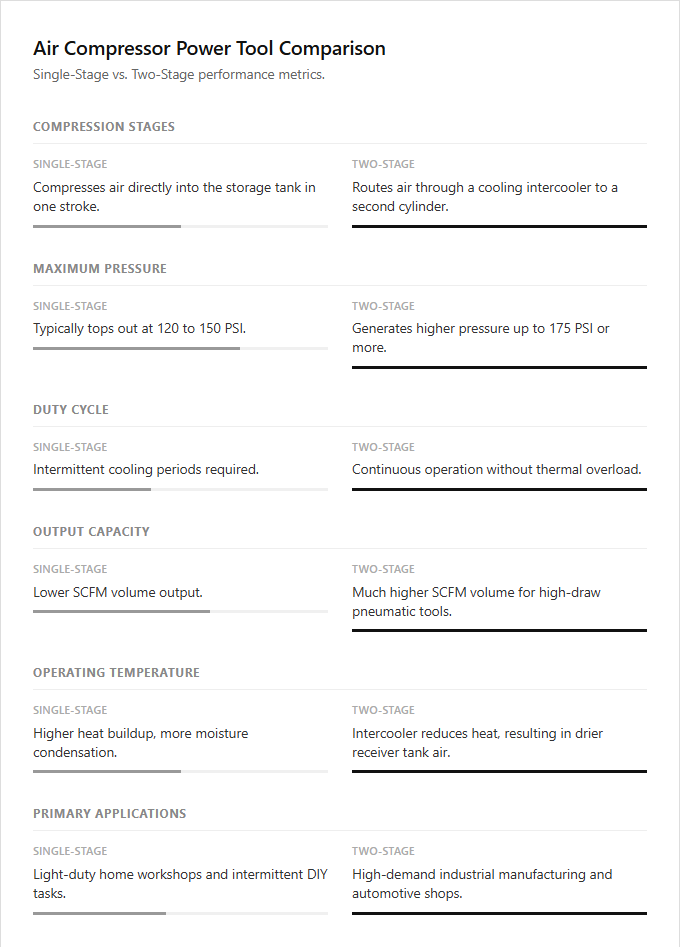
| Compression Stages | Single-stage compressors compress air directly into the storage tank in one cylinder stroke, whereas two-stage units route air through a cooling intercooler to a second, smaller cylinder for dual-stage compression. |
| Maximum Pressure | Single-stage models typically top out at 120 to 150 PSI, while two-stage compressors utilize their secondary piston chamber to generate higher pounds per square inch (PSI) levels up to 175 PSI or more. |
| Duty Cycle | Two-stage compressors offer a continuous duty cycle suitable for demanding operations, unlike single-stage models which require intermittent cooling periods to prevent thermal overload. |
| Output Capacity (CFM) | Two-stage compressors deliver a much higher volume of standard cubic feet per minute (SCFM), which is critical for operating high-draw pneumatic tools continuously. |
| Operating Temperature | An integrated intercooler in two-stage systems reduces the heat of compression, resulting in lower operating temperatures and less moisture condensation in the receiver tank compared to single-stage units. |
| Primary Applications | Single-stage units are designed for light-duty home workshops and intermittent DIY tasks, whereas two-stage systems are engineered for high-demand industrial manufacturing and automotive service centers. |
How Intercoolers Work in Two-Stage Compressors
When selecting an air compressor, understanding the mechanical distinctions between single-stage and two-stage models is essential. Single-stage compressors compress air directly into a tank in one stroke, whereas two-stage models utilize a sequential process. Specifically, two-stage units employ an intercooler to lower the temperature of the compressed air between the first and second compression stages, which enhances efficiency and reduces equipment wear.
This cooling process allows two-stage systems to safely generate much higher pressure for demanding applications. Single-stage units operate at lower pressures, making them highly efficient for intermittent hand tool operation. Single-stage compressors are ideal for home hobbyists and light automotive tasks, while two-stage models are best suited for industrial professionals requiring continuous, heavy-duty pneumatic power.
Single-Stage Compressor Limits: 125 to 150 PSI
When selecting an air compressor, understanding the mechanical difference between single-stage and two-stage models is essential for matching the tool to your operational needs. In a single-stage compressor, air is compressed only once before entering the storage tank. This design inherently limits the maximum pressure output to approximately 125 to 150 PSI, making it highly efficient for standard applications but less suitable for continuous high-pressure demands.
In contrast, two-stage compressors compress air in two separate phases, routing it through a cooling tube to achieve pressures exceeding 175 PSI. This multi-stage process allows for the sustained operation of heavy-duty pneumatic machinery. Single-stage models are ideal for DIY hobbyists and light workshop tasks requiring intermittent power, whereas two-stage units are best suited for commercial mechanics and industrial operators requiring continuous, high-pressure output.
Two-Stage Compressors for Continuous High-PSI Industrial Use
When selecting an air compressor, understanding the mechanical distinction between single-stage and two-stage models is essential for operational efficiency. Single-stage compressors compress air directly into the tank in a single stroke, which is ideal for intermittent use. In contrast, two-stage compressors compress air twice, cooling it between stages to reach significantly higher pressure levels.
This dual-stage process allows two-stage compressors to operate reliably at a continuous 100% duty cycle. Engineered for demanding, high-PSI industrial environments, these machines deliver consistent power without requiring cooling breaks.
Single-stage models are best suited for DIY hobbyists and light automotive workshops, whereas two-stage units are built for industrial operators who require continuous high-pressure air for heavy-duty machinery.
Two-Stage Units Boost High-Pressure Efficiency and CFM
When selecting an air compressor, understanding the mechanical distinction between single-stage and two-stage systems is essential for optimal performance. While single-stage models compress air to its final pressure in a single piston stroke, two-stage units employ a dual-phase process with intermediary cooling. This cooling mechanism allows two-stage compressors to achieve significantly higher volumetric efficiency, delivering a greater Cubic Feet per Minute (CFM) rate at elevated operating pressures.
By reducing air temperature between compression cycles, these advanced units minimize heat buildup and maximize power output under continuous loads. Single-stage models are best suited for DIY enthusiasts performing intermittent workshop tasks, whereas two-stage systems are ideal for industrial professionals requiring continuous, high-pressure power for heavy-duty pneumatic machinery.
Stepped Cylinder Design in Two-Stage Compressors
Single-stage and two-stage air compressors differ primarily in how they compress air to reach target pressures. In a two-stage compressor, efficiency is driven by a stepped cylinder configuration. This design features a larger low-pressure cylinder that performs the initial compression, followed by a smaller high-pressure cylinder that compresses the air further. An intercooler cools the air between these stages, reducing heat buildup and increasing overall system efficiency.
Single-stage models compress air in one stroke directly to the tank, making them simpler but less suited for continuous high-pressure applications. DIY enthusiasts and home mechanics typically benefit from the portability and lower cost of single-stage units, while industrial operators requiring continuous high-volume airflow are best suited for the durable performance of two-stage systems.
Two-Stage Compressors: More Efficient at High PSI
When selecting an air compressor, understanding the mechanical efficiency of single-stage versus two-stage systems is critical for optimizing operational costs. Single-stage compressors compress air to its final pressure in a single piston stroke, which is highly effective for moderate pressure demands. In contrast, two-stage compressors utilize two distinct chambers with an intercooler in between to lower the air temperature before the second compression cycle.
This cooling process reduces the air volume, meaning the system requires significantly less brake horsepower (BHP) per cubic foot per minute (CFM) to reach high PSI levels. By lowering the BHP requirements per CFM, two-stage units deliver superior energy efficiency and less component wear during demanding applications. Single-stage models are ideal for DIY hobbyists and light carpenters requiring intermittent, low-pressure tools, while two-stage compressors are best suited for automotive mechanics and industrial operators demanding continuous, high-volume output.
Lower Discharge Temperatures Protect Two-Stage Compressor Oil
In compressed air systems, the primary differentiator between single-stage and two-stage compressors lies in their thermal management. Single-stage models compress air to its final pressure in a single stroke, generating significant heat. Two-stage systems utilize an intercooler between stages to cool the air, resulting in significantly lower discharge temperatures.
This reduction in operating temperature prevents the thermal degradation of compressor oil and minimizes downstream moisture condensation. By maintaining cooler runs, two-stage units ensure longer component life and deliver higher air quality. Single-stage units are best suited for DIY hobbyists requiring intermittent, lower-pressure air, while two-stage compressors are designed for industrial operators demanding continuous, high-pressure output.
Leave a comment