
Achieving a flawless finish on woodworking projects often turns into a frustrating bottleneck. Many craftspeople struggle with unsightly swirl marks on flat panels or accidentally rounded-over edges, usually the result of deploying the wrong machine for the job.
Before upgrading, woodworkers typically look to standard tooling investments-such as heavy-duty belt sanders or basic hand-sanding blocks-to resolve these surface issues. Yet, choosing the correct specialized finishing tool instead grants unprecedented control, preserving sharp profiles while drastically reducing manual labor hours.
It is important to stipulate, however, that neither tool is a universal solution. While a 1/4-sheet orbital sander excels at prepping broad, flat surfaces like cabinet doors, a detail delta sander is indispensable for navigating the tight, intricate corners of a vintage dining chair.
This guide compares sheet and detail sanders across key performance metrics-including material removal rate, corner accessibility, and abrasive costs-to help you select the optimal tool for your workshop's finishing needs.
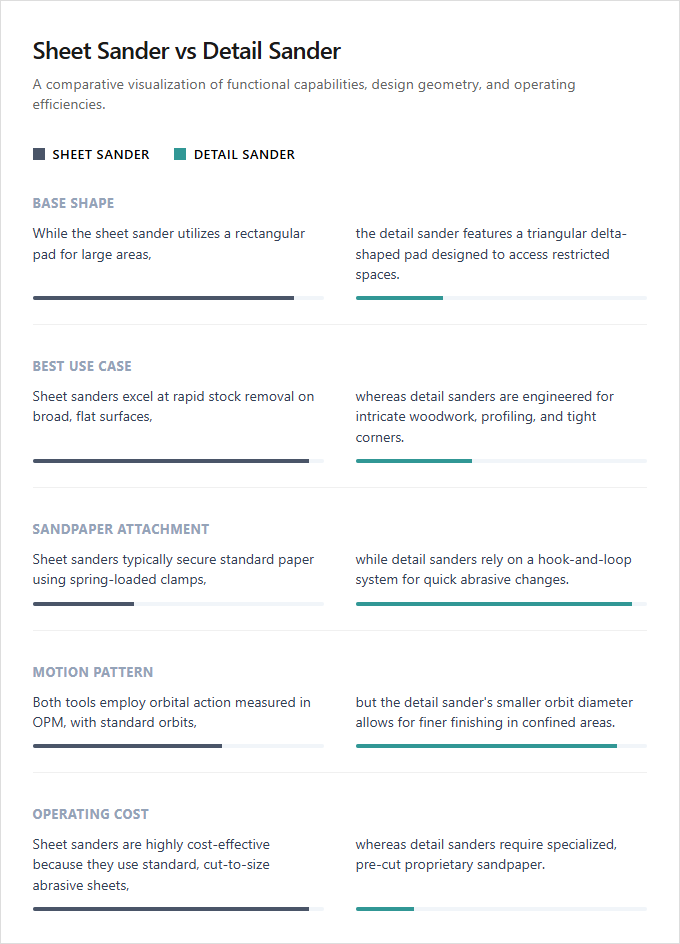
| Factor | Summary |
|---|---|
| Base Shape | While the sheet sander utilizes a rectangular pad for large areas, the detail sander features a triangular delta-shaped pad designed to access restricted spaces. |
| Best Use Case | Sheet sanders excel at rapid stock removal on broad, flat surfaces, whereas detail sanders are engineered for intricate woodwork, profiling, and tight corners. |
| Sandpaper Attachment | Sheet sanders typically secure standard paper using spring-loaded clamps, while detail sanders rely on a hook-and-loop system for quick abrasive changes. |
| Motion Pattern | Both tools employ orbital action measured in orbits per minute (OPM), but the detail sander's smaller orbit diameter allows for finer finishing in confined areas. |
| Operating Cost | Sheet sanders are highly cost-effective because they use standard, cut-to-size abrasive sheets, whereas detail sanders require specialized, pre-cut proprietary sandpaper. |
Platen Geometry: Flat Surfaces vs. Tight Corners
Sheet sanders and detail sanders serve distinct roles in woodworking based primarily on their platen geometry. A sheet sander features a large, square or rectangular base designed to hold standard fractional sheets of sandpaper. This broad, flat footprint provides maximum surface contact, making it highly efficient for rapid material removal and achieving uniform finishes on expansive, flat areas like tabletops or doors.
In contrast, a detail sander utilizes a triangular, iron-shaped platen. This pointed geometry allows the tool to access tight-radius corners, intricate moldings, and narrow recesses where larger square sanders cannot fit. Cabinetmakers and furniture restorers benefit from the precision of the detail sander, while general carpenters and DIYers tackling large-scale refinishing projects will find the sheet sander indispensable.
How Orbit Stroke and OPM Impact Material Removal
When comparing sheet sanders and detail sanders, the material removal rate is primarily driven by the relationship between orbit stroke diameter and orbits per minute (OPM). Sheet sanders utilize a larger orbit stroke diameter, typically around 1/16 to 3/32 inches, allowing each grain of abrasive to sweep a wider path. This larger stroke, combined with consistent OPM ratings, maximizes efficiency during flat-surface stock removal.
Detail sanders employ a smaller orbit stroke diameter to maintain control and prevent aggressive gouging in confined spaces. These tools rely on higher OPM ratings to deliver an ultra-fine finish rather than rapid bulk removal. Sheet sanders are ideal for DIYers and professionals prepping expansive flat panels, whereas detail sanders are suited for furniture restorers refinishing intricate, multi-angled pieces.
Why Delta Pads Beat Sheet Sanders in Corners
When selecting between a sheet sander and a detail sander, the primary differentiator lies in their base plate geometry and resulting maneuverability. Sheet sanders utilize a square pad that excels at rapid, uniform stock removal on broad, flat surfaces. However, this square design significantly restricts flush-sanding capability along vertical boundaries, as the tool housing often prevents the abrasive from reaching the absolute edge.
In contrast, detail sanders feature a triangular delta pad engineered specifically for high corner-ingress. This pointed profile allows the tool to navigate tight angles, intricate contours, and complex joints where standard rectangular sanders cannot fit.
Sheet sanders are ideal for trade professionals processing large, flat panels, while detail sanders are best suited for furniture restorers and hobbyists handling intricate, detailed woodwork.
Abrasive Attachment: Clamps vs. Hook-and-Loop
Sheet sanders are designed for large, flat surfaces, traditionally utilizing a mechanical tensioning clamp system to secure abrasive sheets. This mechanism allows operators to cut economical, standard sandpaper to size, offering a highly cost-effective solution for bulk material removal. While securing the paper via metal clamps requires more manual preparation, it ensures a tight, slip-free hold during prolonged, flat sanding tasks.
In contrast, detail sanders feature triangular pads equipped with hook-and-loop backing systems for rapid abrasive changes. This system relies on tiny plastic hooks gripping a looped fabric backing on the sandpaper, facilitating efficient transitions when working in tight corners or complex angles. Sheet sanders are ideal for budget-conscious craftsmen tackling large, flat panels, whereas detail sanders best serve restorers and hobbyists focused on intricate furniture and tight-corner applications.
The Superior Cost-Efficiency of Standard Sheet Sanders
When selecting between a sheet sander and a detail sander, consumable cost-efficiency represents a primary operational differentiator. Sheet sanders offer superior long-term economy because they utilize standard fractional abrasive sheets, which operators can cut directly from inexpensive, bulk sandpaper rolls. This capability eliminates the need for expensive, proprietary pre-cut sanding pads. In contrast, detail sanders require specialized triangular hook-and-loop sheets that carry a premium price tag per unit, leading to higher ongoing maintenance expenses.
The design profiles of these tools also dictate their specific utility on the job site. Sheet sanders feature a broad, flat base optimized for rapid material removal on large expanses, whereas detail sanders employ a pointed, iron-shaped head to access tight corners and complex contours. Sheet sanders are ideal for high-volume cabinet makers focusing on flat panels, whereas detail sanders are best suited for furniture restorers handling intricate, ornate woodwork.
Sheet Sanders: Best for Large, Flat Surfaces
When preparing wood surfaces, selecting the appropriate tool depends on the workpiece geometry. Orbital sheet sanders utilize a square pad that accommodates standard sandpaper sheets, providing a large, flat footprint. This superior surface area coverage capacity makes orbital sheet sanders exceptionally efficient for broad, flat workpieces such as tabletops, panels, and doors.
Detail sanders feature a compact, triangular pad designed specifically to access tight corners, narrow crevices, and intricate profiles. While sheet sanders excel at rapid material removal on expansive planes, detail sanders prioritize precision in restricted spaces. Broad-surface carpenters and cabinet makers rely on sheet sanders for high-production flattening, whereas craft hobbyists and furniture restorers benefit most from the nimble control of detail sanders.
Aligning Dust Extraction Ports with Abrasive Holes
When selecting between a sheet sander and a detail sander, dust management remains a critical technical consideration. Both tool types utilize integrated vacuum ports that must precisely align with the pre-punched holes in the abrasive paper to ensure effective debris extraction. This alignment prevents thermal buildup, extends abrasive life, and maintains a clean workspace. While sheet sanders employ a square pad for larger flat surfaces, detail sanders feature a triangular, iron-shaped pad designed to access tight corners and intricate crevices.
To maximize dust extraction efficiency, users must ensure the hole patterns on the sanding sheets match the specific manufacturer configuration of the tool's backing pad. Cabinet makers and refinishers requiring rapid material removal on broad, flat panels will benefit most from the stable output of a sheet sander, whereas hobbyists and furniture restorers working on complex joints require the agility and precision of a detail sander.
Leave a comment