
Achieving a flawless, blemish-free finish is one of the most frustrating bottlenecks in woodworking. Nothing is more discouraging than spending hours on a custom build, only to discover unsightly swirl marks or uneven surfaces once the final stain or topcoat is applied.
Traditionally, woodworkers have relied on standard workshop assets-such as manual sanding blocks or aggressive belt sanders-to bridge the gap between raw timber and a finish-ready surface. However, understanding and choosing the right orbital pad geometry grants you the ability to slash preparation time in half while securing an optical-grade smoothness that highlights the wood's natural grain.
To set realistic expectations, we must stipulate that no single tool is a universal cure-all. For example, while a standard 1/4-sheet square sander is indispensable for flushing up tight 90-degree corners, a 5-inch round random orbital sander is the industry benchmark for swirl-free face-grain preparation.
This guide will analyze the mechanical differences between square and round pads, compare their material removal rates, and help you select the optimal sander for your specific woodworking projects.
| Factor | Summary |
|---|---|
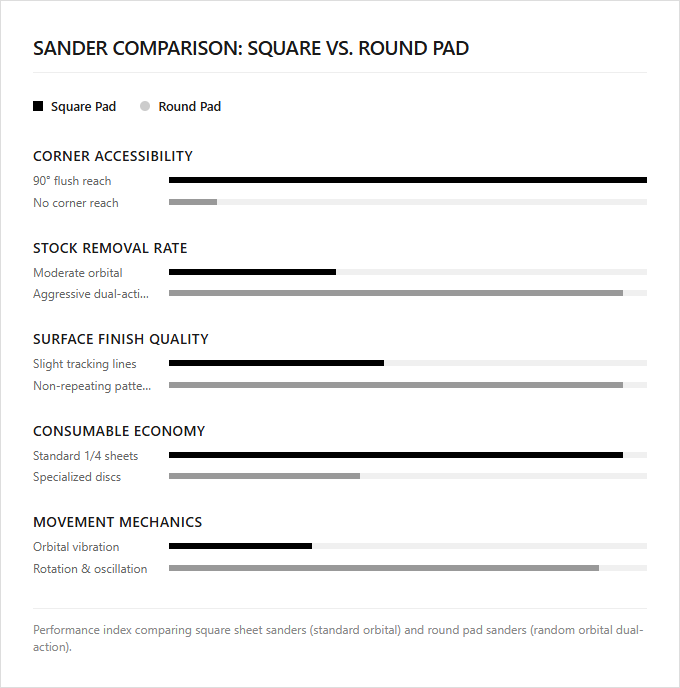
| Movement Type | Round pad sanders utilize a dual-action random orbital motion to prevent directional scratching, whereas square pad sanders rely on a simpler orbital vibration. |
| Corner Accessibility | Square pad sanders are engineered for flush sanding into ninety-degree corners, whereas the circular design of round pad sanders prevents them from reaching into tight right-angled intersections. |
| Stock Removal Rate | Round pad sanders deliver a significantly higher material removal rate due to their aggressive combination of rotation and oscillation. |
| Surface Finish Quality | The non-repeating pattern of a round sander provides superior scratch pattern mitigation, leaving a smoother finish than the tracking lines often left by square sheet sanders. |
| Consumable Compatibility | Square sanders are highly cost-effective because they accept standard quarter-sheet abrasives, while round sanders require specialized hook-and-loop sanding discs. |
Square Pad Corner Access vs. Round Pad Radial Limits
When selecting an orbital sander, the pad geometry dictates operational efficiency on specific workpiece profiles. Square pad sanders offer exceptional orthogonal corner accessibility, allowing the abrasive media to reach directly into 90-degree joints and tight edges. This design eliminates unsanded gaps and ensures uniform material removal right up to the boundary of intersecting surfaces.
In contrast, round pad sanders are subject to a radial limitation. Their circular shape prevents the abrasive from contacting the interior apex of right-angled corners, necessitating manual detail sanding in those areas. Square sanders are ideal for cabinetmakers and installers working with built-ins and tight corners, while round sanders are best suited for refinishers and furniture makers requiring ultra-smooth, swirl-free finishes on expansive, flat surfaces.
Random Orbital Motion for Swirl-Free Surface Prep
Selecting between a square pad and a round pad sander depends heavily on the desired finish and workpiece geometry. Round pad sanders utilize a distinct random orbital motion, combining rotation with oscillation to effectively prevent the swirl marks often associated with standard orbital sanding. This unique movement makes the round pad highly efficient for pristine surface preparation and seamless finishing on open, flat surfaces.
In contrast, square pad sanders feature a standard orbital path that allows the tool to easily reach into tight 90-degree corners and sand directly against vertical edges. Professionals focusing on cabinet making and detailed trim work benefit most from the corner-clearing capability of the square pad, while refinishers and furniture makers requiring flawless, swirl-free surfaces are better suited to the round pad model.
Stock removal rate efficiency differences between the two pad geometries
Round orbit sanders offer superior stock removal efficiency compared to square sheet sanders. The rapid, dual-action rotation of a round pad prevents gouging and expels wood dust continuously, allowing the abrasive to maintain optimal contact with the material. This geometry and motion yield a significantly faster material removal rate on flat, open surfaces.
Square pad sanders utilize a simpler orbital motion that delivers a lower stock removal rate. This square geometry excels in tight corners and along straight edges where round pads cannot physically reach. While the square design requires more time for bulk material removal, it eliminates the need for tedious manual detail sanding in recessed areas.
Woodworkers prioritizing rapid surface preparation on large panels benefit most from the high-efficiency round pad sanders, whereas cabinet makers and detail-oriented refinishers requiring precise corner access are better suited for square pad sanders.
Hook-and-loop fastening systems versus mechanical wire clamp paper attachment
Square pad sanders typically utilize mechanical wire clamp systems to secure standard sandpaper sheets, offering a highly cost-effective and versatile option. Conversely, round pad sanders generally employ hook-and-loop fastening systems, which allow for rapid, convenient disc changes and optimal dust extraction through pre-punched holes.
While the wire clamp design reduces operating costs by allowing the use of bulk sandpaper, it requires more time and precision to load. The hook-and-loop system prioritizes efficiency and a secure hold during high-speed rotation, though the proprietary pads incur a higher replacement cost. Square clamp sanders are ideal for budget-conscious DIYers focusing on flat surfaces and corners, whereas round hook-and-loop sanders best suit professional woodworkers requiring rapid material removal and seamless finishes.
Orbit stroke length variance affecting the aggressiveness of the abrasion
When selecting between square and round pad sanders, the variance in orbit stroke length is the primary factor dictating abrasion aggressiveness. Square pad sanders typically utilize a smaller, 1/16-inch orbit stroke, providing a gentle action that minimizes surface scarring. In contrast, round pad sanders leverage larger orbit strokes, often between 3/32 and 3/16 inch, to significantly increase the tool's cutting speed and material removal capacity.
This stroke variance directly alters the friction and speed of the abrasive grit against the workpiece. Square pad sanders are ideal for DIY hobbyists focusing on detail work and tight, right-angle corners, while round pad sanders are best suited for professional woodworkers requiring rapid stock removal and swirl-free finishes on large, open surfaces.
Dust extraction efficiency determined by standardized vacuum hole patterns
When comparing square pad (quarter-sheet) and round pad (random orbital) sanders, dust extraction efficiency is heavily influenced by their standardized vacuum hole patterns. Round pad sanders typically feature industry-standard 5-hole or 8-hole configurations that align precisely with matching sanding discs, facilitating highly efficient, direct airflow to pull debris away from the work surface. Conversely, square pad sanders often rely on manual paper punches or less standardized layouts, which can restrict airflow and result in higher dust accumulation during operation.
The superior extraction design of the round pad maintains a cleaner workspace and extends abrasive life by preventing clogging. Detailed finish carpenters and budget-conscious DIYers benefit from the corner-reaching square pad, whereas professional refinishers requiring rapid, dust-free surface preparation should choose the round pad sander.
Rotational torque and eccentric counterweight dynamics in round sanders
While square pad sanders rely on a direct orbital path to navigate corners efficiently, round pad sanders utilize a sophisticated interplay of rotational torque and eccentric counterweight dynamics. In round models, an offset counterweight generates a continuous elliptical orbit, while the drive spindle allows the pad to spin freely. This design leverages centrifugal force and rotational torque to create a random, dual-action motion that prevents the abrasive from repeating its exact path.
The variable rotational speed, regulated by surface friction and counterweight inertia, ensures highly efficient material removal and minimizes surface scratching. Square sanders are ideal for detail-oriented woodworkers who need to reach tight 90-degree corners, while round sanders are best suited for refinishers and DIYers seeking rapid, swirl-free smoothing on broad, flat surfaces.
Leave a comment