
Woodworkers frequently struggle with the frustrating realities of traditional high-speed steel (HSS) jointer knives: rapid dulling, tedious alignment setups, and the dreaded tear-out on figured grain. To address these finish issues, craftspeople typically rely on frequent manual sharpening regimens or precision dial-indicator jigs to maintain a true face on their stock.
However, upgrading to a helical cutterhead with indexable carbide inserts grants woodworkers an unprecedented level of surface finish consistency, vastly reduced noise levels, and near-zero setup downtime. While this transition requires a higher upfront financial investment and careful verification of machine compatibility, the long-term ROI is undeniable-especially when processing challenging material like highly figured curly maple.
In this guide, we will analyze the performance differences between HSS knives and carbide inserts, evaluate the cost-to-benefit ratio of cutterhead conversions, and outline the step-by-step process for executing this precision upgrade.
| Factor | Summary |
|---|---|
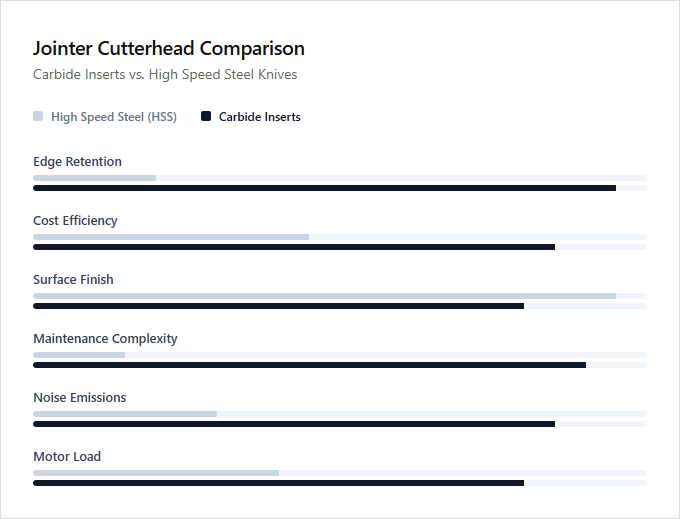
| Edge Retention | Carbide inserts maintain their sharpness significantly longer than high-speed steel knives due to their superior metallurgical hardness, which greatly extends tool life before edge degradation occurs. |
| Cost Efficiency | Although high-speed steel knives have a lower initial purchase price, carbide inserts prove more cost-effective over time due to indexable edges that allow partial replacement rather than buying entire new blades. |
| Surface Finish | HSS knives produce an exceptionally smooth surface finish on straight-grain lumber due to their keener cutting edge, while carbide inserts in a helical head minimize tear-out on highly figured hardwoods using a shear-cutting angle. |
| Maintenance Complexity | Realigning straight HSS knives requires tedious calibration with a dial indicator, whereas indexable carbide inserts can be quickly rotated ninety degrees to expose a fresh cutting edge. |
| Noise Emissions | The segmented helical design of carbide insert cutterheads drastically reduces operational decibel levels by breaking up the continuous wind-shear effect generated by spinning straight HSS knives. |
| Motor Load | The sequential, interrupted cut of carbide inserts reduces cutting resistance and motor load compared to the simultaneous full-width impact of straight HSS knives. |
Indexable tungsten carbide inserts versus high-speed steel edge retention
High-speed steel (HSS) jointer knives deliver an exceptionally sharp initial edge, producing a pristine surface finish on softwoods and domestic lumber. However, HSS lacks long-term wear resistance when processing highly abrasive materials, requiring frequent sharpening or complete replacement to maintain cutting performance.
Indexable tungsten carbide inserts offer superior hardness and thermal stability, maintaining their cutting edge up to ten times longer than traditional steel. When an insert chips or dulls, it can be individually rotated to expose a fresh edge, minimizing maintenance downtime. Straight HSS knives remain ideal for budget-conscious hobbyists working primarily with softwoods, while indexable carbide cutters are best suited for high-volume professionals and woodworkers frequently utilizing figured or abrasive hardwoods.
Helical cutterhead shear-cut geometry reducing grain tearout
Traditional high-speed steel (HSS) straight knives strike the wood at a flat angle, which frequently causes grain tearout on figured or reverse-grain lumber. Modern helical cutterheads solve this issue by utilizing indexable carbide inserts positioned in a spiral pattern. This shear-cut geometry slices through wood fibers at an angle, acting like a hand plane to drastically reduce tearout and produce a superior surface finish.
While HSS knives deliver an exceptionally sharp initial edge at a lower upfront cost, carbide inserts retain their sharpness up to ten times longer and can be rotated individually when damaged. High-speed steel knives are ideal for budget-conscious hobbyists working primarily with softwoods, whereas carbide helical cutterheads are best suited for production shops and professionals regularly milling highly figured hardwoods.
Rockwell hardness scale differential between carbide and HSS
When equipping a jointer, the primary performance differentiator between High-Speed Steel (HSS) knives and carbide inserts is their position on the Rockwell hardness scale. Standard HSS knives typically register between 62 and 65 HRC (Rockwell C). In contrast, tungsten carbide is substantially harder, often registering between 75 and 80 HRC (or up to 92 HRA on the Rockwell A scale). This significant hardness gap directly dictates how each cutting edge wear-resists over time.
While HSS knives can be sharpened to a keener initial edge, their lower Rockwell rating makes them susceptible to rapid dulling when facing abrasive woods. Carbide's superior hardness allows it to maintain a clean cutting edge up to ten times longer than steel, resisting heat and nicking from embedded grit.
Budget-conscious hobbyists working primarily with domestic softwoods will benefit most from the sharpness and affordability of HSS knives, whereas high-volume professional workshops regularly processing figured hardwoods require the enduring durability of carbide inserts.
Staggered insert configuration lowering decibel output
When selecting jointer cutterheads, the choice between carbide inserts and high-speed steel (HSS) knives significantly impacts workshop volume and performance. Helical cutterheads featuring carbide inserts utilize a staggered configuration that breaks up the continuous cut into smaller, sequential bites. This helical alignment drastically lowers the decibel output by reducing air turbulence and cutting impact, creating a quieter and safer working environment compared to traditional straight blades.
Traditional HSS knives feature long, continuous edges that generate higher noise levels but offer an exceptionally smooth finish on softwoods at a lower initial cost. Straight HSS knives are highly suitable for budget-conscious hobbyists working occasionally with softwoods, while staggered carbide inserts are ideal for high-volume professionals prioritizing noise reduction, longevity, and minimal maintenance when milling diverse hardwoods.
Segmented chip load reducing motor horsepower requirements
In jointer technology, the choice between indexable carbide inserts and traditional high-speed steel (HSS) knives significantly impacts machine efficiency. Cutterheads featuring carbide inserts shear the wood in small, segmented bites rather than a single wide cut. This segmented chip load greatly reduces physical resistance during operation, which lowers the overall motor horsepower requirements and allows smaller motors to process tough hardwoods with ease.
Traditional straight HSS knives engage the entire width of the board simultaneously, demanding substantial power and requiring frequent maintenance. While HSS blades provide an excellent, smooth finish on clean stock, carbide inserts offer superior longevity and quieter operation. Straight HSS knives are best suited for budget-conscious hobbyists working occasionally with softwoods, while carbide insert cutterheads are ideal for production-oriented professionals seeking maximum durability and minimal downtime.
Four-sided rotatable cutting edges eliminating knife-setting jig alignment
When selecting a jointer, the choice between traditional High-Speed Steel (HSS) knives and indexable carbide inserts significantly impacts workshop productivity. Standard HSS knives require meticulous, often frustrating alignment using specialized jigs whenever they are nicked or dull. In contrast, helical cutterheads featuring carbide inserts utilize four-sided rotatable cutting edges; when one side dulls, the user simply rotates the insert to reveal a fresh, perfectly aligned edge, completely eliminating the need for tedious knife-setting procedures.
While HSS knives offer a lower upfront cost and a highly polished finish on softwoods, carbide inserts deliver superior longevity and reduced noise. Traditional straight HSS knives are best suited for budget-conscious hobbyists who do not mind manual machine calibration, whereas carbide-equipped cutterheads are ideal for high-production woodworkers and professionals who require minimal downtime and consistent accuracy.
Optimized dust collection CFM efficiency due to smaller chip geometry
When evaluating jointer cutterheads, the choice between helical carbide inserts and traditional high-speed steel (HSS) knives significantly impacts workshop dust collection efficiency. Standard HSS knives shear wood across the entire board width, producing large, curly shavings that can easily clog ductwork and choke airflow. In contrast, segmented carbide inserts slice the wood in a staggered sequence, producing much smaller, uniform chips. This reduced chip geometry optimizes dust collection CFM efficiency by allowing waste to flow freely through the extraction system with less resistance.
Choosing the right cutterhead depends on specific production demands and material choices. High-speed steel knives are suited for budget-conscious hobbyists working primarily with softwoods, while helical carbide inserts are ideal for production-grade shops and woodworkers who frequently process figured hardwoods and demand minimal downtime.
Leave a comment