
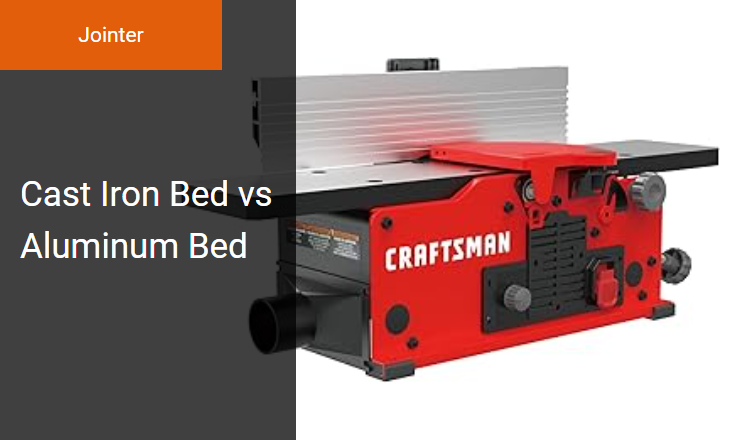
Achieving perfectly flat, square stock can be incredibly frustrating when your jointer's beds fail to remain perfectly coplanar. To resolve this, many woodworkers initially turn to standard, entry-level benchtop models as their default machinery choice to manage initial workshop footprints and costs.
However, selecting the proper table material grants you permanent deflection resistance and lifetime coplanarity, fundamentally elevating your milling precision. To be clear, this choice comes with the stipulation that even the highest-grade bed material still requires precise initial calibration and periodic maintenance to perform optimally. For example, high-end shops have long relied on heavy cast iron beds-such as those on industrial Powermatic jointers-for vibration dampening, while mobile craftsmen favor lightweight aluminum extrusions.
Below, we will analyze the critical differences between cast iron and aluminum beds, comparing their weight, thermal stability, and long-term wear resistance to help you choose the ideal foundation for your woodworking projects.
| Factor | Summary |
|---|---|
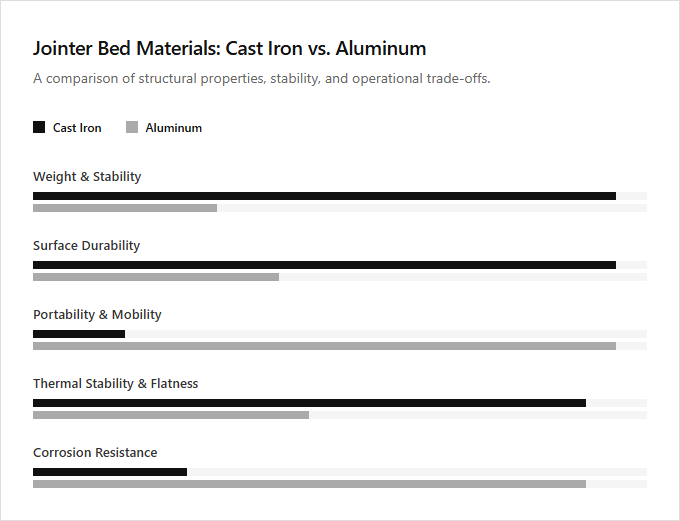
| Weight & Stability | Cast iron beds offer superior vibration damping and mass, whereas lightweight aluminum beds are more susceptible to harmonic resonance during operation. |
| Durability | Cast iron provides exceptional resistance to surface abrasion from rough-sawn lumber, while softer aluminum beds are prone to gouging and wear over time. |
| Portability | The low specific gravity of aluminum makes these beds ideal for mobile jobsite use, whereas heavy cast iron beds are designed for stationary workshop configurations. |
| Flatness & Precision | Cast iron tables undergo stress-relieving processes to ensure permanent coplanarity, whereas aluminum has a higher coefficient of thermal expansion and can warp under temperature fluctuations. |
| Maintenance & Corrosion | Cast iron requires regular application of sealants to prevent ferrous oxidation, while aluminum beds naturally resist rust through a self-passivating oxide layer. |
Coefficient of thermal expansion affecting long-term coplanarity
Cast iron beds offer superior long-term coplanarity due to their low coefficient of thermal expansion. This material successfully resists dimensional changes caused by temperature fluctuations in workshops lacking climate control. The structural mass and thermal stability of cast iron ensure that the infeed and outfeed tables remain perfectly parallel over years of heavy use, minimizing the need for frequent recalibration.
Aluminum beds possess a significantly higher coefficient of thermal expansion, making them more susceptible to minor dimensional shifts and alignment drift when exposed to ambient temperature changes. While lightweight and cost-effective, aluminum requires more frequent monitoring to maintain precise table alignment over time. Serious woodworkers requiring permanent, heavy-duty accuracy benefit most from cast iron, while mobile contractors and hobbyists value the portability of aluminum.
Modulus of elasticity and resistance to structural deflection under load
Cast iron jointer beds possess a high modulus of elasticity, providing exceptional stiffness and superior resistance to structural deflection under load. This material rigidity ensures that the infeed and outfeed tables remain perfectly coplanar, even when supporting heavy, dense timber. The dense molecular structure of cast iron also dampens machinery vibrations, preserving alignment accuracy during intensive milling operations.
Aluminum beds feature a lower modulus of elasticity, making them more susceptible to temporary deflection under significant downward force. While engineered ribbing helps mitigate this flex, aluminum cannot match the absolute structural stability of cast iron under heavy workpieces. Cast iron jointers are ideal for stationary professional woodworkers requiring uncompromising precision for large-scale projects, whereas aluminum models suit mobile contractors and hobbyists who prioritize portability over maximum torsional rigidity.
Vibration damping capacity of cast iron versus aluminum resonance
Cast iron is highly valued in woodworking machinery for its exceptional mass and natural vibration-damping capacity. The graphite microstructure within the iron matrix absorbs harmonic frequencies generated by the high-speed cutterhead, ensuring a remarkably stable work surface. This structural stability minimizes tool chatter, allowing for cleaner, more precise cuts on dense hardwoods.
Aluminum beds, while significantly lighter, possess a higher natural resonance that can transmit motor vibrations directly to the workpiece. This resonance requires users to feed stock more cautiously to avoid surface imperfections during operation. Heavy cast iron jointers are best suited for high-precision professional workshops, while aluminum-bed models are ideal for mobile contractors and DIY hobbyists prioritizing portability.
Dimensional stability through stress-relieving heat treatment
Cast iron jointer beds offer superior dimensional stability due to the thermal stress-relieving processes they undergo during manufacturing. This critical heat treatment stabilizes the crystalline structure of the iron, ensuring the bed resists warping and maintains a perfectly flat reference surface over decades of heavy use. The sheer mass of cast iron also dampens motor vibrations, preserving the tool's alignment during deep cuts.
In contrast, extruded aluminum beds lack the molecular density of cast iron and do not undergo the same intensive stress-relieving heat treatments. While aluminum is more susceptible to flexing under heavy loads and temperature fluctuations, its lightweight nature provides unmatched portability. Heavy cast iron jointers are ideal for stationary professional woodworkers requiring lifetime precision, whereas lightweight aluminum models suit mobile contractors who prioritize jobsite portability.
Precision-ground surface tolerances versus extruded aluminum profiles
Cast iron jointer beds undergo rigorous precision-grinding to achieve flat surface tolerances within thousandths of an inch. This dense material effectively dampens motor vibration and resists temperature-induced warping, establishing a highly stable, long-lasting reference plane for flattening lumber.
Aluminum jointer beds utilize extruded profiles. While modern extrusion techniques provide respectable straightness and a lightweight design, these beds lack the absolute planar precision of ground iron and can flex under heavy workloads.
Stationary cast iron units are best suited for professional woodworkers requiring uncompromising, lifelong accuracy, while portable aluminum models serve mobile contractors and hobbyists who prioritize workshop flexibility.
Surface hardness and resistance to abrasive wear and galling
Cast iron jointer beds offer superior surface hardness and exceptional resistance to abrasive wear. The material's microstructural graphite acts as a natural lubricant, significantly reducing friction and the risk of galling when sliding heavy, rough lumber across the table. This high density ensures the bed resists scratching and maintains its flat reference surface over years of heavy workshop use.
Conversely, aluminum beds possess lower surface hardness and are more susceptible to abrasive wear from grit embedded in raw wood. Under high friction, aluminum is more prone to galling, though anodized coatings can mitigate this vulnerability. While aluminum significantly reduces the machine's weight, the softer metal degrades faster under high-volume workloads.
Cast iron is best suited for stationary workshop professionals requiring maximum durability and precision, whereas aluminum is ideal for DIY hobbyists and mobile contractors who prioritize portability.
Parallelogram linkage adjustability versus fixed-bed coplanarity maintenance
Cast iron jointers frequently feature parallelogram linkage systems, which allow the beds to adjust along a tight arc relative to the cutterhead. This design simplifies maintaining coplanarity, as users can precisely align the tables along four independent points to counteract any future sagging or misalignment. The heavy cast iron construction further dampens vibration, securing these precise adjustments over long periods of heavy use.
In contrast, aluminum jointers typically utilize fixed-bed designs, such as dovetailed ways. While these systems are significantly lighter, restoring coplanarity if the bed shifts requires tedious manual shimming rather than simple linkage adjustments. Robust cast iron models with parallelogram linkages are suited for stationary professional woodworkers demanding lifetime precision, while light aluminum fixed-bed units best serve mobile contractors and hobbyists prioritizing portability.
Leave a comment