
Woodworkers and cabinetmakers frequently battle the frustrating reality of planer tear-out, frequent downtime, and the escalating costs of maintaining a pristine timber finish. Achieving optimal thickness planer cutterhead performance is a constant struggle when balancing surface quality against operational overhead.
Typically, shops absorb these ongoing expenses through standard tooling budgets or routine equipment maintenance allocations, accepting frequent blade degradation as an inevitable cost of doing business. However, strategically selecting between disposable and resharpenable blades grants operators unprecedented control over both surface finish precision and long-term cost predictability.
Of course, this optimization requires a clear understanding of specific operational boundaries, such as cutterhead geometry, feed rates, and the density of the timber being processed. For instance, commercial shops utilizing 12-inch benchtop planers often see dramatic ROI shifts when moving from standard high-speed steel (HSS) disposables to heavy-duty resharpenable knives.
This article evaluates the critical trade-offs between disposable and resharpenable blades, analyzing cost-per-cut metrics, maintenance workflows, and how to choose the ideal configuration for your specific workshop demands.
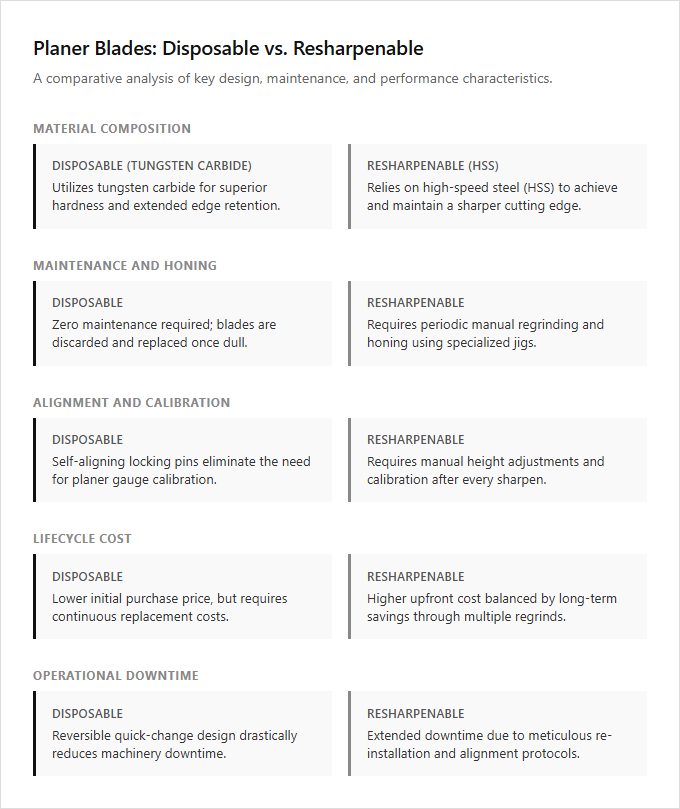
| Factor | Summary |
|---|---|
| Material Composition | Disposable blades typically utilize tungsten carbide for superior hardness, whereas resharpenable alternatives rely on high-speed steel (HSS) for a sharper cutting edge. |
| Maintenance and Honing | Resharpenable blades require periodic regrinding using specialized honing jigs to restore the bevel angle, while disposable options are discarded once dull. |
| Alignment and Calibration | Indexable disposable blades feature self-aligning locking pins that eliminate the need for planer gauge calibration, unlike resharpenable blades that require manual height adjustment after sharpening. |
| Lifecycle Cost | While disposable blades have a lower initial purchase price, resharpenable blades provide superior long-term amortization due to their capability for multiple regrinds. |
| Operational Downtime | The quick-change design of reversible disposable inserts drastically reduces machinery downtime compared to the meticulous re-installation process required for resharpened blades. |
Tungsten carbide indexable inserts versus high-speed steel (HSS) metallurgy
Woodworking professionals selecting planer blades must weigh the distinct advantages of tungsten carbide indexable inserts against high-speed steel (HSS) metallurgy. Carbide inserts offer exceptional hardness and heat resistance, maintaining a sharp edge up to ten times longer than steel. These disposable blades feature multiple pre-ground edges that can be quickly rotated when dull, eliminating the downtime associated with precision grinding.
High-speed steel resharpenable blades provide superior keenness, allowing for an incredibly smooth surface finish on softwoods and figured grains. Although HSS dulls more rapidly, these blades can be repeatedly reground to restore their razor-sharp edge, making them highly cost-effective over a long service life. Tungsten carbide is ideal for high-volume commercial operators processing abrasive man-made materials and hardwoods, while resharpenable HSS blades best serve traditional craftspeople demanding pristine, custom-honed finishes.
Shear angle optimization for reducing grain tear-out
Minimizing grain tear-out in woodworking depends heavily on the planer blade's shear angle. Disposable blades are engineered with highly precise, factory-set shear angles. This optimization ensures a clean, shearing cut across challenging grain directions, as the ultra-sharp, thin carbide or HSS edges slice wood fibers rather than tearing them.
Resharpenable blades feature thicker steel profiles that allow for custom bevel grinding to adjust the shear angle for specific wood species. While they require manual precision to maintain this optimal geometry over time, they offer superior durability under heavy use. High-volume production shops processing rough lumber benefit most from resharpenable blades, whereas cabinetry makers working with highly figured hardwoods are best suited for the precision of disposable systems.
Cutterhead runout tolerances and concentricity
Disposable planer blades feature highly consistent manufacturing dimensions, ensuring minimal cutterhead runout and superior concentricity right out of the box. Because these blades require no manual height adjustment during installation, the cutterhead maintains an optimal, balanced rotational path that reduces machine vibration.
In contrast, resharpenable blades offer thicker steel that can be ground multiple times, though this process alters their physical mass. Achieving precise concentricity with resharpenables demands meticulous setup calibration, as even microscopic height discrepancies increase runout tolerances and produce uneven finishes. High-production shops prioritizing fast setups and flawless factory tolerances benefit from disposable systems, whereas patient craftsmen with dedicated sharpening jigs prefer the longevity of resharpenable blades.
Knife projection height alignment using indexing pins versus setting jigs
Disposable planer blades offer efficiency and precision through a design that utilizes integrated indexing pins. These pins automatically align the blade to the correct projection height on the cutterhead, eliminating the need for manual calibration. This system ensures consistent cutting geometry and rapid blade changes without the need for specialized measurement tools.
Resharpenable blades rely on manual setup using setting jigs to establish the proper knife projection. Because grinding alters the blade's physical dimensions, operators must use magnetic or mechanical jigs to align the cutting edges precisely. While this process demands more time and technical skill, it allows for extended tool life through multiple regrinds.
Disposable blades are ideal for busy contractors prioritizing speed and low-maintenance setups, whereas resharpenable blades suit traditional woodworkers who value tool longevity and self-sufficient maintenance.
Helical spiral cutterhead geometry versus straight-knife configurations
When evaluating planer efficiency, cutterhead geometry dictates overall performance. Helical spiral cutterheads employ multiple small, disposable carbide inserts arranged in a staggered pattern. This design shears wood fibers at an angle, significantly reducing tearout on figured grain and operating at much lower noise levels. Conversely, traditional straight-knife configurations utilize long, resharpenable steel blades that cut across the entire width of the workpiece simultaneously.
While straight knives offer a lower initial purchase price and can be resharpened multiple times, they require meticulous, time-consuming alignment during installation. Disposable helical inserts require no adjustment; when dull, they are simply rotated to expose a fresh edge. High-volume professional shops benefit most from the low-maintenance, superior finish of helical systems, whereas budget-conscious hobbyists who prioritize lower upfront costs often prefer resharpenable straight-knife setups.
Chip load optimization relative to feed rate and cutterhead RPM
Optimizing chip load in planers requires a precise calibration of feed rate, cutterhead RPM, and knife projection. Disposable blades maintain a highly consistent cutting circle, allowing operators to calculate and maintain the exact chip thickness required to prevent grain tear-out or thermal degradation. Because their geometry never changes, the relationship between feed rate and RPM remains perfectly predictable throughout the blade's lifespan.
Resharpenable blades offer excellent edge retention but require careful height adjustment after each grind, as a reduced knife radius alters the chip load dynamics and cut quality. High-volume production shops prioritizing rapid maintenance and strict dimensional accuracy favor disposable inserts, while traditional woodworkers who enjoy precise machine calibration and tool self-sufficiency prefer resharpenable blades.
Jointing and precision grinding procedures for edge restoration
Disposable planer blades offer convenience through quick, reversible indexing, eliminating the need for complex maintenance. Resharpenable high-speed steel or carbide-tipped blades require periodic jointing and precision grinding to restore a keen cutting edge. Jointing straightens the cutting arc directly on the machine cutterhead, while precision wet-grinding restores the bevel angle on a dedicated jig, ensuring microscopic sharpness and balanced tool rotation.
The restoration process for resharpenable blades demands specialized equipment and operator skill to maintain consistent blade height and prevent overheating the steel. Disposable blades appeal to high-production shops and mobile contractors who prioritize rapid blade changes and minimal downtime, while resharpenable options suit traditional woodworkers and industrial facilities equipped to perform precise in-house tool conditioning for long-term cost efficiency.
Leave a comment