
Achieving a flawless, tear-out-free surface on figured timber is a constant struggle for woodworkers, often thwarted by rapidly dulling planer knives. While most craftspeople initially rely on standard, factory-supplied high-speed steel (HSS) replacements as their baseline tooling investment, managing these recurring consumable costs can drain a workshop's operational budget.
Upgrading your cutterhead, however, grants you unprecedented edge retention and significantly reduced machine downtime. To manage expectations, one must stipulate that while premium carbide offers immense longevity, its high upfront cost and susceptibility to impact damage require careful consideration. For example, while HSS delivers an unmatched pristine edge on soft pine, carbide is essential for dimensioning abrasive hardwoods like teak and quarterly-sawn white oak without constant blade changes.
In this article, we will analyze the key differences between High-Speed Steel and Carbide knives, evaluating their cutting performance, cost-per-board-foot, and maintenance requirements to help you select the ideal blade configuration for your thickness planer.
| Factor | Summary |
|---|---|
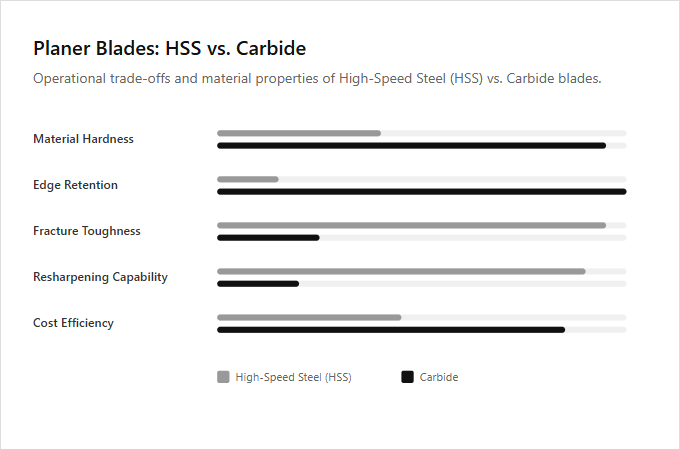
| Material Hardness | Carbide blades exhibit significantly higher metallurgical hardness than High-Speed Steel, allowing them to withstand extreme friction and heat during high-RPM planing. |
| Edge Retention | High-Speed Steel blades dull faster but can be sharpened to a keener cutting edge radius, whereas carbide blades maintain their shearing edge up to ten times longer due to superior wear resistance. |
| Fracture Toughness | High-Speed Steel possesses superior fracture toughness, making it less prone to catastrophic chipping when encountering embedded nails compared to the brittle grain structure of tungsten carbide. |
| Resharpening Capability | High-Speed Steel blades can be easily reground using standard aluminum oxide wheels, while carbide blades require specialized diamond abrasives for sharpening due to their extreme density. |
| Cost Efficiency | Although carbide blades require a higher initial capital expenditure, their extended operational lifespan provides a lower long-term cost-per-linear-foot compared to High-Speed Steel. |
Rockwell C: Tungsten Carbide vs. High-Speed Steel
When selecting planer blades, the metallurgical difference between High-Speed Steel (HSS) and tungsten carbide is a critical factor in tool performance. This distinction is defined by their hardness on the Rockwell C (HRC) scale. Standard HSS blades typically register between 61 and 64 HRC, providing a sharp, precise edge for clean cuts. Tungsten carbide blades achieve a significantly higher rating, often equivalent to 75 to 80 HRC, which offers superior wear resistance against highly abrasive materials.
This hardness variance directly impacts edge retention and tool longevity under high thermal friction. High-speed steel blades are ideal for hobbyists requiring ultra-smooth finishes on softwoods, while carbide blades are best suited for high-volume professionals processing abrasive composites and dense hardwoods.
Volumetric wear resistance and edge retention lifespan under high friction
High-Speed Steel (HSS) and tungsten carbide represent two distinct tiers of metallurgical performance in planer blades. Under the intense friction and heat of high-speed rotation, carbide blades exhibit superior volumetric wear resistance. The extreme hardness of carbide allows it to maintain its sharp cutting edge up to ten times longer than HSS when processing abrasive materials like MDF, exotic hardwoods, or glue-lined plywood.
HSS blades offer unmatched initial sharpness and impact resistance, resisting the micro-chipping that often plagues brittle carbide when encountering knots. While they deliver an exceptionally clean finish on softwoods, they dull rapidly under continuous thermal stress. Budget-conscious hobbyists working primarily with domestic softwoods benefit most from HSS blades, whereas high-volume commercial woodworkers processing dense hardwoods require the long-term endurance of carbide.
Fracture toughness variations dictating impact resistance against wood knots
When selecting planer blades, understanding material fracture toughness is critical for managing impact resistance against hard wood knots. High-Speed Steel (HSS) blades exhibit high fracture toughness, allowing the cutting edge to absorb sudden mechanical shocks without structural failure. This elasticity prevents the blade from chipping or cracking when encountering dense density variations, ensuring a reliable finish on unpredictable timber.
Tungsten carbide blades offer exceptional hardness and edge retention but suffer from lower fracture toughness. This inherent brittleness makes carbide highly susceptible to micro-chipping under the severe impact forces generated by knots. Professional woodworkers frequently processing reclaimed or highly knotted lumber benefit most from resilient HSS blades, while high-volume shops milling clean, abrasive hardwoods are better served by long-lasting carbide.
Maximum cutting edge keenness and wedge angle geometry limits
High-Speed Steel (HSS) planer blades excel in achieving maximum cutting edge keenness. Due to the fine molecular structure of steel, HSS can be ground to a highly acute wedge angle, typically between 35 and 40 degrees. This razor-sharp geometry slices cleanly through wood fibers, producing an exceptionally smooth, glass-like finish on softwoods and figured grains without causing tear-out.
In contrast, carbide blades face physical geometry limits because the material consists of cobalt-bonded tungsten particles. Grinding carbide to extremely acute angles causes micro-chipping along the cutting edge, requiring a blunter wedge angle of 45 to 55 degrees to maintain structural integrity. HSS is best suited for fine woodworkers seeking flawless surface finishes on domestic hardwoods, while carbide is ideal for high-volume carpenters processing abrasive composites, MDF, and glue-laden materials.
Integration with helical indexable insert cutterheads versus straight-knife heads
In traditional straight-knife planer cutterheads, High-Speed Steel (HSS) blades offer a razor-sharp edge that produces an exceptionally smooth finish on softwoods, though they dull quickly when encountering abrasive materials. While carbide straight knives provide significantly longer edge life, their brittleness makes them prone to chipping during heavy-duty operations on straight-knife setups.
The evolution to helical indexable insert cutterheads leverages the strengths of solid carbide. These small, four-sided carbide inserts are positioned at a shear angle, reducing tear-out on figured grain and drastically lowering noise levels compared to straight HSS knives. If an insert is damaged, users can simply rotate it to a fresh edge rather than replacing or sharpening an entire straight blade.
High-speed steel straight knives are ideal for budget-conscious hobbyists working primarily with softwoods, whereas helical carbide systems are suited for high-volume professionals processing highly figured hardwoods.
Resharpening feasibility using diamond grinding wheels versus aluminum oxide
High-Speed Steel (HSS) planer blades offer excellent sharpness and are easily reconditioned using standard aluminum oxide grinding wheels. This conventional abrasive is highly effective on HSS, allowing operators to quickly restore a keen edge with minimal expense. Conversely, tungsten carbide blades require the extreme hardness of diamond grinding wheels. Standard aluminum oxide wheels cannot cut carbide and will only generate excessive heat, potentially damaging the blade structure.
While diamond wheels provide the precision needed for carbide maintenance, they require specialized equipment and careful calibration. High-speed steel blades are best suited for hobbyists and traditional woodworkers who prefer frequent, cost-effective in-house sharpening, whereas carbide blades are ideal for high-production professionals who prioritize tool longevity when processing highly abrasive hardwoods and composites.
Mitigating Tear-Out and Roughness on Figured Timber
High-Speed Steel (HSS) planer blades hone to an exceptionally keen edge, delivering superior surface roughness (Ra) values and a glass-like finish on standard hardwoods. This extreme sharpness cleanly shears wood fibers, though highly figured timber remains vulnerable to grain tear-out under high feed rates. Carbide blades, particularly in helical cutterheads, excel at mitigating tear-out on difficult grain by utilizing a shearing cut action that prevents lifting, despite producing slightly higher initial Ra values than pristine HSS.
HSS blades are ideal for fine furniture makers seeking flawless finishes on domestic woods, whereas carbide blades suit high-volume workshops and woodworkers frequently processing abrasive exotics or highly figured slabs.
Leave a comment